Question 8:
Diagram 4 shows a trapezium PQRST. QS is parallel to PT.
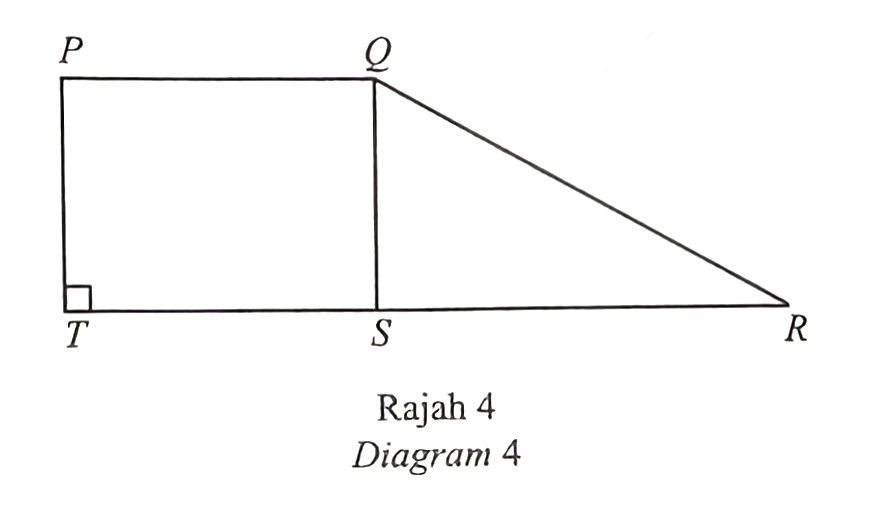 It is given that TR = 26 cm, QS = x cm and SR = 2x cm.
(a)(i) State the area, in cm2, of PQST in terms of x.
(ii) Hence, find the maximum area, in cm2, of PQST.
[4 marks]
(b) Given that the rate of change of the area of PQST is 36 cm2 s-1 when x = √5 cm, calculate the length, in cm, of QS after 3 seconds. [4 marks]
(c) Find the approximate change of the area, in cm2, of PQST when the value of x changes from 2 to 1.98 . [2 marks]
Answer:
(a)(i) $$ \begin{aligned} A & =(26-2 x)(x) \\ & =26 x-2 x^2 \end{aligned} $$
(a)(ii) $$ \begin{aligned} \frac{\mathrm{d} A}{\mathrm{~d} x} & =0 \\ 26-4 x & =0 \\ x & =6.5 \mathrm{~cm} \end{aligned} $$
$$ \begin{aligned} A_{\text { maximum }} & =26(6.5)-2(6.5)^2 \\ & =84.5 \mathrm{~cm}^2 \end{aligned} $$
(b) $$ \begin{aligned} & \frac{\mathrm{d} A}{\mathrm{~d} t}=36 \mathrm{~cm}^2 \mathrm{~s}^{-1}, x=\sqrt{5} \\ & \frac{\mathrm{~d} A}{\mathrm{~d} t}=\frac{\mathrm{d} A}{\mathrm{~d} x} \times \frac{\mathrm{d} x}{\mathrm{~d} t} \\ & 36=[26-4(\sqrt{5})] \times \frac{\mathrm{d} x}{\mathrm{~d} t} \\ & \frac{\mathrm{~d} x}{\mathrm{~d} t}=2.11 \mathrm{~cm} \mathrm{~s}^{-1} \end{aligned} $$
$$ \begin{aligned} x & =\int\left(\frac{\mathrm{d} x}{\mathrm{~d} t}\right) \mathrm{d} t \\ & =\int 2.11 \mathrm{~d} t \\ & =2.11 t+c \end{aligned} $$
$$ \begin{aligned} & t=0, x=\sqrt{5} \\ & \sqrt{5}=2.11(0)+c \\ & c=\sqrt{5} \\ & x=2.11 t+\sqrt{5} \end{aligned} $$
$$ \begin{aligned} t=3, x & =2.11(3)+\sqrt{5} \\ & =8.57 \mathrm{~cm} \end{aligned} $$
(c) $$ \begin{aligned} \delta x & =1.98-2=-0.02 \mathrm{~cm} \\ \delta A & \approx \frac{\mathrm{~d} A}{\mathrm{~d} x} \times \delta x \\ & \approx[26-4(2)] \times(-0.02) \\ & \approx-\frac{9}{25} \mathrm{~cm}^2 \end{aligned} $$
Diagram 4 shows a trapezium PQRST. QS is parallel to PT.
It is given that TR = 26 cm, QS = x cm and SR = 2x cm.(a)(i) State the area, in cm2, of PQST in terms of x.
(ii) Hence, find the maximum area, in cm2, of PQST.
[4 marks]
(b) Given that the rate of change of the area of PQST is 36 cm2 s-1 when x = √5 cm, calculate the length, in cm, of QS after 3 seconds. [4 marks]
(c) Find the approximate change of the area, in cm2, of PQST when the value of x changes from 2 to 1.98 . [2 marks]
Answer:
(a)(i) $$ \begin{aligned} A & =(26-2 x)(x) \\ & =26 x-2 x^2 \end{aligned} $$
(a)(ii) $$ \begin{aligned} \frac{\mathrm{d} A}{\mathrm{~d} x} & =0 \\ 26-4 x & =0 \\ x & =6.5 \mathrm{~cm} \end{aligned} $$
$$ \begin{aligned} A_{\text { maximum }} & =26(6.5)-2(6.5)^2 \\ & =84.5 \mathrm{~cm}^2 \end{aligned} $$
(b) $$ \begin{aligned} & \frac{\mathrm{d} A}{\mathrm{~d} t}=36 \mathrm{~cm}^2 \mathrm{~s}^{-1}, x=\sqrt{5} \\ & \frac{\mathrm{~d} A}{\mathrm{~d} t}=\frac{\mathrm{d} A}{\mathrm{~d} x} \times \frac{\mathrm{d} x}{\mathrm{~d} t} \\ & 36=[26-4(\sqrt{5})] \times \frac{\mathrm{d} x}{\mathrm{~d} t} \\ & \frac{\mathrm{~d} x}{\mathrm{~d} t}=2.11 \mathrm{~cm} \mathrm{~s}^{-1} \end{aligned} $$
$$ \begin{aligned} x & =\int\left(\frac{\mathrm{d} x}{\mathrm{~d} t}\right) \mathrm{d} t \\ & =\int 2.11 \mathrm{~d} t \\ & =2.11 t+c \end{aligned} $$
$$ \begin{aligned} & t=0, x=\sqrt{5} \\ & \sqrt{5}=2.11(0)+c \\ & c=\sqrt{5} \\ & x=2.11 t+\sqrt{5} \end{aligned} $$
$$ \begin{aligned} t=3, x & =2.11(3)+\sqrt{5} \\ & =8.57 \mathrm{~cm} \end{aligned} $$
(c) $$ \begin{aligned} \delta x & =1.98-2=-0.02 \mathrm{~cm} \\ \delta A & \approx \frac{\mathrm{~d} A}{\mathrm{~d} x} \times \delta x \\ & \approx[26-4(2)] \times(-0.02) \\ & \approx-\frac{9}{25} \mathrm{~cm}^2 \end{aligned} $$