Question 5:
(a)(i) $$ \text { Prove that } 2 \cot ^2 A \sin ^2 A=1+\cos 2 A \text {. } $$
(ii) $$ \text { Hence, solve the equation } 2 \cot ^2 A \sin ^2 A=\frac{1}{2} \text { for } 0 \leqslant A \leqslant 2 \pi \text { in terms of } \pi \text {. } $$
[5 marks]
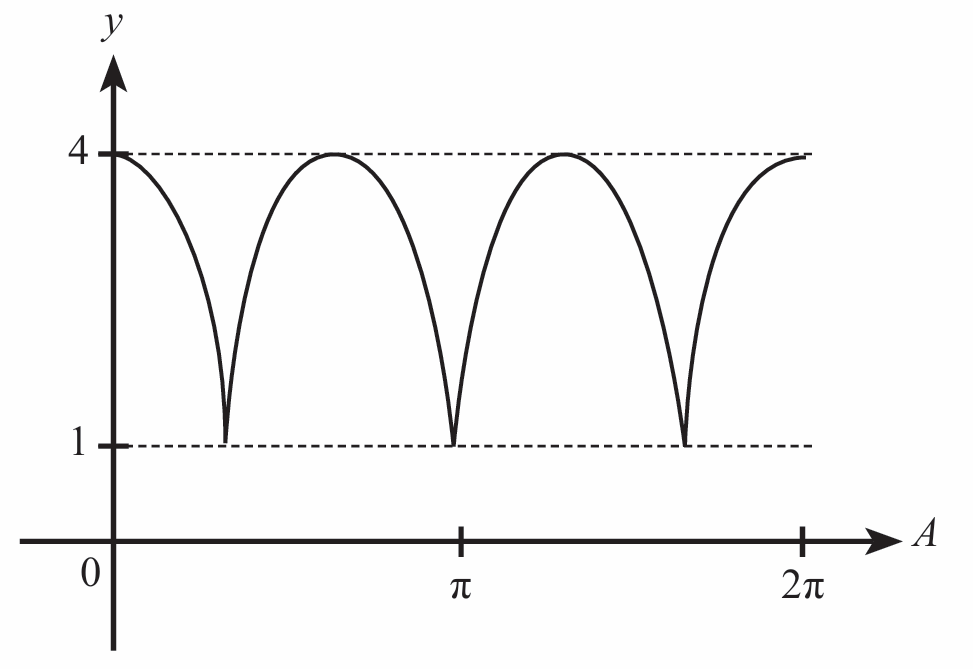
(b) $$ \text { Sketch the graph of } y=1+\left|3 \cos \frac{3}{2} A\right| \text { for } 0 \leqslant A \leqslant 2 \pi \text {. } $$
[4 marks]
Answer:
(a)(i) $$ \begin{aligned} 2 \cot ^2 A \sin ^2 A & =2\left(\frac{\cos ^2 A}{\sin ^2 A}\right) \sin ^2 A \\ & =2 \cos ^2 A \\ & =\left(2 \cos ^2 A-1\right)+1 \\ & =1+\cos 2 A \end{aligned} $$
(a)(ii) $$ \begin{aligned} & 2 \cot ^2 A \sin ^2 A=\frac{1}{2} \\ & \qquad 1+\cos 2 A=\frac{1}{2} \\ & \qquad \cos 2 A=-\frac{1}{2} \\ & \alpha=\cos ^{-1}\left(\frac{1}{2}\right)=\frac{\pi}{3} \\ & 2 A=\pi-\frac{\pi}{3}, \pi+\frac{\pi}{3} \\ & A=\frac{\pi}{3}, \frac{2 \pi}{3}, \frac{4 \pi}{3}, \frac{5 \pi}{3} \end{aligned} $$
(b)
(a)(i) $$ \text { Prove that } 2 \cot ^2 A \sin ^2 A=1+\cos 2 A \text {. } $$
(ii) $$ \text { Hence, solve the equation } 2 \cot ^2 A \sin ^2 A=\frac{1}{2} \text { for } 0 \leqslant A \leqslant 2 \pi \text { in terms of } \pi \text {. } $$
[5 marks]
(b) $$ \text { Sketch the graph of } y=1+\left|3 \cos \frac{3}{2} A\right| \text { for } 0 \leqslant A \leqslant 2 \pi \text {. } $$
[4 marks]
Answer:
(a)(i) $$ \begin{aligned} 2 \cot ^2 A \sin ^2 A & =2\left(\frac{\cos ^2 A}{\sin ^2 A}\right) \sin ^2 A \\ & =2 \cos ^2 A \\ & =\left(2 \cos ^2 A-1\right)+1 \\ & =1+\cos 2 A \end{aligned} $$
(a)(ii) $$ \begin{aligned} & 2 \cot ^2 A \sin ^2 A=\frac{1}{2} \\ & \qquad 1+\cos 2 A=\frac{1}{2} \\ & \qquad \cos 2 A=-\frac{1}{2} \\ & \alpha=\cos ^{-1}\left(\frac{1}{2}\right)=\frac{\pi}{3} \\ & 2 A=\pi-\frac{\pi}{3}, \pi+\frac{\pi}{3} \\ & A=\frac{\pi}{3}, \frac{2 \pi}{3}, \frac{4 \pi}{3}, \frac{5 \pi}{3} \end{aligned} $$
(b)
Question 6:
Diagram 3 shows a triangle BOA. The straight lines OX and BY intersect at point P.
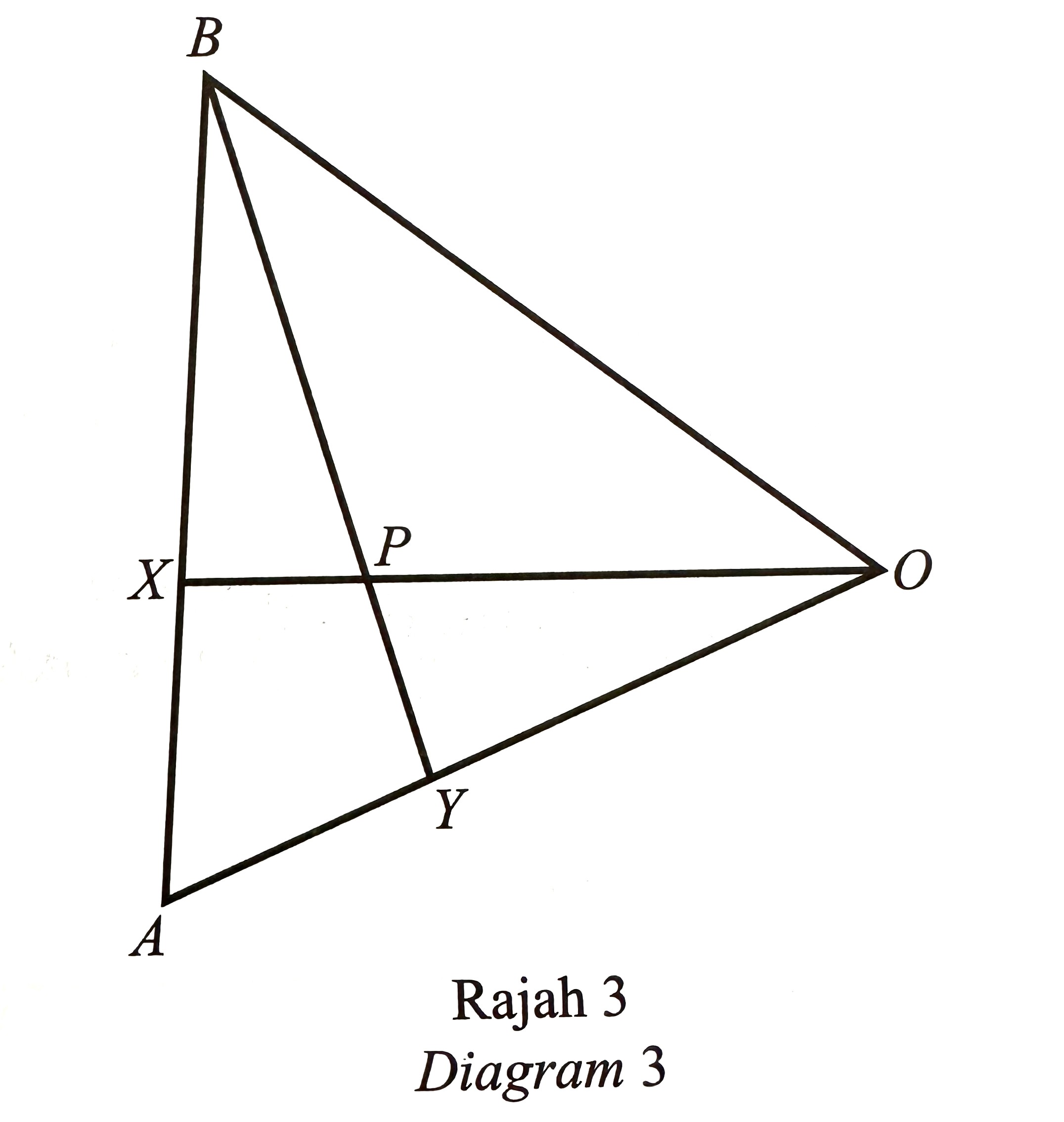
$$ \text { It is given that } \overrightarrow{O A}=4 \underline{a}, \overrightarrow{A X}=\underline{b}, 3 \overrightarrow{B X}=2 \overrightarrow{B A} \text { and } \overrightarrow{O Y}=\frac{3}{4} \overrightarrow{O A} \text {. } $$
(a) $$ \text { Express in terms of } \underline{a} \text { and } \underline{b} \text { : } $$
$$ \begin{aligned} &\text { (i) } \overrightarrow{O X} \text {, }\\ &\text { (ii) } \overrightarrow{B Y} \text {. } \end{aligned} $$
[3 marks]
(b) $$ \text { If } \overrightarrow{O P}=\lambda \overrightarrow{O X} \text {, such that} \lambda \text { is a constant, find } B P: P Y \text {. } $$
[5 marks]
Answer:
(a)(i) $$ \begin{aligned} \overrightarrow{O X} & =\overrightarrow{O A}+\overrightarrow{A X} \\ & =4 \underline{a}+\underline{b} \end{aligned} $$
(a)(ii) $$ \begin{aligned} \stackrel{\rightharpoonup}{B Y} & =\stackrel{\rightharpoonup}{B A}+\stackrel{\rightharpoonup}{A Y} \\ & =-3 \underline{b}+(-\underline{a}) \\ & =-3 \underline{b}-\underline{a} \end{aligned} $$
(b) $$ \begin{aligned} & \stackrel{\rightharpoonup}{B P}=k \stackrel{\rightharpoonup}{B Y} \\ & \stackrel{\rightharpoonup}{O P}=\lambda \stackrel{\rightharpoonup}{O X} \\ & \stackrel{\rightharpoonup}{B P}=\stackrel{\rightharpoonup}{B O}+\stackrel{\rightharpoonup}{O P} \end{aligned} $$
$$ \begin{aligned} k \overrightarrow{B Y} & =(\overrightarrow{B A}+\overrightarrow{A O})+\lambda(4 \underline{a}+\underline{b}) \\ k(-\underline{a}-3 \underline{b}) & =(-3 \underline{b}-4 \underline{a})+\lambda(4 \underline{a}+\underline{b}) \\ -k \underline{a}-3 k \underline{b} & =(-4+4 \lambda) \underline{a}+(-3+\lambda) \underline{b} \end{aligned} $$
$$ \begin{aligned} -4+4 \lambda & =-k … (1) \\ -3+\lambda & =-3 k … (2) \\ \lambda & =3-3 k … (3) \end{aligned} $$
$$ \begin{aligned} &\text { Substitute (3) into (1) }\\ &\begin{aligned} -4+4(3-3 k) & =-k \\ -4+12-12 k & =-k \\ k & =\frac{8}{11} \end{aligned} \end{aligned} $$
$$ \begin{aligned} & \overrightarrow{B P}=\frac{8}{11} \overrightarrow{B Y} \\ & B P: P Y=8: 3 \end{aligned} $$
Diagram 3 shows a triangle BOA. The straight lines OX and BY intersect at point P.
$$ \text { It is given that } \overrightarrow{O A}=4 \underline{a}, \overrightarrow{A X}=\underline{b}, 3 \overrightarrow{B X}=2 \overrightarrow{B A} \text { and } \overrightarrow{O Y}=\frac{3}{4} \overrightarrow{O A} \text {. } $$
(a) $$ \text { Express in terms of } \underline{a} \text { and } \underline{b} \text { : } $$
$$ \begin{aligned} &\text { (i) } \overrightarrow{O X} \text {, }\\ &\text { (ii) } \overrightarrow{B Y} \text {. } \end{aligned} $$
[3 marks]
(b) $$ \text { If } \overrightarrow{O P}=\lambda \overrightarrow{O X} \text {, such that} \lambda \text { is a constant, find } B P: P Y \text {. } $$
[5 marks]
Answer:
(a)(i) $$ \begin{aligned} \overrightarrow{O X} & =\overrightarrow{O A}+\overrightarrow{A X} \\ & =4 \underline{a}+\underline{b} \end{aligned} $$
(a)(ii) $$ \begin{aligned} \stackrel{\rightharpoonup}{B Y} & =\stackrel{\rightharpoonup}{B A}+\stackrel{\rightharpoonup}{A Y} \\ & =-3 \underline{b}+(-\underline{a}) \\ & =-3 \underline{b}-\underline{a} \end{aligned} $$
(b) $$ \begin{aligned} & \stackrel{\rightharpoonup}{B P}=k \stackrel{\rightharpoonup}{B Y} \\ & \stackrel{\rightharpoonup}{O P}=\lambda \stackrel{\rightharpoonup}{O X} \\ & \stackrel{\rightharpoonup}{B P}=\stackrel{\rightharpoonup}{B O}+\stackrel{\rightharpoonup}{O P} \end{aligned} $$
$$ \begin{aligned} k \overrightarrow{B Y} & =(\overrightarrow{B A}+\overrightarrow{A O})+\lambda(4 \underline{a}+\underline{b}) \\ k(-\underline{a}-3 \underline{b}) & =(-3 \underline{b}-4 \underline{a})+\lambda(4 \underline{a}+\underline{b}) \\ -k \underline{a}-3 k \underline{b} & =(-4+4 \lambda) \underline{a}+(-3+\lambda) \underline{b} \end{aligned} $$
$$ \begin{aligned} -4+4 \lambda & =-k … (1) \\ -3+\lambda & =-3 k … (2) \\ \lambda & =3-3 k … (3) \end{aligned} $$
$$ \begin{aligned} &\text { Substitute (3) into (1) }\\ &\begin{aligned} -4+4(3-3 k) & =-k \\ -4+12-12 k & =-k \\ k & =\frac{8}{11} \end{aligned} \end{aligned} $$
$$ \begin{aligned} & \overrightarrow{B P}=\frac{8}{11} \overrightarrow{B Y} \\ & B P: P Y=8: 3 \end{aligned} $$
Question 7:
The gradient function of a curve is 2x – 2. The curve passes through point (-2, -7).
(a) Find the equation of the curve. [3 marks]
(b) If the curve moved 1 unit to the left, find the new equation of the curve.
Hence, find the volume generated, in terms of π, when the region bounded by the curve and the x-axis is revolved 180° about the y-axis. [4 marks]
Answer:
(a) $$ \begin{aligned} & \frac{\mathrm{d} y}{\mathrm{~d} x}=2 x-2 \\ & y=\int(2 x-2) \mathrm{d} x \\ & \quad=\frac{2 x^2}{2}-2 x+c \\ & x=-2, y=-7 \\ & -7=(-2)^2-2(-2)+c \\ & c=-15 \\ & y=x^2-2 x-15 \end{aligned} $$
(b) $$ \begin{aligned} y & =(x+1)^2-2(x+1)-15 \\ y & =x^2+2 x+1-2 x-2-15 \\ y & =x^2-16 \\ x^2 & =y+16 \\ V & =\pi \int_{-16}^0(y+16) \mathrm{d} y \\ & =\pi\left[\frac{y^2}{2}+16 y\right]_{-16}^0 \\ & =\pi\left[\frac{0^2}{2}+16(0)\right]-\pi\left[\frac{(-16)^2}{2}+16(-16)\right] \\ & =128 \pi \end{aligned} $$