Question 10:
Table 1 shows the values of two variables, x and y, obtained from an experiment. The variables x and y are related by the
$$ \text { equation } y+\sqrt{h}=\frac{k^2}{x} \text {, where } h \text { and } k \text { are constants. } $$

(a) Plot xy against x, using a scale of 2 cm to 1 unit on the x-axis and 2 cm to 0.5 unit on the xy-axis.
Hence, draw the line of best fit. [4 marks]
(b) By using the graph in 10(a),
(i) $$ \text { find the value of } x \text { when } y^2=\frac{4}{x^2} \text {, } $$
(ii) $$ \text { write } y+\sqrt{h}=\frac{k^2}{x} \text { in linear form, hence find the value of } h \text { and of } k \text {. } $$
[6 marks]
Answer:
(a)

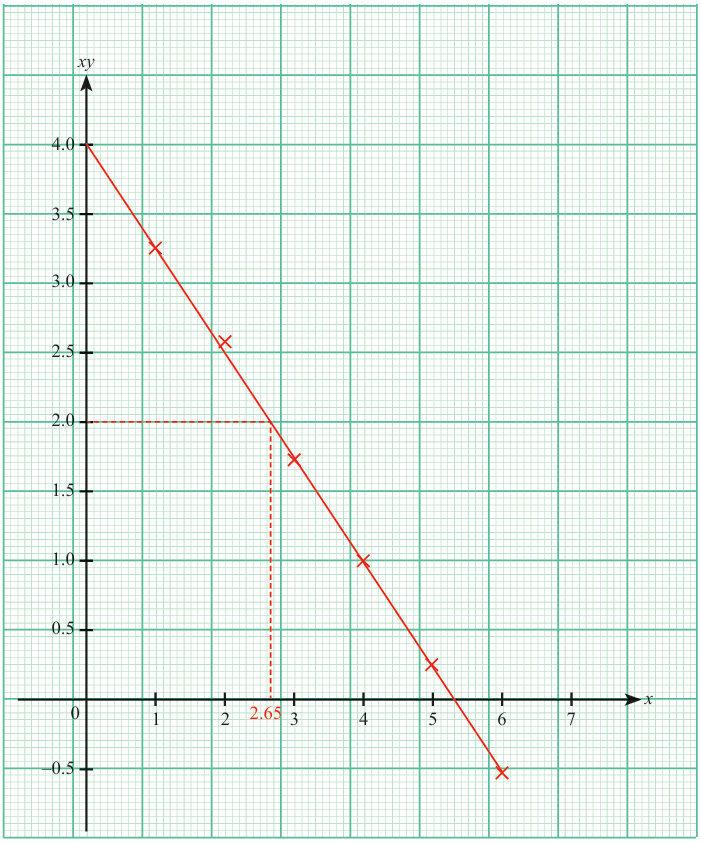
(b)(i) $$ \begin{aligned} y^2 & =\frac{4}{x^2} \\ x^2 y^2 & =4 \\ (x y)^2 & =4 \\ x y & =2 \\ x & =2.65 \end{aligned} $$
(b)(ii) $$ \begin{gathered} y+\sqrt{h}=\frac{k^2}{x} \\ x y+x \sqrt{h}=k^2 \\ x y=(-\sqrt{h}) x+k^2 \\ m=\frac{4-1}{0-4} \\ =-\frac{3}{4} \end{gathered} $$
$$ \begin{aligned} m & =-\sqrt{h} \\ -\sqrt{h} & =-\frac{3}{4} \\ \sqrt{h} & =\frac{3}{4} \\ h & =\frac{9}{16} \end{aligned} $$
$$ \begin{aligned} c & =k^2 \\ k^2 & =4 \\ k & =2 \end{aligned} $$
Table 1 shows the values of two variables, x and y, obtained from an experiment. The variables x and y are related by the
$$ \text { equation } y+\sqrt{h}=\frac{k^2}{x} \text {, where } h \text { and } k \text { are constants. } $$
(a) Plot xy against x, using a scale of 2 cm to 1 unit on the x-axis and 2 cm to 0.5 unit on the xy-axis.
Hence, draw the line of best fit. [4 marks]
(b) By using the graph in 10(a),
(i) $$ \text { find the value of } x \text { when } y^2=\frac{4}{x^2} \text {, } $$
(ii) $$ \text { write } y+\sqrt{h}=\frac{k^2}{x} \text { in linear form, hence find the value of } h \text { and of } k \text {. } $$
[6 marks]
Answer:
(a)
(b)(i) $$ \begin{aligned} y^2 & =\frac{4}{x^2} \\ x^2 y^2 & =4 \\ (x y)^2 & =4 \\ x y & =2 \\ x & =2.65 \end{aligned} $$
(b)(ii) $$ \begin{gathered} y+\sqrt{h}=\frac{k^2}{x} \\ x y+x \sqrt{h}=k^2 \\ x y=(-\sqrt{h}) x+k^2 \\ m=\frac{4-1}{0-4} \\ =-\frac{3}{4} \end{gathered} $$
$$ \begin{aligned} m & =-\sqrt{h} \\ -\sqrt{h} & =-\frac{3}{4} \\ \sqrt{h} & =\frac{3}{4} \\ h & =\frac{9}{16} \end{aligned} $$
$$ \begin{aligned} c & =k^2 \\ k^2 & =4 \\ k & =2 \end{aligned} $$
Question 11:
(a) A company produces a type of potato chips and packed them before being marketed. The mass of a packet of chips ranging from 75 g to 80 g will be accepted for marketing, while the mass of a packet of chips that is out of that range will be sent for repacking. Table 2 shows the mass of a packet of chips and the number of packets in ratio at a particular time.
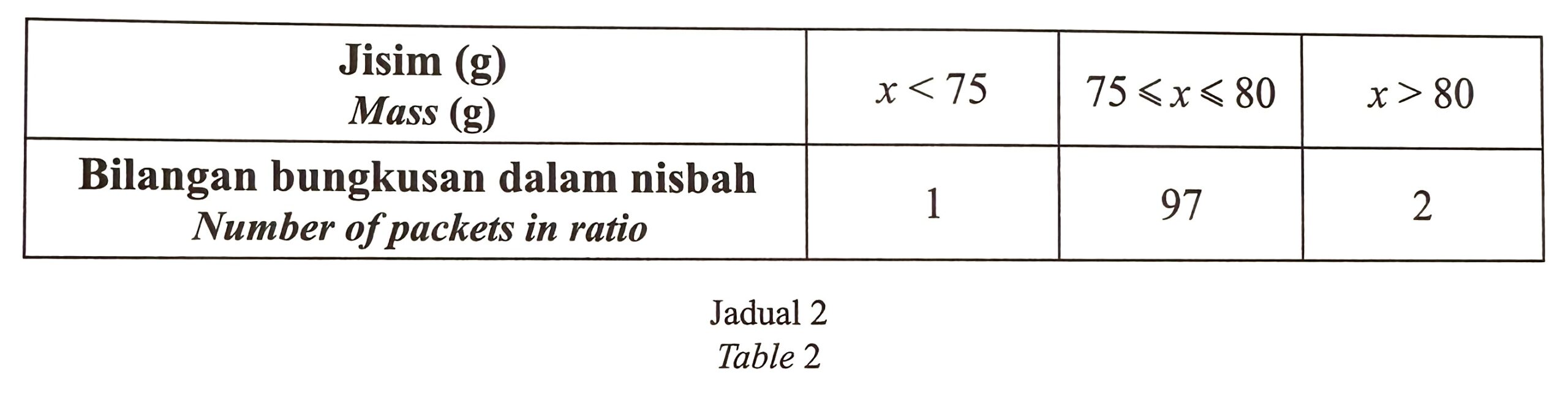
(i) Find the mean number of packets of chips marketed if the company produces 5000 packets of chips.
(ii) If 6 packets of chips are chosen at random from the company, find the probability that exactly 2 packets will be sent for repacking.
(iii) If a manager chooses 10 packet of chips randomly from the repacking unit, find the probability that he will get more than 2 packets of chips that have the mass below the range.
[6 marks]
(b) A random variable X is normally distributed with X ∼ N (12, 25).
Given that P(X > k) = ¼ P(X ≤ k), find the value of k.
[4 marks]
Answer:
(a)(i) $$ \begin{aligned} n & =5000, p=\frac{97}{1+97+2}=0.97 \\ \mu & =n p \\ & =(5000)(0.97) \\ & =4850 \end{aligned} $$
(a)(ii) $$ \begin{aligned} & p=0.03, q=0.97, n=6, r=2 \\ & P(X=2)={ }^6 C_2(0.03)^2(0.97)^4 \\ &=0.01195 \end{aligned} $$
(a)(iii) $$ n=10, p=\frac{1}{3}, q=\frac{2}{3}, r>2 $$
$$ \begin{aligned} P(X>2) & =1-P(X \leqslant 2) \\ & =1-P(X=0)-P(X=1)-P(X=2) \\ & =1-{ }^{10} C_0\left(\frac{1}{3}\right)^0\left(\frac{2}{3}\right)^{10}-{ }^{10} C_1\left(\frac{1}{3}\right)^1\left(\frac{2}{3}\right)^9-{ }^{10} C_2\left(\frac{1}{3}\right)^2\left(\frac{2}{3}\right)^8 \\ & =1-0.0173-0.0867-0.1951 \\ & =0.7009 \end{aligned} $$
(b) $$ P(X>k)=\frac{1}{4}[P(X \leqslant k)] $$
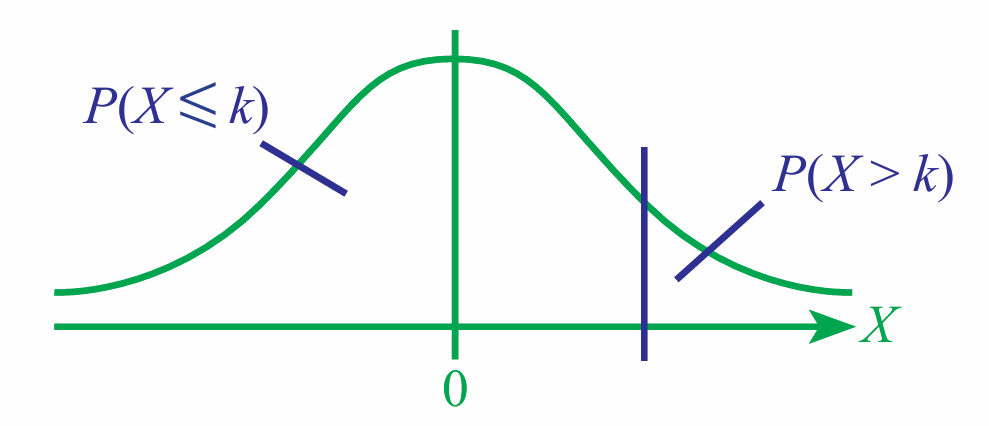
$$ \begin{aligned} P(X \leqslant k)+P(X>k) & =1 \\ 4 P(X \leqslant k)+P(X>k) & =1 \\ P(X>k) & =0.2 \\ \frac{k-12}{\sqrt{25}} & =0.842 \\ k & =16.21 \end{aligned} $$
(a) A company produces a type of potato chips and packed them before being marketed. The mass of a packet of chips ranging from 75 g to 80 g will be accepted for marketing, while the mass of a packet of chips that is out of that range will be sent for repacking. Table 2 shows the mass of a packet of chips and the number of packets in ratio at a particular time.
(i) Find the mean number of packets of chips marketed if the company produces 5000 packets of chips.
(ii) If 6 packets of chips are chosen at random from the company, find the probability that exactly 2 packets will be sent for repacking.
(iii) If a manager chooses 10 packet of chips randomly from the repacking unit, find the probability that he will get more than 2 packets of chips that have the mass below the range.
[6 marks]
(b) A random variable X is normally distributed with X ∼ N (12, 25).
Given that P(X > k) = ¼ P(X ≤ k), find the value of k.
[4 marks]
Answer:
(a)(i) $$ \begin{aligned} n & =5000, p=\frac{97}{1+97+2}=0.97 \\ \mu & =n p \\ & =(5000)(0.97) \\ & =4850 \end{aligned} $$
(a)(ii) $$ \begin{aligned} & p=0.03, q=0.97, n=6, r=2 \\ & P(X=2)={ }^6 C_2(0.03)^2(0.97)^4 \\ &=0.01195 \end{aligned} $$
(a)(iii) $$ n=10, p=\frac{1}{3}, q=\frac{2}{3}, r>2 $$
$$ \begin{aligned} P(X>2) & =1-P(X \leqslant 2) \\ & =1-P(X=0)-P(X=1)-P(X=2) \\ & =1-{ }^{10} C_0\left(\frac{1}{3}\right)^0\left(\frac{2}{3}\right)^{10}-{ }^{10} C_1\left(\frac{1}{3}\right)^1\left(\frac{2}{3}\right)^9-{ }^{10} C_2\left(\frac{1}{3}\right)^2\left(\frac{2}{3}\right)^8 \\ & =1-0.0173-0.0867-0.1951 \\ & =0.7009 \end{aligned} $$
(b) $$ P(X>k)=\frac{1}{4}[P(X \leqslant k)] $$
$$ \begin{aligned} P(X \leqslant k)+P(X>k) & =1 \\ 4 P(X \leqslant k)+P(X>k) & =1 \\ P(X>k) & =0.2 \\ \frac{k-12}{\sqrt{25}} & =0.842 \\ k & =16.21 \end{aligned} $$