Question 5:
$$ \text { The coordinates of points } P \text { and } Q \text { are }(2,3) \text { and }(q, 2 q) \text { respectively. } $$
$$ \text { Given that } \overrightarrow{P Q} \text { is a unit vector. } $$
$$ \text { Using the vectors’s triangle law, find the possible values of } q \text {. } $$
[4 marks]
Answer:
$$ \begin{aligned} \overrightarrow{O P} & =2 \underline{i}+3 \underline{j} \\ \overrightarrow{O Q} & =q \underline{i}+2 q \underline{j} \\ \overrightarrow{P Q} & =\overrightarrow{P O}+\overrightarrow{O Q} \\ & =-2 \underline{i}-3 \underline{j}+q \underline{i}+2 q \underline{j} \\ & =(-2+q) \underline{i}+(-3+2 q) \underline{j} \end{aligned} $$
$$ \text { Unit vector, }|\overrightarrow{P Q}|=1 $$
$$ \begin{aligned} &\text { Then, }\\ &\begin{aligned} & \sqrt{(-2+q)^2+(-3+2 q)^2}=1 \\ & 4-4 q+q^2+9-12 q+4 q^2=1 \\ & 5 q^2-16 q+12=0 \\ &(5 q-6)(q-2)=0 \\ & q=\frac{6}{5}, q=2 \end{aligned} \end{aligned} $$
Question 6:
$$ \text { The variables } x \text { and } y \text { are related by the equation } y=\frac{p x}{q x-1} \text {, } $$
such that p and q are constants.
If a graph of y against x is drawn, its curve will pass through (½ , -6) whereas a straight line with the gradient of 1/8 is obtained when a graph of 1/y against 1/x is drawn.
Find the value of p and of q.
[4 marks]
Answer:
$$ \begin{aligned} y & =\frac{p x}{q x-1} \\ \frac{1}{y} & =\frac{q x-1}{p x} \\ \frac{1}{y} & =\frac{q}{p}-\frac{1}{p x} \\ \frac{1}{y} & =-\frac{1}{p}\left(\frac{1}{x}\right)+\frac{q}{p} \\ -\frac{1}{p} & =\frac{1}{8} \\ p & =-8 \end{aligned} $$
$$ \text { Substitute }, p=-8, x=\frac{1}{2}, y=-6 $$
$$ \begin{aligned} -6 & =\frac{(-8)\left(\frac{1}{2}\right)}{q\left(\frac{1}{2}\right)-1} \\ -3 q+6 & =-4 \\ 3 q & =10 \\ q & =\frac{10}{3} \end{aligned} $$
Question 7:
Diagram 2 shows sectors AOB and COD inscribed in a circle with centre O.
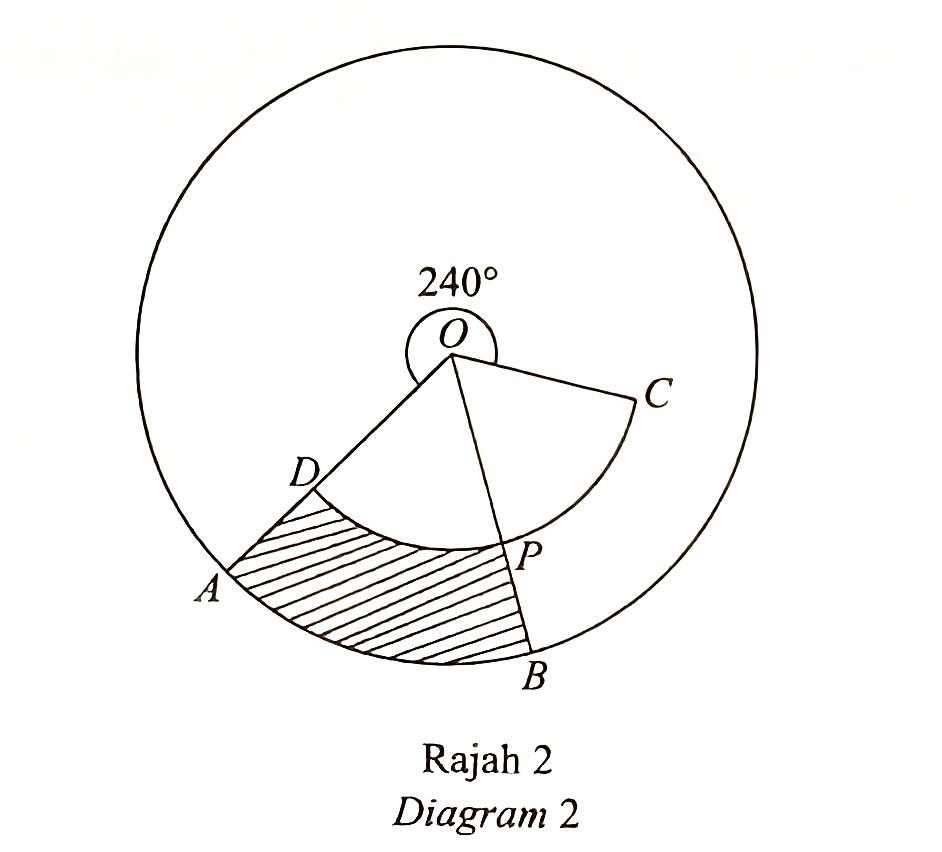
The radius of the circle and the radius of the sector COD is h cm and k cm respectively. The lengths of arc CP and arc PD are equal. It is given that the perimeter of the minor sector AOB is 15.235 cm and the area of the shaded region is 8.376 cm2.
[Use π = 3.142 ]
(a) State the ∠COD, in terms of π, [1 mark]
(b) Hence, calculate the value of h and of k to the nearest integer. [6 marks]
Answer:
(a) $$ \frac{120 \pi}{180}=\frac{2}{3} \pi $$
(b) $$ \begin{aligned} \angle A O B & =\frac{60(3.142)}{180} \\ & =1.047 \mathrm{rad} \end{aligned} $$
$$ \begin{aligned} h+h+1.047 h & =15.235 \\ 3.047 h & =15.235 \\ h & =5 \end{aligned} $$
$$ \begin{aligned} &\frac{1}{2}(5)^2(1.047)-\frac{1}{2}(k)^2(1.047)=8.376\\ &\begin{aligned} k^2 & =9 \\ k & =3, k=-3 \text ({ ignore }) \\ k & =3 \end{aligned} \end{aligned} $$
Diagram 2 shows sectors AOB and COD inscribed in a circle with centre O.
The radius of the circle and the radius of the sector COD is h cm and k cm respectively. The lengths of arc CP and arc PD are equal. It is given that the perimeter of the minor sector AOB is 15.235 cm and the area of the shaded region is 8.376 cm2.
[Use π = 3.142 ]
(a) State the ∠COD, in terms of π, [1 mark]
(b) Hence, calculate the value of h and of k to the nearest integer. [6 marks]
Answer:
(a) $$ \frac{120 \pi}{180}=\frac{2}{3} \pi $$
(b) $$ \begin{aligned} \angle A O B & =\frac{60(3.142)}{180} \\ & =1.047 \mathrm{rad} \end{aligned} $$
$$ \begin{aligned} h+h+1.047 h & =15.235 \\ 3.047 h & =15.235 \\ h & =5 \end{aligned} $$
$$ \begin{aligned} &\frac{1}{2}(5)^2(1.047)-\frac{1}{2}(k)^2(1.047)=8.376\\ &\begin{aligned} k^2 & =9 \\ k & =3, k=-3 \text ({ ignore }) \\ k & =3 \end{aligned} \end{aligned} $$