Question 1:
Diagram 1 shows the mapping of function f, such that p is a constant.
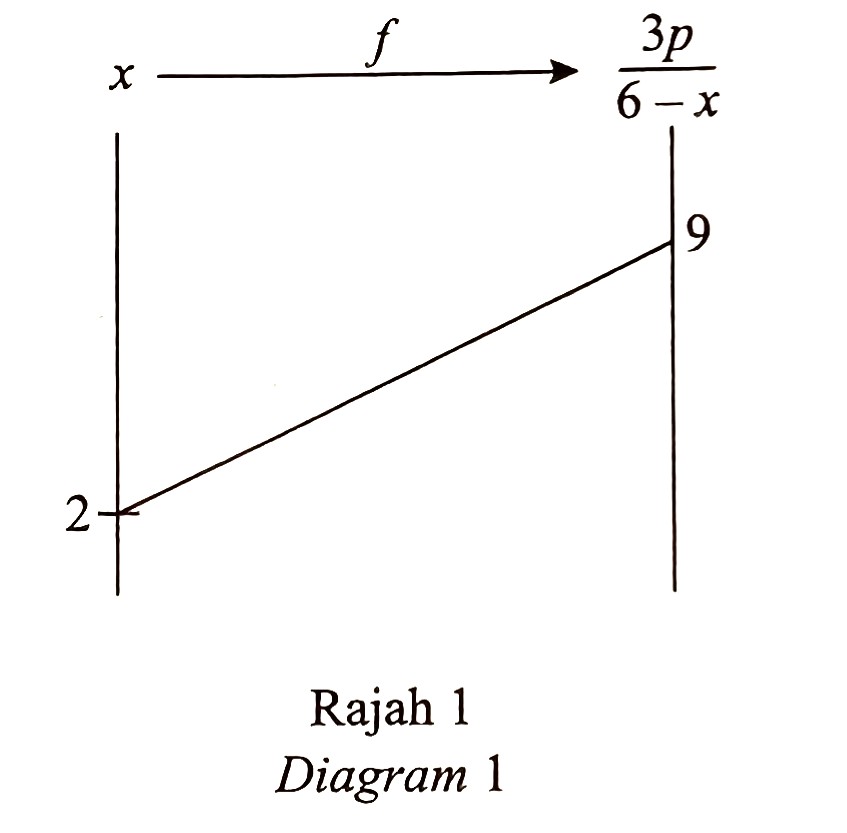 (a) State the object which has no image. [1 mark]
(b) Find the value of p. [2 marks]
Answer:
(a) x = 6
(b) $$ \begin{aligned} \frac{3 p}{6-2} & =9 \\ 3 p & =36 \\ p & =12 \end{aligned} $$
Diagram 1 shows the mapping of function f, such that p is a constant.
(a) State the object which has no image. [1 mark](b) Find the value of p. [2 marks]
Answer:
(a) x = 6
(b) $$ \begin{aligned} \frac{3 p}{6-2} & =9 \\ 3 p & =36 \\ p & =12 \end{aligned} $$
Question 2:
(a) Express p in terms of k of
$$ \begin{aligned} &\text { (i) } x^{2 k+p}=1 \text {, }\\ &\text { (ii) } \quad a^p=(\sqrt[k]{a})^6 \text {. } \end{aligned} $$
[2 marks]
(b) $$ \text { Given that } 3+\frac{3^y}{3^{2(x+1)}}=84 \text {, express } y \text { in terms of } x \text {. } $$
[2 marks]
Answer:
(a)(i) $$ \begin{aligned} x^{2 k+p} & =x^0 \\ 2 k+p & =0 \\ p & =-2 k \end{aligned} $$
(a)(ii) $$ \begin{aligned} &a^p=\left(a^{1 / k}\right)^6\\ &\text { Comparing power }\\ &\begin{aligned} & p=\frac{1}{k}(6) \\ & p=\frac{6}{k} \end{aligned} \end{aligned} $$
(b) $$ \begin{aligned} &3^{y-2 x-2}=3^4\\ &\text { Comparing power }\\ &\begin{aligned} y-2 x-2 & =4 \\ y & =2 x+6 \end{aligned} \end{aligned} $$
Question 3:
(a) $$ \text { Derive that } \log _a m n=\log _a m+\log _a n \text {. } $$
[3 marks]
(b) $$ \text { Hence, find the value of } u \text { if } \log _u(u+3)+\log _u(u-1)=2 \text {. } $$
[3 marks]
Answer:
(a) $$ \begin{aligned} & \text { If } \\ & \log _a m n=p, m n=a^p \\ & \log _a m=q, m=a^q \\ & \log _a n=r, n=a^r \end{aligned} $$
$$ \begin{aligned} &\text { So, }\\ &m n=a^q a^r=a^{q+r} \end{aligned} $$
$$ \begin{aligned} &\text { Then, }\\ &\log _a m n=q+r=\log _a m+\log _a n \end{aligned} $$
(b) $$ \begin{aligned} \log _u(u+3)(u-1) & =2 \\ (u+3)(u-1) & =u^2 \\ u^2+2 u-3 & =u^2 \\ 2 u & =3 \\ u & =\frac{3}{2} \end{aligned} $$
Question 4:
(a) Fei buys a block of ice cube. On the journey back home, the ice melts at the rate of 5.5 cm3 per minute.
Determine the rate of change of the side length, in cm s-1, of the ice at the instant when the side length is 15 cm.
[3 marks]
(b) $$ \text { Given that } \frac{\mathrm{d}}{\mathrm{~d} x}\left[\frac{5}{1-x^2}\right]=g(x) \text {, find } \int[2 g(x)+3] \mathrm{d} x \text {. } $$
[3 marks]
Answer:
(a) $$ \begin{aligned} \frac{\mathrm{d} V}{\mathrm{~d} t} & =\frac{-5.5}{60} \mathrm{~cm}^3 \mathrm{~s}^{-1} \\ V & =x^3 \\ \frac{\mathrm{~d} V}{\mathrm{~d} x} & =3 x^2 \end{aligned} $$
$$ \begin{aligned} &\text { When } x=15 \text {, }\\ &\begin{aligned} \frac{\mathrm{d} V}{\mathrm{~d} x} & =3(15)^2 \\ & =675 \end{aligned} \end{aligned} $$
$$ \begin{aligned} \frac{\mathrm{d} x}{\mathrm{~d} t} & =\frac{\mathrm{d} x}{\mathrm{~d} V} \times \frac{\mathrm{d} V}{\mathrm{~d} t} \\ & =\frac{1}{\mathrm{~d} V} \times \frac{\mathrm{d} V}{\mathrm{~d} t} \\ & =\frac{1}{675} \times \frac{-5.5}{60} \\ & =\frac{-11}{81000} \end{aligned} $$
(b) $$ \begin{aligned} & \int[2 g(x)+3] \mathrm{d} x \\ & =\int 2 g(x) \mathrm{d} x+\int 3 \mathrm{~d} x \\ & =2\left(\frac{5}{1-x^2}\right)+3 x+c \end{aligned} $$