Question 10:
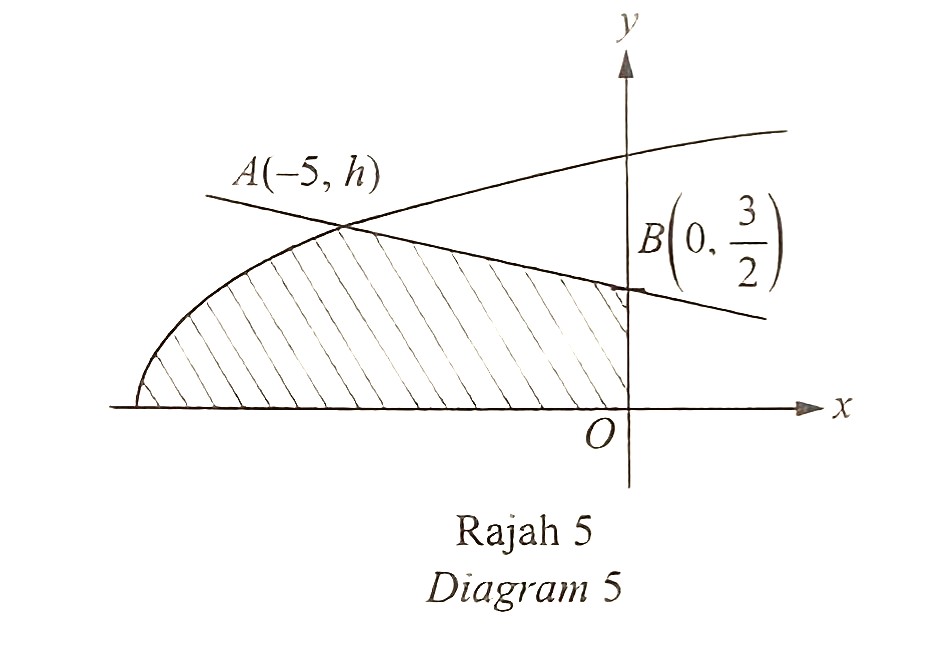
Diagram 5 shows the straight line AB intersects the curve y2 = x + 9 at point A.
 Find
(a) the gradient of the tangent to the curve at point A, [2 marks]
(b) the area of the shaded region, [5 marks]
(c) the volume generated, in terms of π, when the region bounded by the curve, the straight line y = h, the y-axis and the x-axis is revolved through 360o about the y-axis. [3 marks]
Answer:
(a) $$ \begin{aligned} \frac{\mathrm{d} y}{\mathrm{~d} x} & =\frac{1}{2}(x+9)^{-\frac{1}{2}}(1) \\ & =\frac{1}{2}(-5+9)^{-\frac{1}{2}} \\ & =\frac{1}{4} \end{aligned} $$
(b) $$ \begin{aligned} h & =\sqrt{-5+9} \\ & = \pm 2 \\ \therefore h & =2 \end{aligned} $$
$$ \begin{aligned} \int_{-9}^{-5}(x+9)^{\frac{1}{2}} & =\left[\frac{2}{3}(x+9)^{\frac{3}{2}}\right]_{-9}^{-5} \\ & =\frac{2}{3}(-5+9)^{\frac{3}{2}}-\frac{2}{3}(-9+9)^{\frac{3}{2}} \\ & =\frac{16}{3} \end{aligned} $$
$$ \begin{aligned} &\text { Shaded area region }\\ &\begin{aligned} & =\frac{1}{2}\left(2+\frac{3}{2}\right)(5)+\frac{16}{3} \\ & =14.08 \end{aligned} \end{aligned} $$
(c) $$ \begin{aligned} & \pi \int_0^2\left(y^2-9\right)^2 \mathrm{~d} y \\ & =\pi \int_0^2 y^4-18 y^2+81 \mathrm{~d} y \\ & =\pi\left[\frac{y^5}{5}-\frac{18 y^3}{3}+81 y\right]_0^2 \\ & =\pi\left[\frac{y^5}{5}-6 y^3+81 y\right]_0^2 \\ & =\pi\left[\frac{(2)^5}{5}-6(2)^3+81(2)\right]-\pi\left[\frac{(0)^5}{5}-6(0)^3+81(0)\right] \\ & =120.4 \pi \end{aligned} $$
Diagram 5 shows the straight line AB intersects the curve y2 = x + 9 at point A.
Find(a) the gradient of the tangent to the curve at point A, [2 marks]
(b) the area of the shaded region, [5 marks]
(c) the volume generated, in terms of π, when the region bounded by the curve, the straight line y = h, the y-axis and the x-axis is revolved through 360o about the y-axis. [3 marks]
Answer:
(a) $$ \begin{aligned} \frac{\mathrm{d} y}{\mathrm{~d} x} & =\frac{1}{2}(x+9)^{-\frac{1}{2}}(1) \\ & =\frac{1}{2}(-5+9)^{-\frac{1}{2}} \\ & =\frac{1}{4} \end{aligned} $$
(b) $$ \begin{aligned} h & =\sqrt{-5+9} \\ & = \pm 2 \\ \therefore h & =2 \end{aligned} $$
$$ \begin{aligned} \int_{-9}^{-5}(x+9)^{\frac{1}{2}} & =\left[\frac{2}{3}(x+9)^{\frac{3}{2}}\right]_{-9}^{-5} \\ & =\frac{2}{3}(-5+9)^{\frac{3}{2}}-\frac{2}{3}(-9+9)^{\frac{3}{2}} \\ & =\frac{16}{3} \end{aligned} $$
$$ \begin{aligned} &\text { Shaded area region }\\ &\begin{aligned} & =\frac{1}{2}\left(2+\frac{3}{2}\right)(5)+\frac{16}{3} \\ & =14.08 \end{aligned} \end{aligned} $$
(c) $$ \begin{aligned} & \pi \int_0^2\left(y^2-9\right)^2 \mathrm{~d} y \\ & =\pi \int_0^2 y^4-18 y^2+81 \mathrm{~d} y \\ & =\pi\left[\frac{y^5}{5}-\frac{18 y^3}{3}+81 y\right]_0^2 \\ & =\pi\left[\frac{y^5}{5}-6 y^3+81 y\right]_0^2 \\ & =\pi\left[\frac{(2)^5}{5}-6(2)^3+81(2)\right]-\pi\left[\frac{(0)^5}{5}-6(0)^3+81(0)\right] \\ & =120.4 \pi \end{aligned} $$
Question 11:
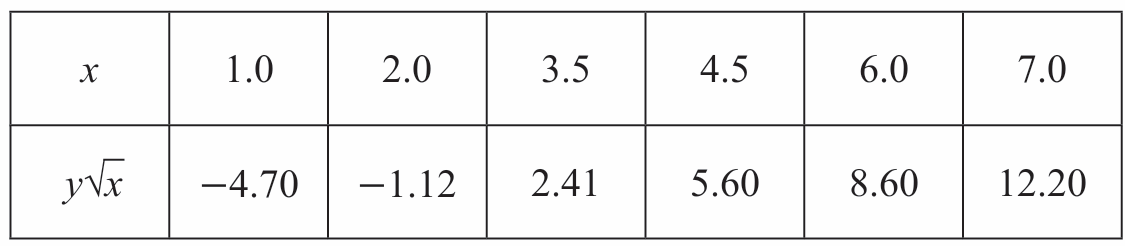
Table 1 shows the values of two variables, x and y, obtained from an experiment. The variables x and y are related by the equation ay = b√x + 1/√x, such that a and b are constants.

(a) Plot y√x against x, using a scale of 2 cm to 1 unit on the x-axis and 2 cm to 2 units on the y√x-axis.
Hence, draw the line of best fit.
[4 marks]
(b) Using the graph in 11(a),
(i) find the value of y when x = 5.7,
(ii) write ay = b√x + 1/√x in linear form, hence find the value of a and of b.
[6 marks]
Answer:
(a)
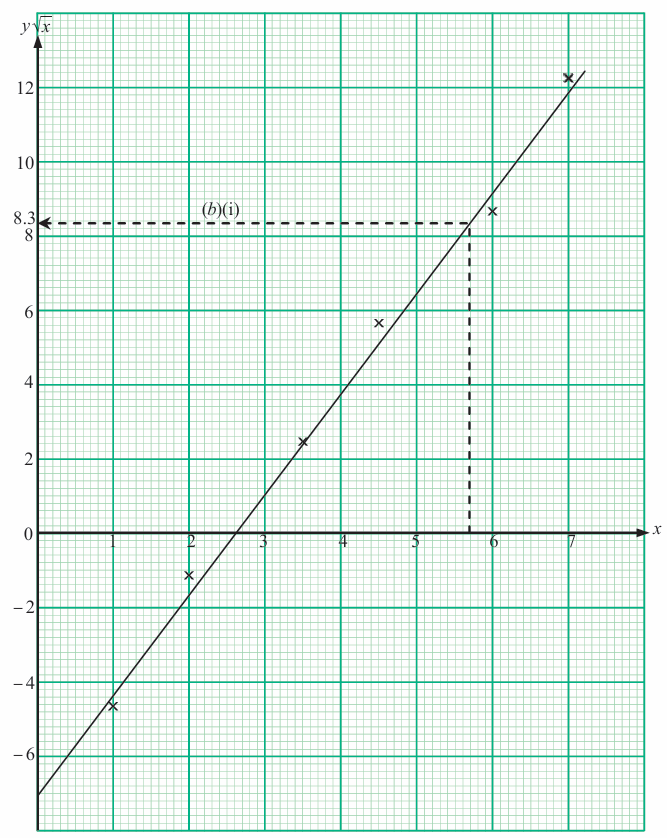
(b)(i) $$ \begin{aligned} x=5.7, y \sqrt{x} & \\ y \sqrt{5.7} & =8.3 \\ y & =3.476 \end{aligned} $$
(b)(ii) $$ \begin{aligned} & y \sqrt{x}=\frac{b}{a} x+\frac{1}{a} \\ & m=\frac{2.41-(-7)}{3.5-0} \\ & =2.689 \end{aligned} $$
$$ \begin{aligned} & \frac{1}{a}=-7 \\ & a=-\frac{1}{7} \\ & \frac{b}{-\frac{1}{7}}=2.689 \\ & b=-0.3841 \end{aligned} $$
Table 1 shows the values of two variables, x and y, obtained from an experiment. The variables x and y are related by the equation ay = b√x + 1/√x, such that a and b are constants.
(a) Plot y√x against x, using a scale of 2 cm to 1 unit on the x-axis and 2 cm to 2 units on the y√x-axis.
Hence, draw the line of best fit.
[4 marks]
(b) Using the graph in 11(a),
(i) find the value of y when x = 5.7,
(ii) write ay = b√x + 1/√x in linear form, hence find the value of a and of b.
[6 marks]
Answer:
(a)
(b)(i) $$ \begin{aligned} x=5.7, y \sqrt{x} & \\ y \sqrt{5.7} & =8.3 \\ y & =3.476 \end{aligned} $$
(b)(ii) $$ \begin{aligned} & y \sqrt{x}=\frac{b}{a} x+\frac{1}{a} \\ & m=\frac{2.41-(-7)}{3.5-0} \\ & =2.689 \end{aligned} $$
$$ \begin{aligned} & \frac{1}{a}=-7 \\ & a=-\frac{1}{7} \\ & \frac{b}{-\frac{1}{7}}=2.689 \\ & b=-0.3841 \end{aligned} $$