Question 8:
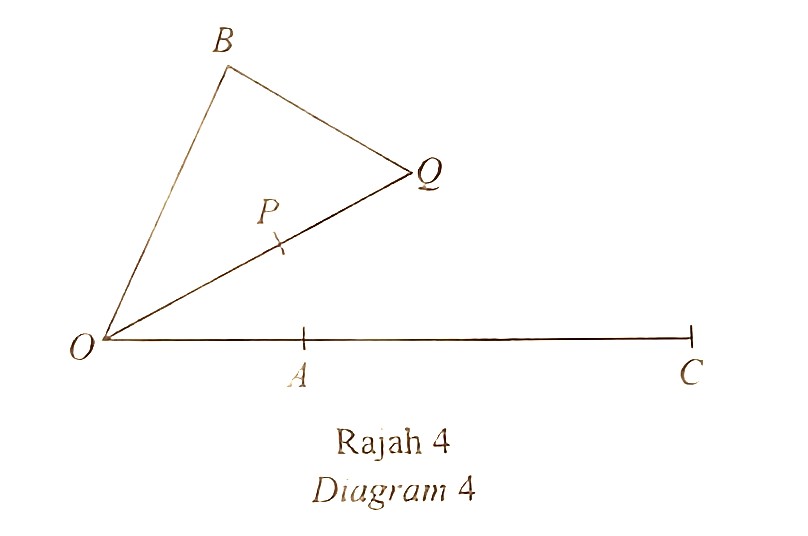
Diagram 4 shows triangle OBQ and the straight line OAC. Point P lies on the straight line OQ and OC = 3OA.
 $$
\text { It is given that } \overrightarrow{O A}=\underline{a}, \overrightarrow{O B}=\underline{b}, \overrightarrow{A P}=\frac{1}{3} \overrightarrow{A B} \text { and } \overrightarrow{O Q}=k \overrightarrow{O P} \text {, }
$$
$$ \text { such that } k \text { is a constant. } $$
(a) Express
(i) $$ \overrightarrow{O P} \text { in terms of } \underline{a} \text { and } \underline{b} \text {, } $$
(ii) $$ \stackrel{\rightharpoonup}{B Q} \text { in terms of } k, \underline{a} \text { and } \underline{b} . $$
[4 marks]
(b) $$ \text { Hence, find the value of } h \text { and of } k \text { if } \overrightarrow{B Q}=h \overrightarrow{B C} \text {, such that } h \text { is a constant. } $$
[5 marks]
(c) $$ \text { State } B Q: Q C \text {. } $$
[1 mark]
Answer:
(a)(i) $$ \begin{aligned} \overrightarrow{O P} & =\overrightarrow{O A}+\overrightarrow{A P} \\ & =\underline{a}+\frac{1}{3}(-\underline{a}+\underline{b}) \\ & =\frac{2}{3} \underline{a}+\frac{1}{3} \underline{b} \end{aligned} $$
(a)(ii) $$ \begin{aligned} \stackrel{\rightharpoonup}{B Q} & =\stackrel{\rightharpoonup}{B O}+\stackrel{\rightharpoonup}{O Q} \\ & =-\underline{b}+k\left(\frac{2}{3} \underline{a}+\frac{1}{3} \underline{b}\right) \\ & =-\underline{b}+\frac{2}{3} k \underline{a}+\frac{k}{3} \underline{b} \end{aligned} $$
(b) $$ \begin{aligned} \overrightarrow{B Q} & =h \overrightarrow{B C} \\ -\underline{b}+\frac{2}{3} k \underline{a}+\frac{k}{3} \underline{b} & =h(-\underline{b}+3 \underline{a}) \\ \left(-1+\frac{k}{3}\right) \underline{b}+\frac{2}{3} k \underline{a} & =-h \underline{b}+3 h \underline{a} \end{aligned} $$
$$ \begin{aligned} &\text { Compare: }\\ &\begin{aligned} -1+\frac{k}{3} & =-h \\ \frac{2}{3} k & =3 h \\ \frac{2}{3} k & =3\left(1-\frac{k}{3}\right) \\ k & =\frac{9}{5} \\ h=1-\frac{9}{15} & =\frac{2}{5} \end{aligned} \end{aligned} $$
(c) $$ \begin{aligned} & 5 B Q=2 B C \\ & B Q: Q C=2: 3 \end{aligned} $$
Diagram 4 shows triangle OBQ and the straight line OAC. Point P lies on the straight line OQ and OC = 3OA.
$$
\text { It is given that } \overrightarrow{O A}=\underline{a}, \overrightarrow{O B}=\underline{b}, \overrightarrow{A P}=\frac{1}{3} \overrightarrow{A B} \text { and } \overrightarrow{O Q}=k \overrightarrow{O P} \text {, }
$$$$ \text { such that } k \text { is a constant. } $$
(a) Express
(i) $$ \overrightarrow{O P} \text { in terms of } \underline{a} \text { and } \underline{b} \text {, } $$
(ii) $$ \stackrel{\rightharpoonup}{B Q} \text { in terms of } k, \underline{a} \text { and } \underline{b} . $$
[4 marks]
(b) $$ \text { Hence, find the value of } h \text { and of } k \text { if } \overrightarrow{B Q}=h \overrightarrow{B C} \text {, such that } h \text { is a constant. } $$
[5 marks]
(c) $$ \text { State } B Q: Q C \text {. } $$
[1 mark]
Answer:
(a)(i) $$ \begin{aligned} \overrightarrow{O P} & =\overrightarrow{O A}+\overrightarrow{A P} \\ & =\underline{a}+\frac{1}{3}(-\underline{a}+\underline{b}) \\ & =\frac{2}{3} \underline{a}+\frac{1}{3} \underline{b} \end{aligned} $$
(a)(ii) $$ \begin{aligned} \stackrel{\rightharpoonup}{B Q} & =\stackrel{\rightharpoonup}{B O}+\stackrel{\rightharpoonup}{O Q} \\ & =-\underline{b}+k\left(\frac{2}{3} \underline{a}+\frac{1}{3} \underline{b}\right) \\ & =-\underline{b}+\frac{2}{3} k \underline{a}+\frac{k}{3} \underline{b} \end{aligned} $$
(b) $$ \begin{aligned} \overrightarrow{B Q} & =h \overrightarrow{B C} \\ -\underline{b}+\frac{2}{3} k \underline{a}+\frac{k}{3} \underline{b} & =h(-\underline{b}+3 \underline{a}) \\ \left(-1+\frac{k}{3}\right) \underline{b}+\frac{2}{3} k \underline{a} & =-h \underline{b}+3 h \underline{a} \end{aligned} $$
$$ \begin{aligned} &\text { Compare: }\\ &\begin{aligned} -1+\frac{k}{3} & =-h \\ \frac{2}{3} k & =3 h \\ \frac{2}{3} k & =3\left(1-\frac{k}{3}\right) \\ k & =\frac{9}{5} \\ h=1-\frac{9}{15} & =\frac{2}{5} \end{aligned} \end{aligned} $$
(c) $$ \begin{aligned} & 5 B Q=2 B C \\ & B Q: Q C=2: 3 \end{aligned} $$
Question 9:
The mass of police cadet members in a school is normally distributed with a mean of 60 kg. It is given that the probability of a police cadet member chosen at random from the school has a mass less than 61 kg is 0.9772 .
(a) If 8 police cadet members are chosen at random from the school, find the probability that
(i) all the 8 members have the mass less than 61 kg,
(ii) at most 6 members have the mass less than 61 kg.
[5 marks]
(b) If a police cadet member is chosen at random from the school, find the probability that the mass is less than 60.5 kg. [5 marks]
Answer:
(a)(i) $$ \begin{aligned} & { }^8 C_8\left(0.9772^8\right)\left(0.0228^0\right) \\ & =0.8315 \end{aligned} $$
(a)(ii) $$ \begin{aligned} & P(X \leqslant 6) \\ & =1-{ }^8 C_8\left(0.9772^8\right)\left(0.0228^0\right)-{ }^8 C_7\left(0.9772^7\right)\left(0.0228^1\right) \\ & =0.0133 \end{aligned} $$
(b) $$ \begin{aligned} \frac{61-60}{\sigma} & =1.999 \\ \sigma & =0.5 \end{aligned} $$
$$ \begin{aligned} & P(X<60.5) \\ & =P\left(Z<\frac{60.5-60}{0.5}\right) \\ & =P(Z<1) \\ & =1-P(Z \geqslant 1) \\ & =0.8413 \end{aligned} $$