Question 13:
(a) Diagram 9 shows angle θ on a Cartesian plane.
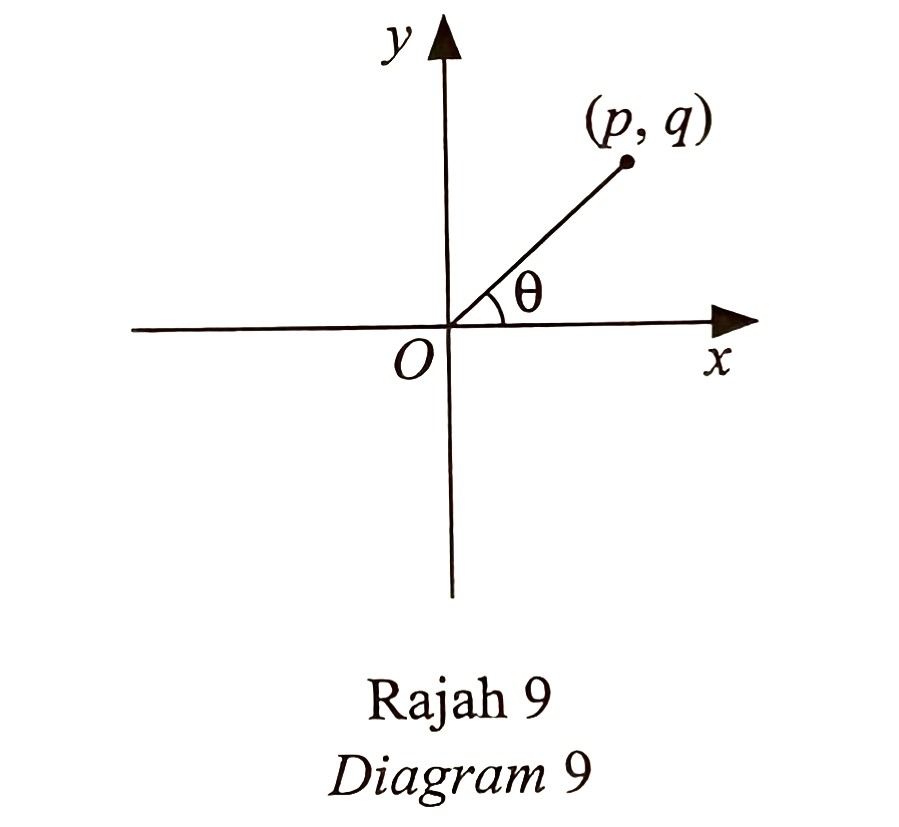
(i) On Diagram 9, label the position of θ.
(ii) State the value of tan (-θ) in terms of p and q.
[2 marks]
(b) Solve the equation 2 cos x = √3 cot x for 0o ≤ x ≤ 360o. [3 marks]
(c) $$ \text { It is given that } \tan m=p \text {, such that } m \text { is a reflex angle. } $$
$$ \text { Express cos }\left(\frac{\pi}{3}-m\right) \text { in terms of } p \text {. } $$
[3 marks]
Answer:
(a)(i)
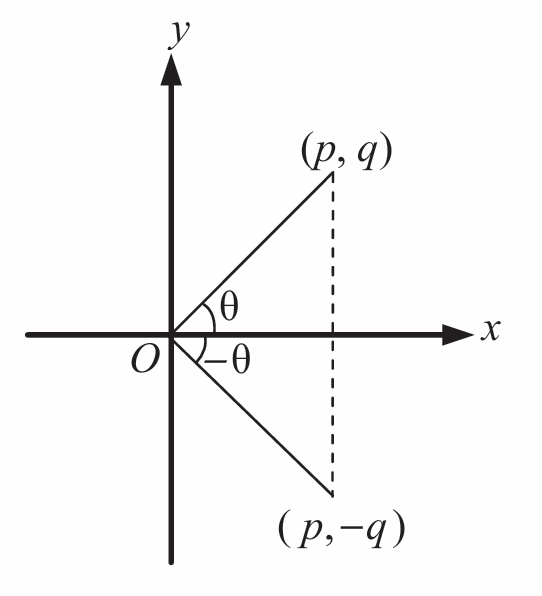
(a)(ii) $$ \begin{aligned} \tan (-\theta) & =-\tan \theta \\ & =-\frac{q}{p} \end{aligned} $$
(b) $$ \begin{aligned} &\begin{aligned} & 2 \operatorname{cos} x=\sqrt{3} \operatorname{cot} x \\ & 2 \operatorname{cos} x=\sqrt{3} \frac{\operatorname{cos} x}{\sin x} \end{aligned}\\ &\begin{aligned} 2 \operatorname{cos} x \sin x-\sqrt{3} \operatorname{cos} x & =0 \\ \operatorname{cos} x(2 \sin x-\sqrt{3}) & =0 \end{aligned} \end{aligned} $$
$$ \begin{aligned} &\begin{aligned} \operatorname{cos} x & =0, \\ x & =90^{\circ}, 270^{\circ} \end{aligned}\\ &\begin{aligned} \sin x & =\frac{\sqrt{3}}{2} \\ x & =60^{\circ}, 120^{\circ} \end{aligned}\\ &x=60^{\circ}, 90^{\circ}, 120^{\circ}, 270^{\circ} \end{aligned} $$
(c) $$ \tan m=\frac{p}{1} \text { in quadrant } 3 $$
$$ \operatorname{cos} m=-\frac{1}{\sqrt{1+p^2}}, \quad \sin m=-\frac{p}{\sqrt{1+p^2}} $$
$$ \begin{aligned} \operatorname{cos}\left(\frac{\pi}{3}-m\right) & =\operatorname{cos} \frac{\pi}{3} \operatorname{cos} m+\sin \frac{\pi}{3} \sin m \\ & =\frac{1}{2} \operatorname{cos} m+\frac{\sqrt{3}}{2} \sin m \\ & =-\frac{1}{2 \sqrt{1+p^2}}-\frac{\sqrt{3} p}{2 \sqrt{1+p^2}} \\ & =\frac{-\sqrt{3} p-1}{2 \sqrt{1+p^2}} \end{aligned} $$
(a) Diagram 9 shows angle θ on a Cartesian plane.
(i) On Diagram 9, label the position of θ.
(ii) State the value of tan (-θ) in terms of p and q.
[2 marks]
(b) Solve the equation 2 cos x = √3 cot x for 0o ≤ x ≤ 360o. [3 marks]
(c) $$ \text { It is given that } \tan m=p \text {, such that } m \text { is a reflex angle. } $$
$$ \text { Express cos }\left(\frac{\pi}{3}-m\right) \text { in terms of } p \text {. } $$
[3 marks]
Answer:
(a)(i)
(a)(ii) $$ \begin{aligned} \tan (-\theta) & =-\tan \theta \\ & =-\frac{q}{p} \end{aligned} $$
(b) $$ \begin{aligned} &\begin{aligned} & 2 \operatorname{cos} x=\sqrt{3} \operatorname{cot} x \\ & 2 \operatorname{cos} x=\sqrt{3} \frac{\operatorname{cos} x}{\sin x} \end{aligned}\\ &\begin{aligned} 2 \operatorname{cos} x \sin x-\sqrt{3} \operatorname{cos} x & =0 \\ \operatorname{cos} x(2 \sin x-\sqrt{3}) & =0 \end{aligned} \end{aligned} $$
$$ \begin{aligned} &\begin{aligned} \operatorname{cos} x & =0, \\ x & =90^{\circ}, 270^{\circ} \end{aligned}\\ &\begin{aligned} \sin x & =\frac{\sqrt{3}}{2} \\ x & =60^{\circ}, 120^{\circ} \end{aligned}\\ &x=60^{\circ}, 90^{\circ}, 120^{\circ}, 270^{\circ} \end{aligned} $$
(c) $$ \tan m=\frac{p}{1} \text { in quadrant } 3 $$
$$ \operatorname{cos} m=-\frac{1}{\sqrt{1+p^2}}, \quad \sin m=-\frac{p}{\sqrt{1+p^2}} $$
$$ \begin{aligned} \operatorname{cos}\left(\frac{\pi}{3}-m\right) & =\operatorname{cos} \frac{\pi}{3} \operatorname{cos} m+\sin \frac{\pi}{3} \sin m \\ & =\frac{1}{2} \operatorname{cos} m+\frac{\sqrt{3}}{2} \sin m \\ & =-\frac{1}{2 \sqrt{1+p^2}}-\frac{\sqrt{3} p}{2 \sqrt{1+p^2}} \\ & =\frac{-\sqrt{3} p-1}{2 \sqrt{1+p^2}} \end{aligned} $$
Question 14:
Diagram 10 shows a curve of a quadratic function f(x) = 2x2 + hx – 2k + 5, such that h and k are constants. The curve has a minimum point at T.
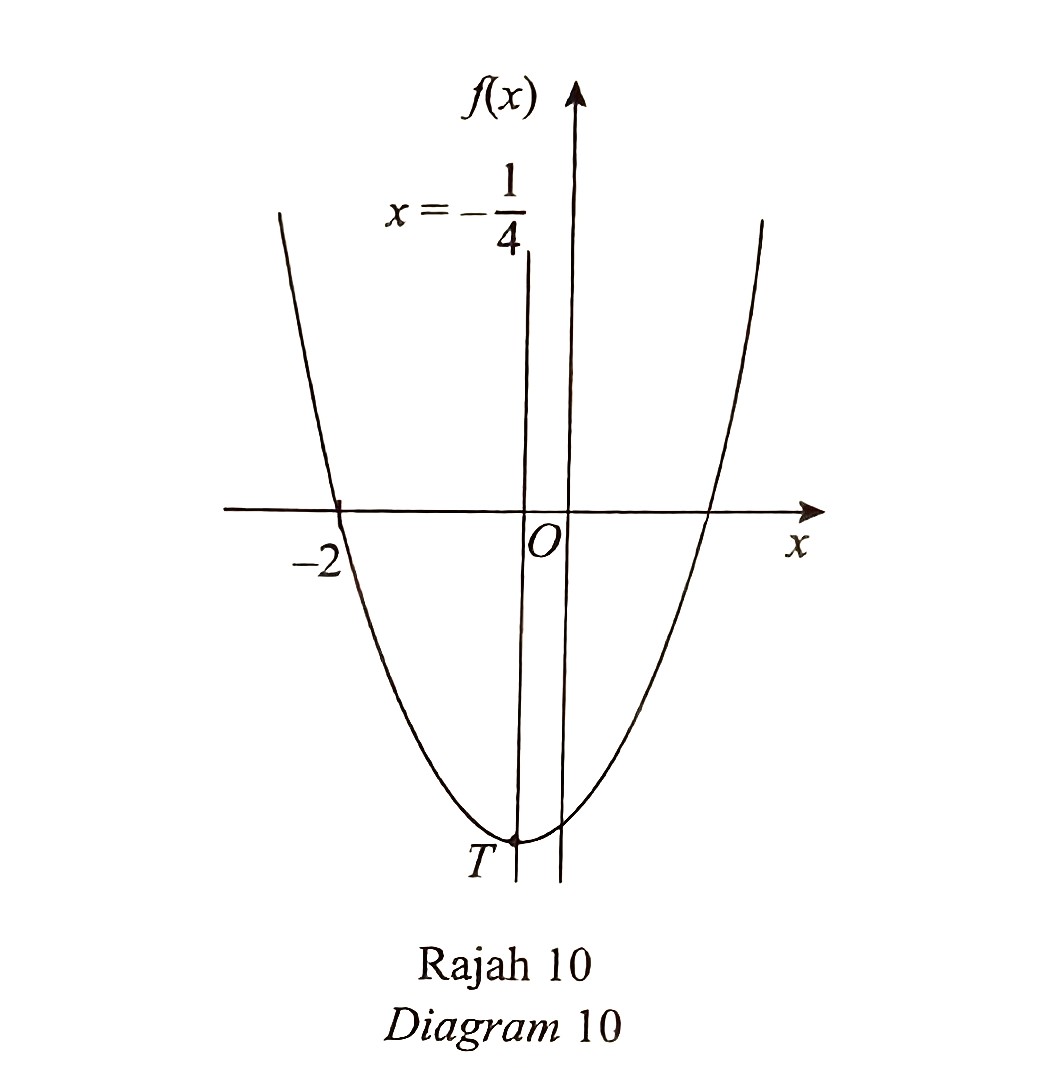 (a) Determine the range of values of x of f(x) > 0. [2 marks]
(b) $$ \text { Prove that } k>\frac{40-h^2}{16} \text {. } $$
[2 marks]
(c) Using the method of completing the square, find the minimum value of function f(x) in terms of k. [4 marks]
Answer:
(a) $$ -\frac{1}{4}+\left[-\frac{1}{4}-(-2)\right]=\frac{3}{2} $$
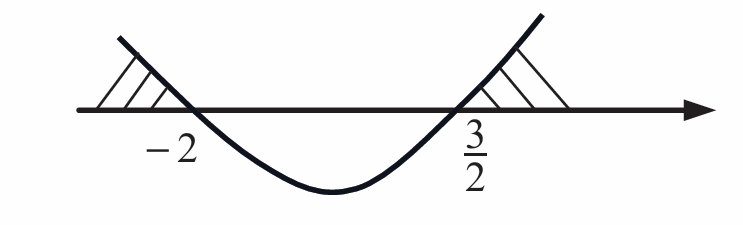 $$
x<-2, x>\frac{3}{2}
$$
(b) $$ \begin{aligned} h^2-4(2)(-2 k+5) & >0 \\ h^2+16 k-40 & >0 \\ k & >\frac{40-h^2}{16} \end{aligned} $$
(c) $$ \begin{aligned} f(x) & =2\left[x^2+\frac{h}{2} x\right]-2 k+5 \\ & =2\left[x^2+\frac{h}{2} x+\left(\frac{\frac{h}{2}}{2}\right)^2-\left(\frac{\frac{h}{2}}{2}\right)^2\right]-2 k+5 \\ & =2\left(x+\frac{h}{4}\right)^2-2\left(\frac{h}{4}\right)^2-2 k+5 \\ & =2\left(x+\frac{h}{4}\right)^2-\frac{h^2}{8}-2 k+5 \\ -\frac{h}{4} & =-\frac{1}{4} \\ h & =1 \end{aligned} $$
$$ \begin{aligned} \text { Minimum value } & =-\frac{1^2}{8}-2 k+5 \\ & =\frac{39}{8}-2 k \end{aligned} $$
Diagram 10 shows a curve of a quadratic function f(x) = 2x2 + hx – 2k + 5, such that h and k are constants. The curve has a minimum point at T.
(a) Determine the range of values of x of f(x) > 0. [2 marks](b) $$ \text { Prove that } k>\frac{40-h^2}{16} \text {. } $$
[2 marks]
(c) Using the method of completing the square, find the minimum value of function f(x) in terms of k. [4 marks]
Answer:
(a) $$ -\frac{1}{4}+\left[-\frac{1}{4}-(-2)\right]=\frac{3}{2} $$
$$
x<-2, x>\frac{3}{2}
$$(b) $$ \begin{aligned} h^2-4(2)(-2 k+5) & >0 \\ h^2+16 k-40 & >0 \\ k & >\frac{40-h^2}{16} \end{aligned} $$
(c) $$ \begin{aligned} f(x) & =2\left[x^2+\frac{h}{2} x\right]-2 k+5 \\ & =2\left[x^2+\frac{h}{2} x+\left(\frac{\frac{h}{2}}{2}\right)^2-\left(\frac{\frac{h}{2}}{2}\right)^2\right]-2 k+5 \\ & =2\left(x+\frac{h}{4}\right)^2-2\left(\frac{h}{4}\right)^2-2 k+5 \\ & =2\left(x+\frac{h}{4}\right)^2-\frac{h^2}{8}-2 k+5 \\ -\frac{h}{4} & =-\frac{1}{4} \\ h & =1 \end{aligned} $$
$$ \begin{aligned} \text { Minimum value } & =-\frac{1^2}{8}-2 k+5 \\ & =\frac{39}{8}-2 k \end{aligned} $$