Question 5:
It is given that f(x) = x2 + 3x – 4.
(a) Find the range of values of x such that f(x) > 0. [2 marks]
(b) The equation px + q – f(x) = 0, such that p and q are constants, has roots α and β.
(i) State α + β and αβ in terms of p and/or q.
(ii) The roots of the quadratic equation x2 + rx + r = 10 are 2/α and 2/β, such that r is a constant.
Express p in terms of q. Express p in terms of q.
[5 marks]
Answer:
(a) $$ \begin{aligned} f(x) & >0 \\ x^2+3 x-4 & >0 \\ (x+4)(x-1) & >0 \end{aligned} $$
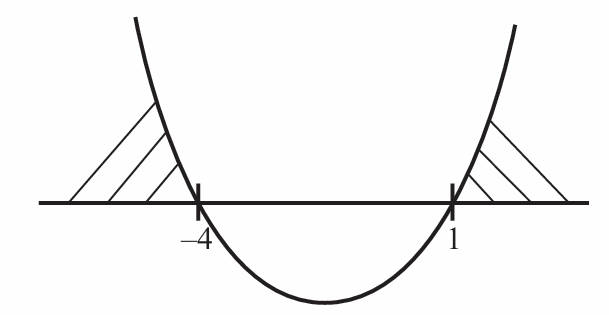
$$ x<-4, x>1 $$
(b)(i) $$ \begin{aligned} & p x+q-\left(x^2+3 x-4\right)=0 \\ & -x^2+(p-3) x+q+4=0 \\ & x^2-(p-3) x-q-4=0 \\ & \alpha+\beta=p-3 \\ & \alpha \beta=-q-4 \end{aligned} $$
(b)(ii) $$ x^2+r x+r-10=0 $$
$$ \begin{aligned} \frac{2}{\alpha}+\frac{2}{\beta} & =-r \text { and }\left(\frac{2}{\alpha}\right)\left(\frac{2}{\beta}\right)=r-10 \\ \frac{2}{\alpha}+\frac{2}{\beta} & =-r \\ 2\left(\frac{\beta+\alpha}{\alpha \beta}\right) & =-r \\ \frac{2(p-3)}{-q-4} & =-r \\ r & =\frac{2(p-3)}{q+4} \end{aligned} $$
$$ \begin{aligned} \left(\frac{2}{\alpha}\right)\left(\frac{2}{\beta}\right) & =r-10 \\ \frac{4}{\alpha \beta} & =r-10 \\ \frac{4}{-q-4} & =r-10 \\ r & =\frac{-4}{q+4}+10 \end{aligned} $$
$$ \begin{aligned} \frac{2(p-3)}{q+4} & =\frac{-4}{q+4}+10 \\ 2(p-3) & =-4+10(q+4) \\ 2(p-3) & =10 q+36 \\ p-3 & =5 q+18 \\ p & =5 q+21 \end{aligned} $$
It is given that f(x) = x2 + 3x – 4.
(a) Find the range of values of x such that f(x) > 0. [2 marks]
(b) The equation px + q – f(x) = 0, such that p and q are constants, has roots α and β.
(i) State α + β and αβ in terms of p and/or q.
(ii) The roots of the quadratic equation x2 + rx + r = 10 are 2/α and 2/β, such that r is a constant.
Express p in terms of q. Express p in terms of q.
[5 marks]
Answer:
(a) $$ \begin{aligned} f(x) & >0 \\ x^2+3 x-4 & >0 \\ (x+4)(x-1) & >0 \end{aligned} $$
$$ x<-4, x>1 $$
(b)(i) $$ \begin{aligned} & p x+q-\left(x^2+3 x-4\right)=0 \\ & -x^2+(p-3) x+q+4=0 \\ & x^2-(p-3) x-q-4=0 \\ & \alpha+\beta=p-3 \\ & \alpha \beta=-q-4 \end{aligned} $$
(b)(ii) $$ x^2+r x+r-10=0 $$
$$ \begin{aligned} \frac{2}{\alpha}+\frac{2}{\beta} & =-r \text { and }\left(\frac{2}{\alpha}\right)\left(\frac{2}{\beta}\right)=r-10 \\ \frac{2}{\alpha}+\frac{2}{\beta} & =-r \\ 2\left(\frac{\beta+\alpha}{\alpha \beta}\right) & =-r \\ \frac{2(p-3)}{-q-4} & =-r \\ r & =\frac{2(p-3)}{q+4} \end{aligned} $$
$$ \begin{aligned} \left(\frac{2}{\alpha}\right)\left(\frac{2}{\beta}\right) & =r-10 \\ \frac{4}{\alpha \beta} & =r-10 \\ \frac{4}{-q-4} & =r-10 \\ r & =\frac{-4}{q+4}+10 \end{aligned} $$
$$ \begin{aligned} \frac{2(p-3)}{q+4} & =\frac{-4}{q+4}+10 \\ 2(p-3) & =-4+10(q+4) \\ 2(p-3) & =10 q+36 \\ p-3 & =5 q+18 \\ p & =5 q+21 \end{aligned} $$
Question 6:
Diagram 3 shows a trapezium FECA. Sector ABHG is a quadrant of a circle with centre A and AHD is an arc of a circle with centre B.
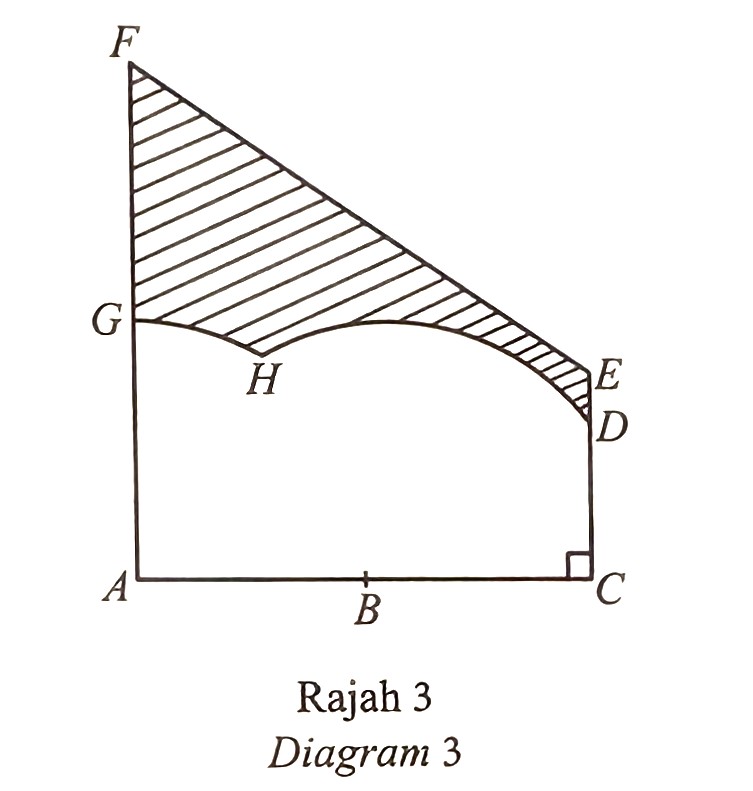
It is given that G is the midpoint of AF, BC = CE = 8 cm and CD = 3 DE. [Guna/Use π = 3.142 ]
(a) Find ∠CBD, in radians correct to four decimal places. [2 marks]
(b) Hence, calculate the perimeter, in cm , of the shaded region. [4 marks]
Answer:
(a)
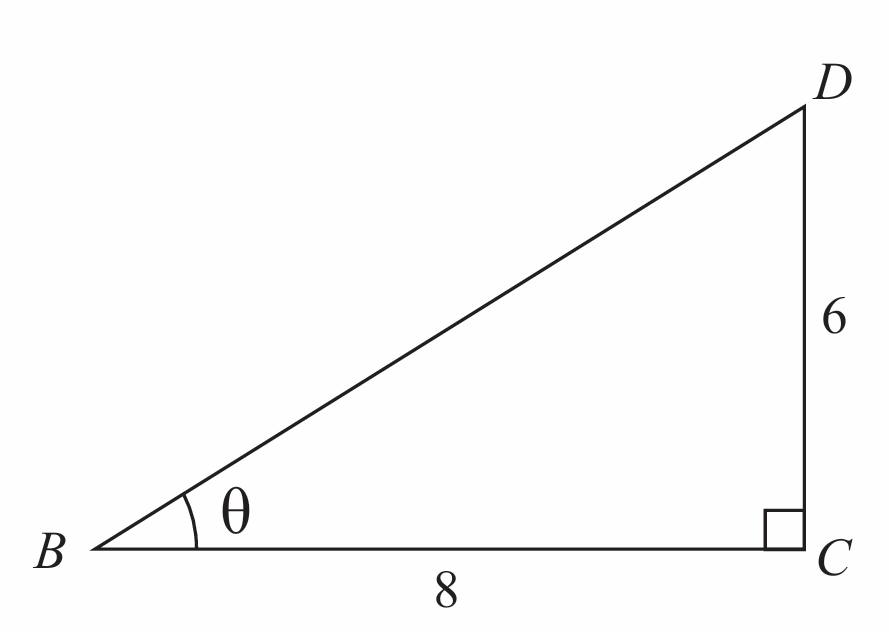
$$ \begin{aligned} \tan \theta & =\frac{6}{8} \\ \theta & =\tan ^{-1}\left(\frac{6}{8}\right) \\ \theta & =0.6435 \text { radian } \end{aligned} $$
(b) $$ \begin{aligned} & B D=\sqrt{6^2+8^2}=10 \mathrm{~cm} \\ & \angle A B H=\frac{\pi}{3} \mathrm{rad} \\ & \angle H B D=\pi-\frac{\pi}{3}-0.6435=1.451 \mathrm{rad} \\ & \angle G A H=\frac{\pi}{2}-\frac{\pi}{3}=\frac{\pi}{6} \mathrm{rad} \\ & E F=\sqrt{12^2+18^2}=21.63 \mathrm{~cm} \end{aligned} $$
$$ \begin{aligned} & S_{G H}=10\left(\frac{\pi}{6}\right)=\frac{5 \pi}{3} \mathrm{~cm} \\ & S_{H D}=10(1.451)=14.51 \end{aligned} $$
$$ \begin{aligned} \text { Perimeter } & =10+\frac{5 \pi}{3}+14.51+2+21.63 \\ & =53.38 \mathrm{~cm} \end{aligned} $$
Diagram 3 shows a trapezium FECA. Sector ABHG is a quadrant of a circle with centre A and AHD is an arc of a circle with centre B.
It is given that G is the midpoint of AF, BC = CE = 8 cm and CD = 3 DE. [Guna/Use π = 3.142 ]
(a) Find ∠CBD, in radians correct to four decimal places. [2 marks]
(b) Hence, calculate the perimeter, in cm , of the shaded region. [4 marks]
Answer:
(a)
$$ \begin{aligned} \tan \theta & =\frac{6}{8} \\ \theta & =\tan ^{-1}\left(\frac{6}{8}\right) \\ \theta & =0.6435 \text { radian } \end{aligned} $$
(b) $$ \begin{aligned} & B D=\sqrt{6^2+8^2}=10 \mathrm{~cm} \\ & \angle A B H=\frac{\pi}{3} \mathrm{rad} \\ & \angle H B D=\pi-\frac{\pi}{3}-0.6435=1.451 \mathrm{rad} \\ & \angle G A H=\frac{\pi}{2}-\frac{\pi}{3}=\frac{\pi}{6} \mathrm{rad} \\ & E F=\sqrt{12^2+18^2}=21.63 \mathrm{~cm} \end{aligned} $$
$$ \begin{aligned} & S_{G H}=10\left(\frac{\pi}{6}\right)=\frac{5 \pi}{3} \mathrm{~cm} \\ & S_{H D}=10(1.451)=14.51 \end{aligned} $$
$$ \begin{aligned} \text { Perimeter } & =10+\frac{5 \pi}{3}+14.51+2+21.63 \\ & =53.38 \mathrm{~cm} \end{aligned} $$
Question 7:
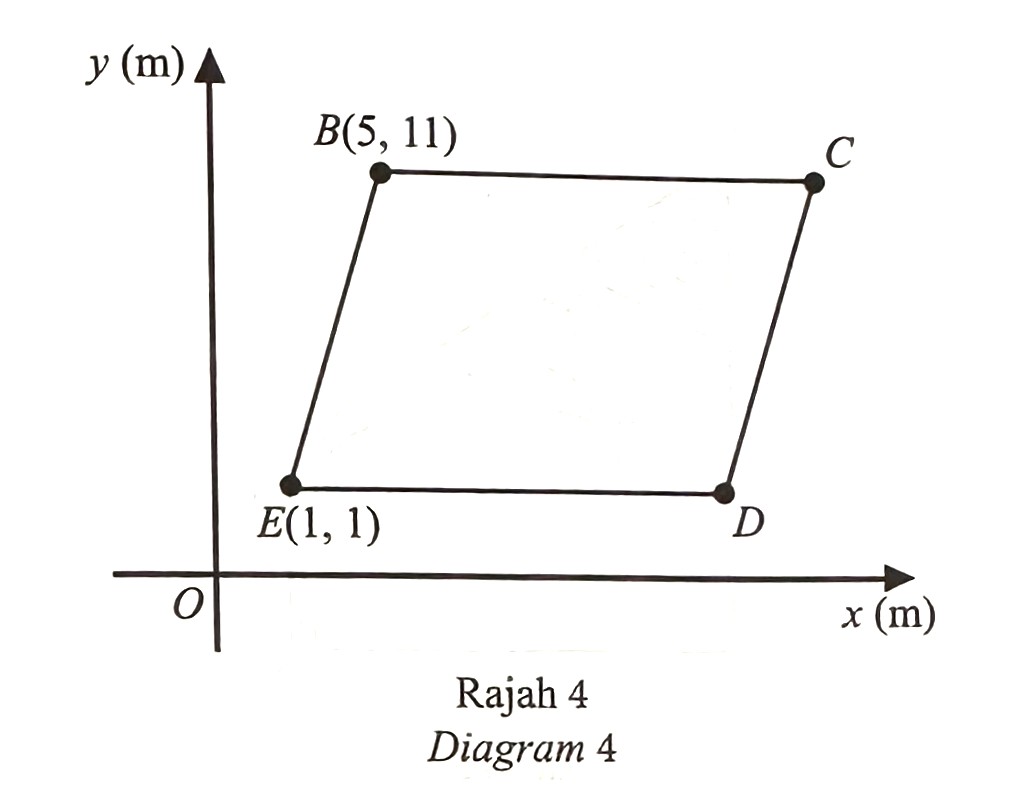
Diagram 4 shows locations of four stations in the school field on a Cartesian plane such that BCDE is a parallelogram.
 (a) $$
\text { State the value of }|\overrightarrow{E D}+\overrightarrow{D B}+\overrightarrow{B E}| \text {. }
$$
[1 mark]
(b) A path from station E to station D is parallel to the x-axis and the displacement is 11 m .
Using vector’s triangle law, find the resultant vector from station E to station C.
[2 marks]
(c) $$ \text { A boy runs from station } E \text { to a cone at } K(5, p) \text { with a constant velocity of }(3 \underline{i}+4 j) \mathrm{m} \mathrm{~s}^{-1} \text {. } $$
He takes t seconds to reach the cone.
Based on the given information, write a vector equation in terms of t and p.
Hence, find the value of t and of p.
[3 marks]
Answer:
(a) $$ |\overrightarrow{E D}+\overrightarrow{D B}+\overrightarrow{B E}|=0 $$
(b) $$ \begin{aligned} \stackrel{\rightharpoonup}{E C} & =11 \underline{i}+4 \underline{i}+10 j \\ & =15 \underline{i}+10 j \end{aligned} $$
(c) $$ \begin{aligned} \binom{1}{1}+\binom{3}{4} t & =\binom{5}{p} \\ 1+3 t & =5 \\ t & =\frac{4}{3} \end{aligned} $$
$$ \begin{aligned} 1+4 t & =p \\ 1+4\left(\frac{4}{3}\right) & =p \\ \frac{3+16}{3} & =p \\ p & =\frac{19}{3} \end{aligned} $$
Diagram 4 shows locations of four stations in the school field on a Cartesian plane such that BCDE is a parallelogram.
(a) $$
\text { State the value of }|\overrightarrow{E D}+\overrightarrow{D B}+\overrightarrow{B E}| \text {. }
$$[1 mark]
(b) A path from station E to station D is parallel to the x-axis and the displacement is 11 m .
Using vector’s triangle law, find the resultant vector from station E to station C.
[2 marks]
(c) $$ \text { A boy runs from station } E \text { to a cone at } K(5, p) \text { with a constant velocity of }(3 \underline{i}+4 j) \mathrm{m} \mathrm{~s}^{-1} \text {. } $$
He takes t seconds to reach the cone.
Based on the given information, write a vector equation in terms of t and p.
Hence, find the value of t and of p.
[3 marks]
Answer:
(a) $$ |\overrightarrow{E D}+\overrightarrow{D B}+\overrightarrow{B E}|=0 $$
(b) $$ \begin{aligned} \stackrel{\rightharpoonup}{E C} & =11 \underline{i}+4 \underline{i}+10 j \\ & =15 \underline{i}+10 j \end{aligned} $$
(c) $$ \begin{aligned} \binom{1}{1}+\binom{3}{4} t & =\binom{5}{p} \\ 1+3 t & =5 \\ t & =\frac{4}{3} \end{aligned} $$
$$ \begin{aligned} 1+4 t & =p \\ 1+4\left(\frac{4}{3}\right) & =p \\ \frac{3+16}{3} & =p \\ p & =\frac{19}{3} \end{aligned} $$