Question 12:
A random variable, X, has a binomial distribution with 5 trials such that the probability of success in each trial is p and the probability of failure in each trial is q. Table 1 shows parts of the probability distribution of X.
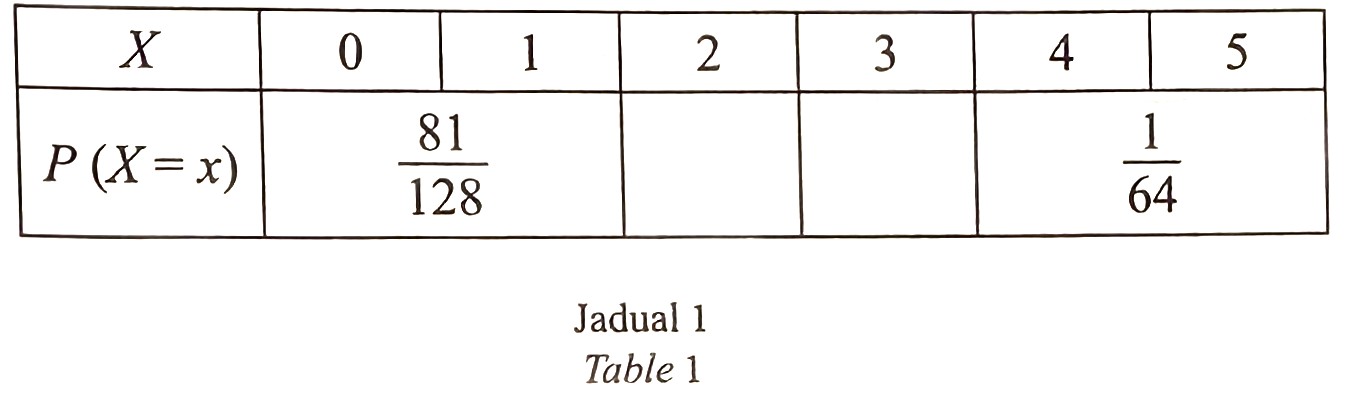 (a) State the value of P(X = 2) + P(X = 3) in fraction form. [1 mark]
(b) Hence, show that p = 3/16q. [3 marks]
Answer:
(a) $$ \begin{aligned} P(X=2)+P(X=3) & =1-\frac{81}{128}-\frac{1}{64} \\ & =\frac{45}{128} \end{aligned} $$
(b) $$ \begin{aligned} &\begin{aligned} { }^5 C_2(p)^2(q)^3+{ }^5 C_3(p)^3(q)^2 & =\frac{45}{128} \\ 10 p^2 q^3+10 p^3 q^2 & =\frac{45}{128} \\ 10 p^2 q^2(q+p) & =\frac{45}{128} \\ p^2 q^2(q+p) & =\frac{9}{256} \\ p^2 q^2(1) & =\frac{9}{256} \\ p q & =\frac{3}{16} \\ p & =\frac{3}{16 q} \end{aligned}\\ &\text { Shown } \end{aligned} $$
A random variable, X, has a binomial distribution with 5 trials such that the probability of success in each trial is p and the probability of failure in each trial is q. Table 1 shows parts of the probability distribution of X.
(a) State the value of P(X = 2) + P(X = 3) in fraction form. [1 mark](b) Hence, show that p = 3/16q. [3 marks]
Answer:
(a) $$ \begin{aligned} P(X=2)+P(X=3) & =1-\frac{81}{128}-\frac{1}{64} \\ & =\frac{45}{128} \end{aligned} $$
(b) $$ \begin{aligned} &\begin{aligned} { }^5 C_2(p)^2(q)^3+{ }^5 C_3(p)^3(q)^2 & =\frac{45}{128} \\ 10 p^2 q^3+10 p^3 q^2 & =\frac{45}{128} \\ 10 p^2 q^2(q+p) & =\frac{45}{128} \\ p^2 q^2(q+p) & =\frac{9}{256} \\ p^2 q^2(1) & =\frac{9}{256} \\ p q & =\frac{3}{16} \\ p & =\frac{3}{16 q} \end{aligned}\\ &\text { Shown } \end{aligned} $$
Question 13:
$$ \text { It is given that } f(x)=\frac{3}{4 x-1}, x \neq \frac{1}{4} \text { and } f g(x)=\frac{3}{4 x^2+3} \text {. } $$
(a) Find the object of f(x) if the image is 1/3. [2 marks]
(b) Express m in terms of p if f(m + 1) = 3fg(p). [2 marks]
(c)(i) Find g(x).
(ii) Hence, determine whether the inverse function of g(x) is exist or not.
Give your justification.
[4 marks]
Answer:
(a) $$ \begin{array}{r} \frac{3}{4 x-1}=\frac{1}{3} \\ x=\frac{5}{2} \end{array} $$
(b) $$ \begin{aligned} f(m+1) & =3 f g(p) \\ \frac{3}{4(m+1)-1} & =3\left(\frac{3}{4 p^2+3}\right) \\ 3(4 m+4-1) & =4 p^2+3 \\ 12 m+9 & =4 p^2+3 \\ m & =\frac{4 p^2-6}{12} \\ m & =\frac{2 p^2-3}{6} \end{aligned} $$
(c)(i) $$ \begin{aligned} \frac{3}{4 g(x)-1} & =\frac{3}{4 x^2+3} \\ 4 g(x)-1 & =4 x^2+3 \\ g(x) & =x^2+1 \end{aligned} $$
(c)(ii) Horizontal line test
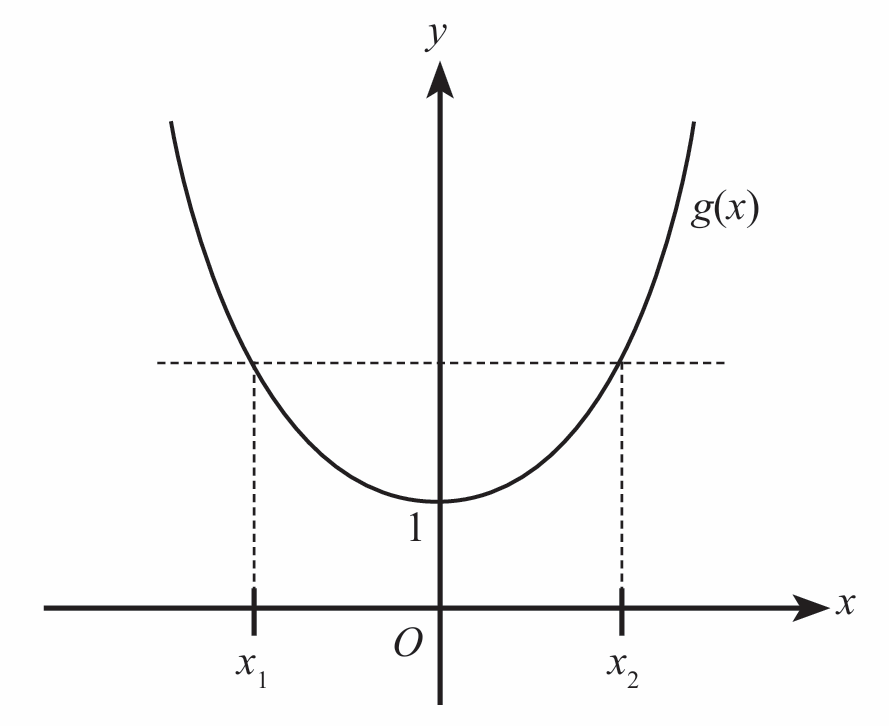
Not one to one relationship
$$ \text { It is given that } f(x)=\frac{3}{4 x-1}, x \neq \frac{1}{4} \text { and } f g(x)=\frac{3}{4 x^2+3} \text {. } $$
(a) Find the object of f(x) if the image is 1/3. [2 marks]
(b) Express m in terms of p if f(m + 1) = 3fg(p). [2 marks]
(c)(i) Find g(x).
(ii) Hence, determine whether the inverse function of g(x) is exist or not.
Give your justification.
[4 marks]
Answer:
(a) $$ \begin{array}{r} \frac{3}{4 x-1}=\frac{1}{3} \\ x=\frac{5}{2} \end{array} $$
(b) $$ \begin{aligned} f(m+1) & =3 f g(p) \\ \frac{3}{4(m+1)-1} & =3\left(\frac{3}{4 p^2+3}\right) \\ 3(4 m+4-1) & =4 p^2+3 \\ 12 m+9 & =4 p^2+3 \\ m & =\frac{4 p^2-6}{12} \\ m & =\frac{2 p^2-3}{6} \end{aligned} $$
(c)(i) $$ \begin{aligned} \frac{3}{4 g(x)-1} & =\frac{3}{4 x^2+3} \\ 4 g(x)-1 & =4 x^2+3 \\ g(x) & =x^2+1 \end{aligned} $$
(c)(ii) Horizontal line test
Not one to one relationship