Question 7:
Diagram 7.1 shows straight lines PA and AQ which intersect at the point A.
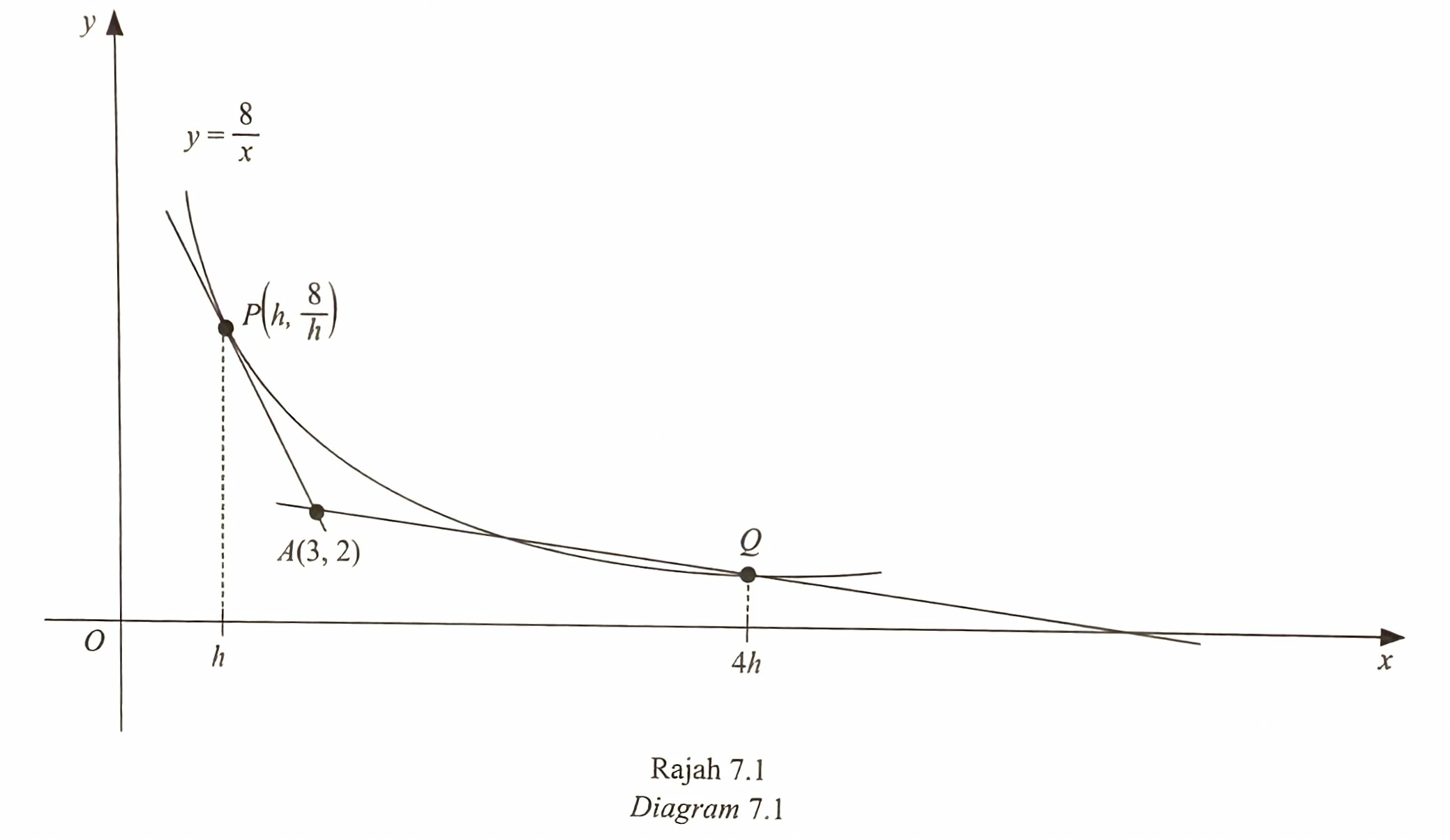 It is given that PA is a tangent to the curve y = 8/x, such that h is a constant.
(a)(i) Find the value of h.
(ii) Hence, determine the coordinates of Q.
[4 marks]
(b) Diagram 7.2 shows part of the curve y = g(x) which has a stationary point at R. The gradient function of the curve y = g(x) is (x – 13)2(x – 4). AQR is a straight line and point R lies on the x-axis.
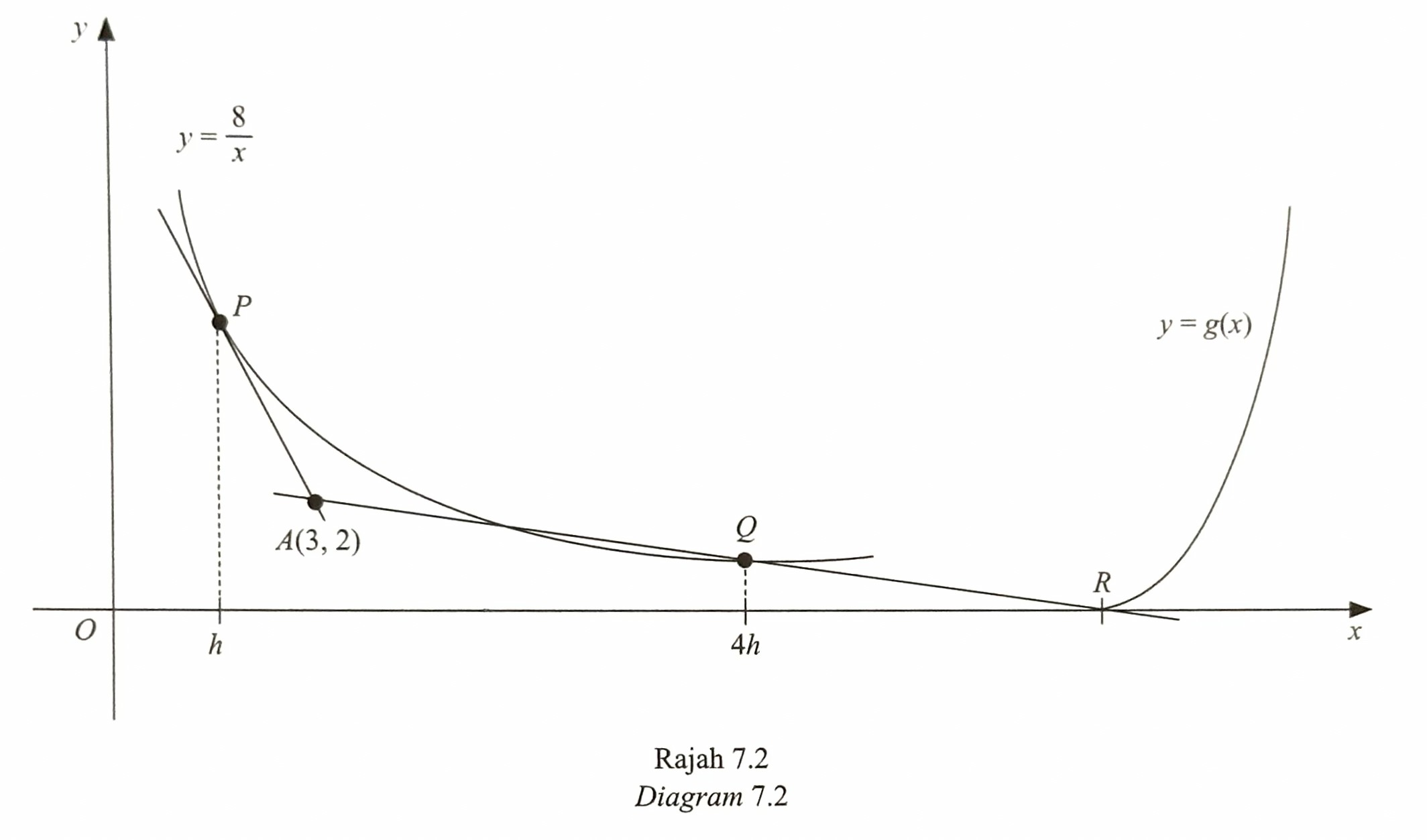 Determine the nature of the stationary point of g(x) at R.
[3 marks]
Answer:
(a)(i)
$$ \begin{aligned} y & =\frac{8}{x} \\ \frac{\mathrm{~d} y}{\mathrm{~d} x} & =-\frac{8}{x^2} \quad, \quad \text { at } P\left(h, \frac{8}{h}\right) \\ & =-\frac{8}{h^2} \ldots(1) \end{aligned} $$
$$ m_{A P}=\frac{\frac{8}{h}-2}{h-3} \ldots (2) $$
$$ \begin{gathered} \text { (1) }=\text { (2) } \\ \frac{\frac{8}{h}-2}{h-3}=-\frac{8}{h^2} \end{gathered} $$
$$ \begin{aligned} -h^2\left(\frac{8}{h}-2\right) & =8(h-3) \\ -8 h+2 h^2 & =8 h-24 \\ 2 h^2-16 h+24 & =0 \\ 2(h-6)(h-2) & =0 \end{aligned} $$
$$ \begin{aligned} h-6 & =0 & , h-2 & =0 \\ h & =6 \text { (ignore) } & , \quad h & =2 \end{aligned} $$
$$ h<3, \therefore h=2 $$
(a)(ii) $$ \begin{aligned} & P(2,4), Q(8, y) \\ & y=\frac{8}{x} \text { at } x=8 \\ & y=\frac{8}{8} \\ & y=1 \\ & \therefore Q(8,1) \end{aligned} $$
(b) $$ \begin{aligned} &A(3,2), Q(8,1), R(x, 0)\\ &\begin{aligned} m_{A R} & =m_{A Q} \\ \frac{2-0}{3-x} & =\frac{2-1}{3-8} \\ \frac{2-0}{3-x} & =-\frac{1}{5} \\ -10 & =3-x \\ x & =13 \end{aligned} \end{aligned} $$
$$ \begin{aligned} & g^{\prime}(x)=(x-13)^2(x-4) \\ & g^{\prime \prime}(x)=(x-13)^2(1)+(2)(x-13)^1(1)(x-4) \\ & g^{\prime \prime}(x)=(x-13)^2+2(x-13)(x-4) \\ & g^{\prime \prime}(13)=(13-13)^2+2(13-13)(13-4) \\ & g^{\prime \prime}(13)=0 \end{aligned} $$
∴ Point R is a point of inflection.
Diagram 7.1 shows straight lines PA and AQ which intersect at the point A.
It is given that PA is a tangent to the curve y = 8/x, such that h is a constant.(a)(i) Find the value of h.
(ii) Hence, determine the coordinates of Q.
[4 marks]
(b) Diagram 7.2 shows part of the curve y = g(x) which has a stationary point at R. The gradient function of the curve y = g(x) is (x – 13)2(x – 4). AQR is a straight line and point R lies on the x-axis.
Determine the nature of the stationary point of g(x) at R.[3 marks]
Answer:
(a)(i)
$$ \begin{aligned} y & =\frac{8}{x} \\ \frac{\mathrm{~d} y}{\mathrm{~d} x} & =-\frac{8}{x^2} \quad, \quad \text { at } P\left(h, \frac{8}{h}\right) \\ & =-\frac{8}{h^2} \ldots(1) \end{aligned} $$
$$ m_{A P}=\frac{\frac{8}{h}-2}{h-3} \ldots (2) $$
$$ \begin{gathered} \text { (1) }=\text { (2) } \\ \frac{\frac{8}{h}-2}{h-3}=-\frac{8}{h^2} \end{gathered} $$
$$ \begin{aligned} -h^2\left(\frac{8}{h}-2\right) & =8(h-3) \\ -8 h+2 h^2 & =8 h-24 \\ 2 h^2-16 h+24 & =0 \\ 2(h-6)(h-2) & =0 \end{aligned} $$
$$ \begin{aligned} h-6 & =0 & , h-2 & =0 \\ h & =6 \text { (ignore) } & , \quad h & =2 \end{aligned} $$
$$ h<3, \therefore h=2 $$
(a)(ii) $$ \begin{aligned} & P(2,4), Q(8, y) \\ & y=\frac{8}{x} \text { at } x=8 \\ & y=\frac{8}{8} \\ & y=1 \\ & \therefore Q(8,1) \end{aligned} $$
(b) $$ \begin{aligned} &A(3,2), Q(8,1), R(x, 0)\\ &\begin{aligned} m_{A R} & =m_{A Q} \\ \frac{2-0}{3-x} & =\frac{2-1}{3-8} \\ \frac{2-0}{3-x} & =-\frac{1}{5} \\ -10 & =3-x \\ x & =13 \end{aligned} \end{aligned} $$
$$ \begin{aligned} & g^{\prime}(x)=(x-13)^2(x-4) \\ & g^{\prime \prime}(x)=(x-13)^2(1)+(2)(x-13)^1(1)(x-4) \\ & g^{\prime \prime}(x)=(x-13)^2+2(x-13)(x-4) \\ & g^{\prime \prime}(13)=(13-13)^2+2(13-13)(13-4) \\ & g^{\prime \prime}(13)=0 \end{aligned} $$
∴ Point R is a point of inflection.
Question 8:
Diagram 8 shows the curve y = f(x) intersects the straight line y = -2x + 14 at point A.
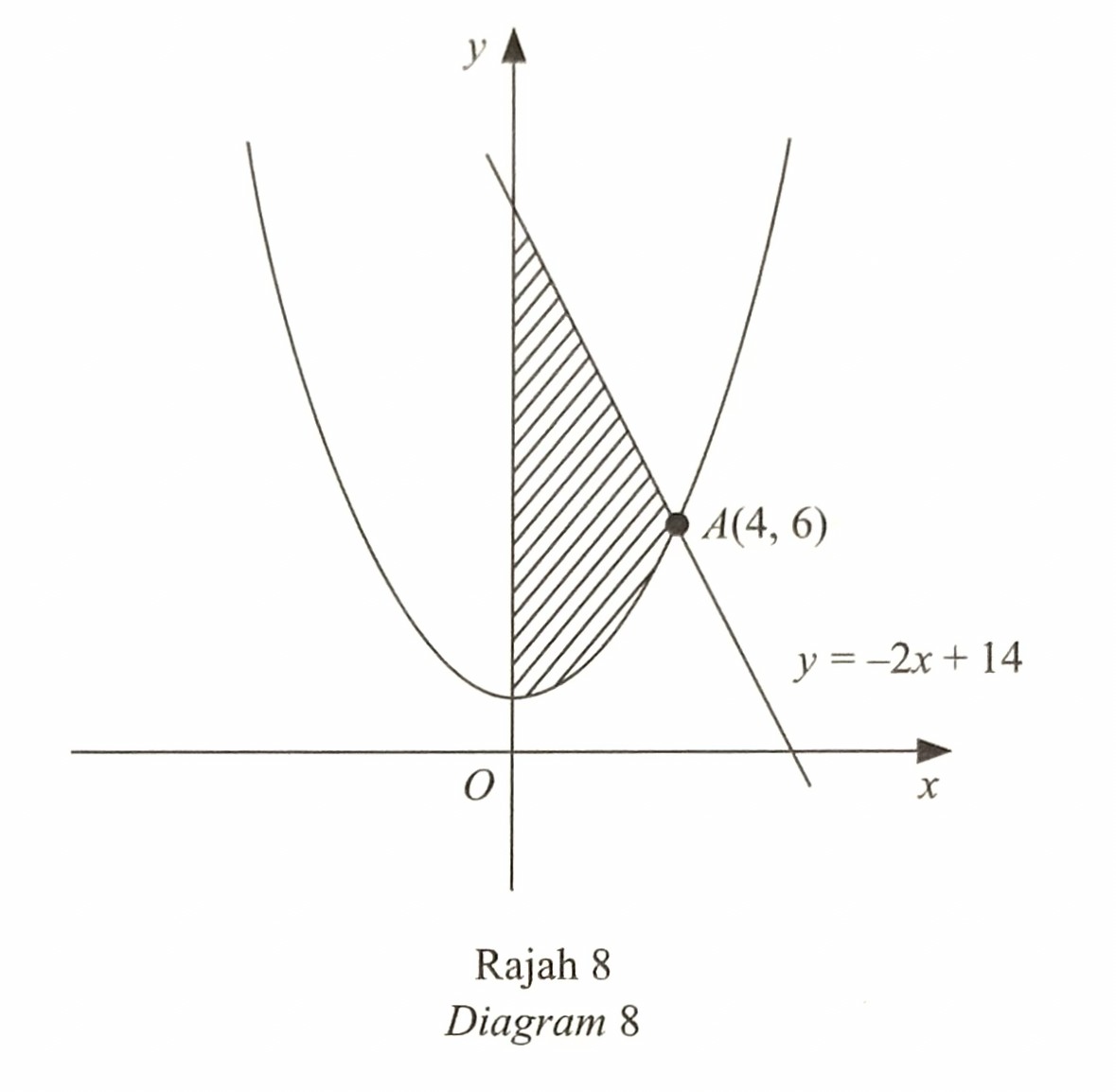 Given that the gradient function of the curve is x/2, find
(a) the equation of the curve, [3 marks]
(b) the area bounded by the curve, the straight line x = 4, the x-axis and the y-axis, [3 marks]
(c) the generated volume, in terms of π, when the shaded region is revolved through 360o about the y-axis. [4 marks]
Answer:
(a) $$ \begin{aligned} & \frac{\mathrm{d} y}{\mathrm{~d} x}=\frac{x}{2} \\ & y=\int \frac{x}{2} \mathrm{~d} x \\ & y=\frac{x^2}{(2)(2)}+c \\ & y=\frac{x^2}{4}+c, \quad \text { at A(4, 6) } \\ & 6=\frac{(4)^2}{4}+c \\ & 6=4+c \\ & c=2 \\ & \therefore y=\frac{1}{4} x^2+2 \end{aligned} $$
(b)
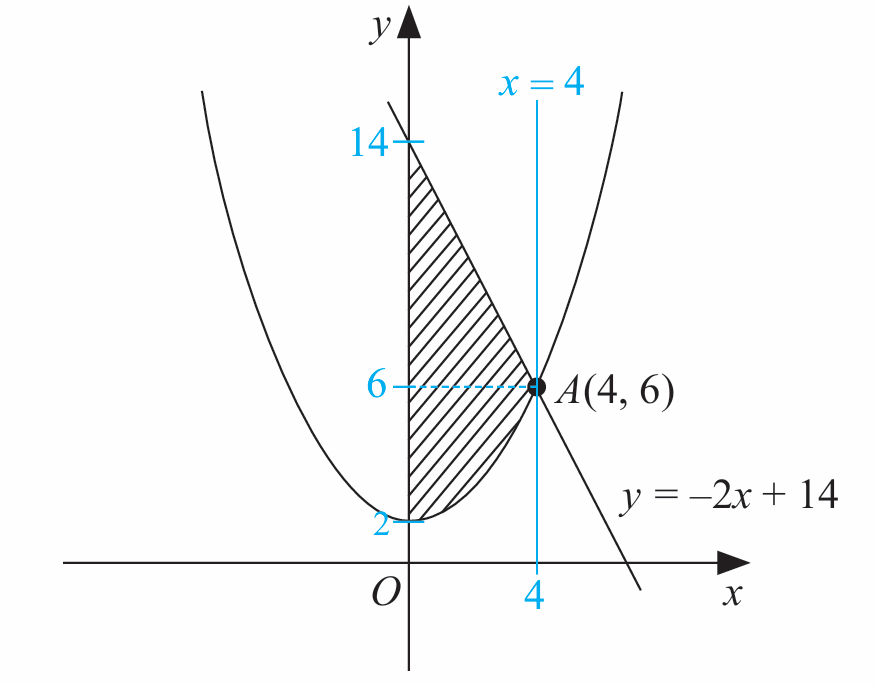
$$ \begin{aligned} \text { Area of the shaded region } & =\text { Area of trapezium }- \text { Area under the curve } \\ & =\frac{1}{2}(6+14)(4)-\int_0^4\left(\frac{1}{4} x^2+2\right) \mathrm{d} x \\ & =40-\left[\frac{x^3}{(3)(4)}+2 x\right]_0^4 \\ & =40-\left[\frac{x^3}{12}+2 x\right]_0^4 \\ & =40-\left[\left(\frac{4^3}{12}+2(4)\right)-\left(\frac{0^3}{12}+2(0)\right)\right] \\ & =40-\left(\frac{40}{3}-0\right) \\ & =\frac{80}{3} \text { unit }^2 \end{aligned} $$
(c) $$ \begin{aligned} y & =\frac{1}{4} x^2+2 \\ 4(y-2) & =x^2 \\ x^2 & =4 y-8 \end{aligned} $$
$$ \begin{aligned} &\text { Volume }\\ &\begin{aligned} & =V_{\text {cone }}+V_{y=2 \rightarrow 6} \\ & =\pi r^2 h+\pi \int_2^6 x^2 \mathrm{~d} y \\ & =\pi(4)^2(14-6)+\pi \int_2^6(4 y-8) \mathrm{d} y \\ & =128 \pi+\pi\left[\frac{4 y^2}{2}-8 y\right]_2^6 \\ & =128 \pi+\pi\left[2 y^2-8 y\right]_2^6 \\ & =128 \pi+\left[\left(2(6)^2-8(6)\right)-\left(2(2)^2-8(2)\right)\right] \pi \\ & =128 \pi+[24-(-8)] \pi \\ & =128 \pi+32 \pi \\ & =160 \pi \text { unit }^3 \end{aligned} \end{aligned} $$
Diagram 8 shows the curve y = f(x) intersects the straight line y = -2x + 14 at point A.
Given that the gradient function of the curve is x/2, find(a) the equation of the curve, [3 marks]
(b) the area bounded by the curve, the straight line x = 4, the x-axis and the y-axis, [3 marks]
(c) the generated volume, in terms of π, when the shaded region is revolved through 360o about the y-axis. [4 marks]
Answer:
(a) $$ \begin{aligned} & \frac{\mathrm{d} y}{\mathrm{~d} x}=\frac{x}{2} \\ & y=\int \frac{x}{2} \mathrm{~d} x \\ & y=\frac{x^2}{(2)(2)}+c \\ & y=\frac{x^2}{4}+c, \quad \text { at A(4, 6) } \\ & 6=\frac{(4)^2}{4}+c \\ & 6=4+c \\ & c=2 \\ & \therefore y=\frac{1}{4} x^2+2 \end{aligned} $$
(b)
$$ \begin{aligned} \text { Area of the shaded region } & =\text { Area of trapezium }- \text { Area under the curve } \\ & =\frac{1}{2}(6+14)(4)-\int_0^4\left(\frac{1}{4} x^2+2\right) \mathrm{d} x \\ & =40-\left[\frac{x^3}{(3)(4)}+2 x\right]_0^4 \\ & =40-\left[\frac{x^3}{12}+2 x\right]_0^4 \\ & =40-\left[\left(\frac{4^3}{12}+2(4)\right)-\left(\frac{0^3}{12}+2(0)\right)\right] \\ & =40-\left(\frac{40}{3}-0\right) \\ & =\frac{80}{3} \text { unit }^2 \end{aligned} $$
(c) $$ \begin{aligned} y & =\frac{1}{4} x^2+2 \\ 4(y-2) & =x^2 \\ x^2 & =4 y-8 \end{aligned} $$
$$ \begin{aligned} &\text { Volume }\\ &\begin{aligned} & =V_{\text {cone }}+V_{y=2 \rightarrow 6} \\ & =\pi r^2 h+\pi \int_2^6 x^2 \mathrm{~d} y \\ & =\pi(4)^2(14-6)+\pi \int_2^6(4 y-8) \mathrm{d} y \\ & =128 \pi+\pi\left[\frac{4 y^2}{2}-8 y\right]_2^6 \\ & =128 \pi+\pi\left[2 y^2-8 y\right]_2^6 \\ & =128 \pi+\left[\left(2(6)^2-8(6)\right)-\left(2(2)^2-8(2)\right)\right] \pi \\ & =128 \pi+[24-(-8)] \pi \\ & =128 \pi+32 \pi \\ & =160 \pi \text { unit }^3 \end{aligned} \end{aligned} $$