Question 5:
Solutions by scale drawing are not accepted.
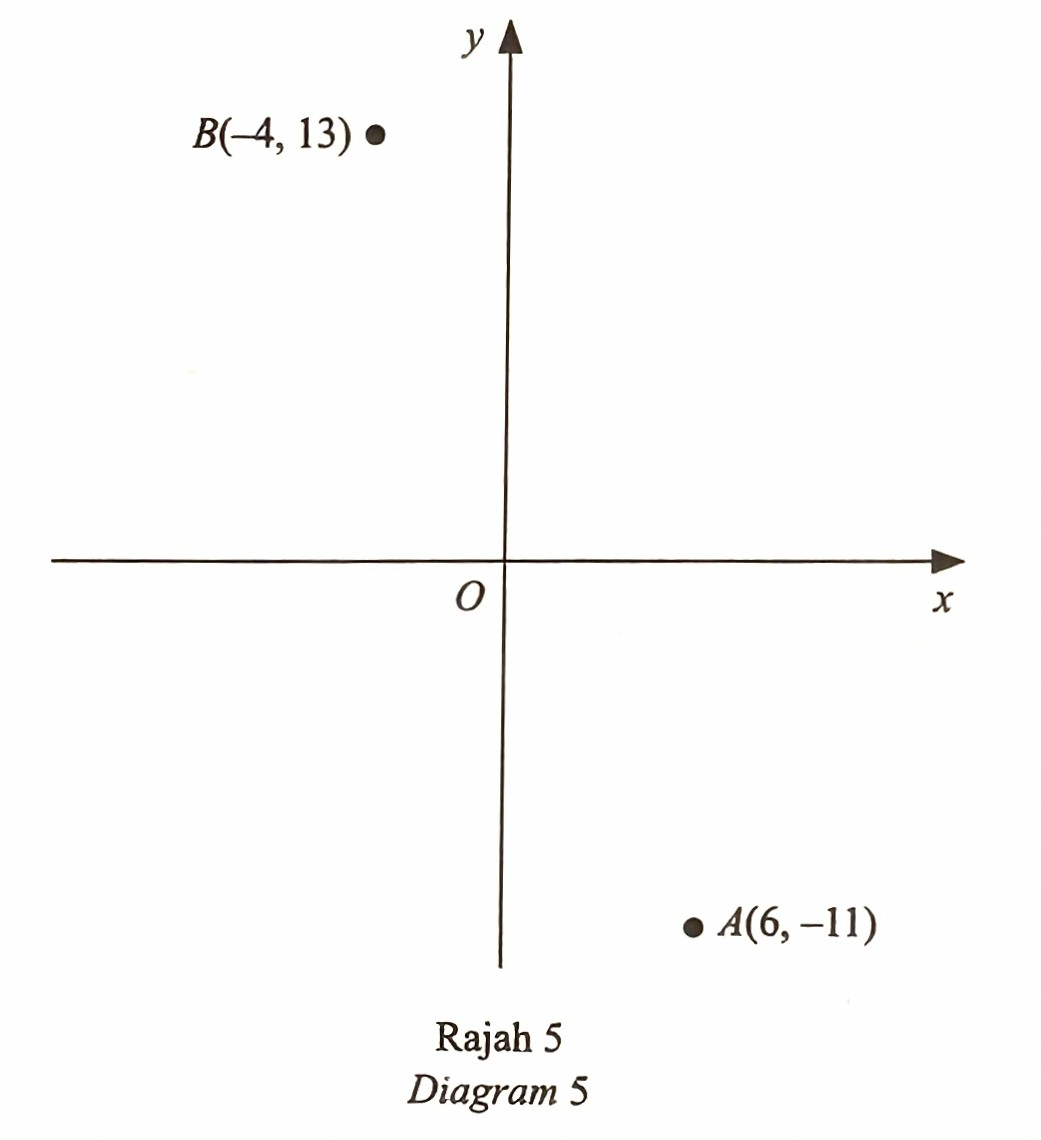
Diagram 5 shows two points on a Cartesian plane.
 (a) $$
\text { Determine } \overrightarrow{A B} \text {. }
$$
(a) $$
\text { Determine } \overrightarrow{A B} \text {. }
$$
[1 mark]
(b) $$ \text { Point } C \text { lies on the same Cartesian plane. } $$
$$ \text { It is given that } \overrightarrow{O C}=(m+2) \underline{i}+12 \underline{j} \text {, such that } m \text { is a constant. } $$
(i) $$ \text { If } \overleftrightarrow{O C} \text { is parallel to } \overrightarrow{A B} \text {, } $$
$$ \text { find the value of } m \text { by using vector’s arithmetic operations. } $$
(ii) $$ \text { Hence, determine the unit vector in the direction of } \overrightarrow{O C} \text {. } $$
$$ \text { State your answer in the form of column vector. } $$
[5 marks]
Answer:
(a)(i) $$ \begin{aligned} & \overrightarrow{A B}=\overrightarrow{A O}+\overrightarrow{O B} \\ & \overrightarrow{A B}=-\overrightarrow{O A}+\overrightarrow{O B} \\ & \overrightarrow{A B}=-(6 \underline{i}-11 \underline{j})+(-4 \underline{i}+13 \underline{j}) \\ & \overrightarrow{A B}=-6 \underline{i}+11 \underline{j}-4 \underline{i}+13 \underline{j} \\ & \overrightarrow{A B}=-10 \underline{i}+24 \underline{j} \end{aligned} $$
(b)(i) $$ \overrightarrow{O C} \| \overrightarrow{A B} $$
$$ \begin{aligned} \overrightarrow{O C} & =k \overrightarrow{A B} \\ (m+2) \underline{i}+12 \underline{j} & =k(-10 \underline{i}+24 \underline{j}) \\ (m+2) \underline{i}+12 \underline{j} & =-10 k \underline{i}+24 k \underline{j} \end{aligned} $$
$$ \begin{aligned} j: 24 k & =12 \\ k & =\frac{12}{24} \\ k & =\frac{1}{2} \end{aligned} $$
$$ \begin{aligned} \underline{i}: m+2 & =-10 k \\ m+2 & =-10\left(\frac{1}{2}\right) \\ m & =-5-2 \\ m & =-7 \end{aligned} $$
$$ \therefore m=-7 $$
(b)(ii) $$ \begin{aligned} & \overrightarrow{O C}=(-7+2) \underline{i}+12 \underline{j} \\ & \overrightarrow{O C}=-5 \underline{i}+12 \underline{j} \end{aligned} $$
$$ \text { unit vector } \stackrel{\rightharpoonup}{O C}=\frac{\stackrel{\rightharpoonup}{O C}}{|\stackrel{\rightharpoonup}{O C}|} $$
$$ \begin{aligned} & =\frac{-5 \underline{i}+12 \underline{j}}{\sqrt{(-5)^2+(12)^2}} \\ & =\frac{-5 \underline{i}+12 \underline{j}}{13} \\ & =\binom{-\frac{5}{13}}{\frac{12}{13}} \end{aligned} $$
Solutions by scale drawing are not accepted.
Diagram 5 shows two points on a Cartesian plane.
(a) $$
\text { Determine } \overrightarrow{A B} \text {. }
$$[1 mark]
(b) $$ \text { Point } C \text { lies on the same Cartesian plane. } $$
$$ \text { It is given that } \overrightarrow{O C}=(m+2) \underline{i}+12 \underline{j} \text {, such that } m \text { is a constant. } $$
(i) $$ \text { If } \overleftrightarrow{O C} \text { is parallel to } \overrightarrow{A B} \text {, } $$
$$ \text { find the value of } m \text { by using vector’s arithmetic operations. } $$
(ii) $$ \text { Hence, determine the unit vector in the direction of } \overrightarrow{O C} \text {. } $$
$$ \text { State your answer in the form of column vector. } $$
[5 marks]
Answer:
(a)(i) $$ \begin{aligned} & \overrightarrow{A B}=\overrightarrow{A O}+\overrightarrow{O B} \\ & \overrightarrow{A B}=-\overrightarrow{O A}+\overrightarrow{O B} \\ & \overrightarrow{A B}=-(6 \underline{i}-11 \underline{j})+(-4 \underline{i}+13 \underline{j}) \\ & \overrightarrow{A B}=-6 \underline{i}+11 \underline{j}-4 \underline{i}+13 \underline{j} \\ & \overrightarrow{A B}=-10 \underline{i}+24 \underline{j} \end{aligned} $$
(b)(i) $$ \overrightarrow{O C} \| \overrightarrow{A B} $$
$$ \begin{aligned} \overrightarrow{O C} & =k \overrightarrow{A B} \\ (m+2) \underline{i}+12 \underline{j} & =k(-10 \underline{i}+24 \underline{j}) \\ (m+2) \underline{i}+12 \underline{j} & =-10 k \underline{i}+24 k \underline{j} \end{aligned} $$
$$ \begin{aligned} j: 24 k & =12 \\ k & =\frac{12}{24} \\ k & =\frac{1}{2} \end{aligned} $$
$$ \begin{aligned} \underline{i}: m+2 & =-10 k \\ m+2 & =-10\left(\frac{1}{2}\right) \\ m & =-5-2 \\ m & =-7 \end{aligned} $$
$$ \therefore m=-7 $$
(b)(ii) $$ \begin{aligned} & \overrightarrow{O C}=(-7+2) \underline{i}+12 \underline{j} \\ & \overrightarrow{O C}=-5 \underline{i}+12 \underline{j} \end{aligned} $$
$$ \text { unit vector } \stackrel{\rightharpoonup}{O C}=\frac{\stackrel{\rightharpoonup}{O C}}{|\stackrel{\rightharpoonup}{O C}|} $$
$$ \begin{aligned} & =\frac{-5 \underline{i}+12 \underline{j}}{\sqrt{(-5)^2+(12)^2}} \\ & =\frac{-5 \underline{i}+12 \underline{j}}{13} \\ & =\binom{-\frac{5}{13}}{\frac{12}{13}} \end{aligned} $$
Question 6:
Wan has a set of ten identical rectangular cards for a children’s game. These cards can be arranged as shown in Diagram 6.
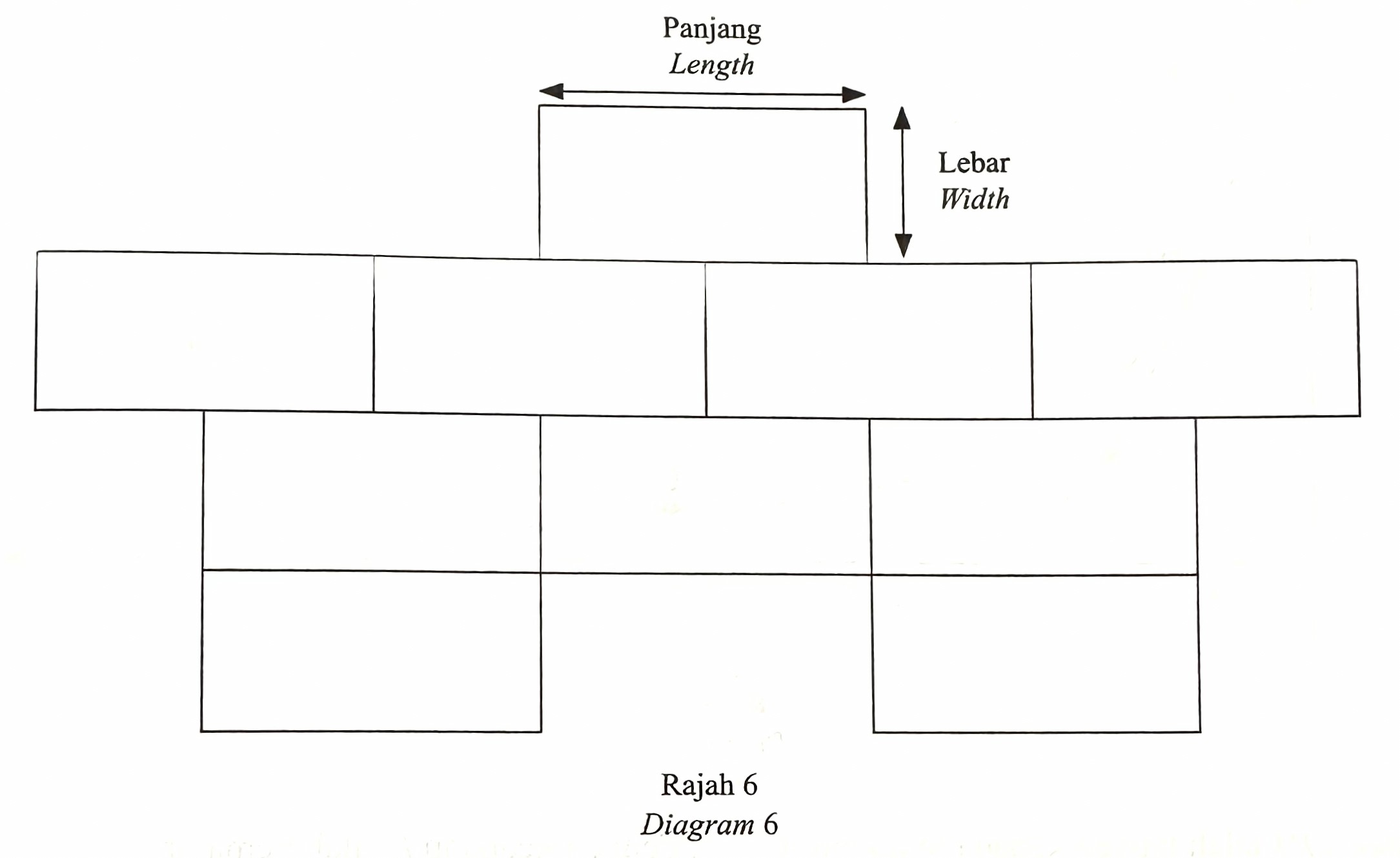
It is given that the perimeter of the arrangement is 81 cm and the area of each card is 17.5 cm2.
(a) Find the length, in cm, and the width, in cm, of one card.
(b) Wan wants to make another ten identical cards.
Is it possible for Wan to cut exactly ten cards from a piece of cardboard measuring 17 cm × 11 cm? Justify your answer.
[8 marks]
Answer:
(a)
$$ \text { Let } x=\text { length, } y=\text { width } $$
$$ \begin{aligned} \text { Perimeter } & =8 x+10 y \\ 81 & =8 x+10 y \\ 10 y & =81-8 x \\ y & =\frac{81}{10}-\frac{8}{10} x \\ y & =8.1-0.8 x \ldots (1) \end{aligned} $$
$$ \begin{aligned} \text { Area } & =x y \\ x(8.1-0.8 x) & =17.5 \\ 8.1 x-0.8 x^2-17.5 & =0 \\ -0.8 x^2+8.1 x-17.5 & =0 \\ 8 x^2-81 x+175 & =0 \\ (8 x-25)(x-7) & =0 \end{aligned} $$
$$ \begin{aligned} 8 x-25 & =0 & , \quad x-7 & =0 \\ x & =\frac{25}{8} & x & =7 \end{aligned} $$
$$ \text { From (1), } $$
$$ \text { When } x=\frac{25}{8}, \quad \begin{aligned} & y=8.1-0.8\left(\frac{25}{8}\right) \\ & y=5.6 \text { (ignore) } \end{aligned} $$
$$ \begin{array}{ll} \text { When } x=7, & y=8.1-0.8(7) \\ & y=2.5 \end{array} $$
Based on the diagram, x > y.
∴ Length = 7 cm
Width = 2.5 cm
(b)
$$ \text { Check dimension: } $$
$$ 17 \mathrm{~cm} \text { sides } \rightarrow 17 \mathrm{~cm} \div 7 \mathrm{~cm}=2.4 \text { cards } $$
$$ 11 \mathrm{~cm} \text { sides } \rightarrow 11 \mathrm{~cm} \div 2.5 \mathrm{~cm}=4.4 \text { cards } $$
$$ 2 \times 4=8 \mathrm{cards} $$
Case 1: Horizontally
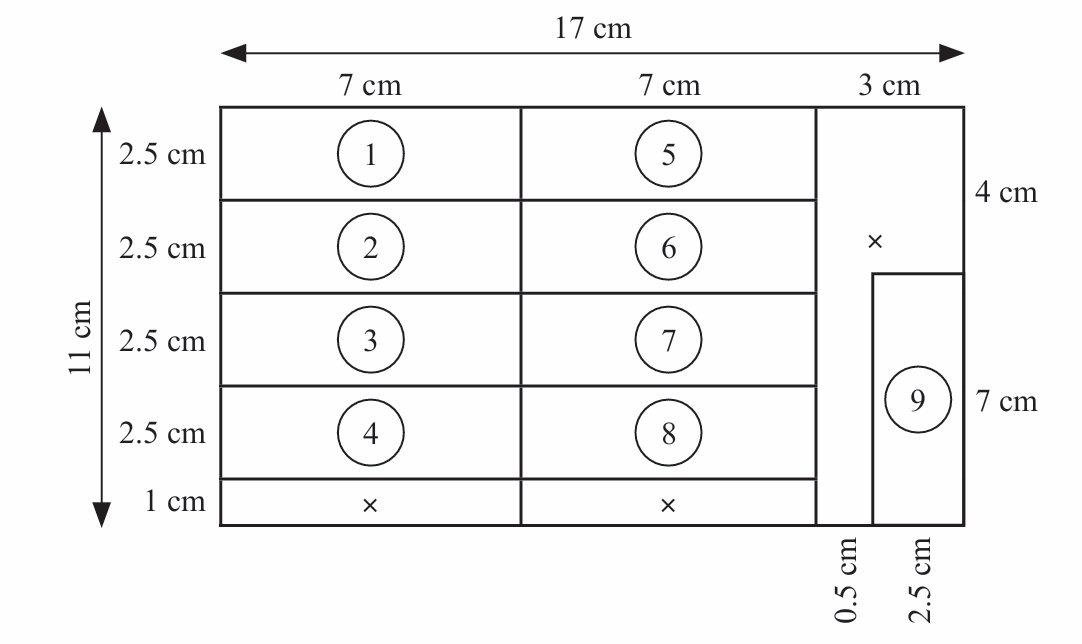
Horizontally, 8 identically cards can be obtained. When rotated, another card can be cut using the remaining dimension (3 cm × 11 cm) of the cardboard as shown in the diagram. It can fit maximum of 9 cards.
Case 2: Vertically
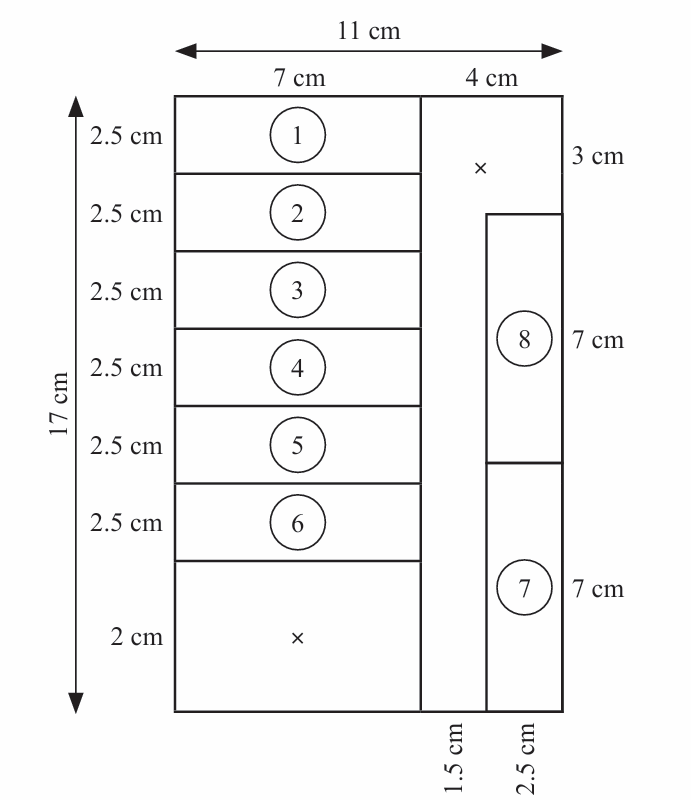
Vertically, 6 identical cards can be obtained. However, another 2 cards can be obtained using the remaining cardboard, as shown. It can fit maximum of 8 cards.
∴ Thus, Wan cannot get exactly 10 cards from the 17 cm × 11 cm cardboard.
Wan has a set of ten identical rectangular cards for a children’s game. These cards can be arranged as shown in Diagram 6.
It is given that the perimeter of the arrangement is 81 cm and the area of each card is 17.5 cm2.
(a) Find the length, in cm, and the width, in cm, of one card.
(b) Wan wants to make another ten identical cards.
Is it possible for Wan to cut exactly ten cards from a piece of cardboard measuring 17 cm × 11 cm? Justify your answer.
[8 marks]
Answer:
(a)
$$ \text { Let } x=\text { length, } y=\text { width } $$
$$ \begin{aligned} \text { Perimeter } & =8 x+10 y \\ 81 & =8 x+10 y \\ 10 y & =81-8 x \\ y & =\frac{81}{10}-\frac{8}{10} x \\ y & =8.1-0.8 x \ldots (1) \end{aligned} $$
$$ \begin{aligned} \text { Area } & =x y \\ x(8.1-0.8 x) & =17.5 \\ 8.1 x-0.8 x^2-17.5 & =0 \\ -0.8 x^2+8.1 x-17.5 & =0 \\ 8 x^2-81 x+175 & =0 \\ (8 x-25)(x-7) & =0 \end{aligned} $$
$$ \begin{aligned} 8 x-25 & =0 & , \quad x-7 & =0 \\ x & =\frac{25}{8} & x & =7 \end{aligned} $$
$$ \text { From (1), } $$
$$ \text { When } x=\frac{25}{8}, \quad \begin{aligned} & y=8.1-0.8\left(\frac{25}{8}\right) \\ & y=5.6 \text { (ignore) } \end{aligned} $$
$$ \begin{array}{ll} \text { When } x=7, & y=8.1-0.8(7) \\ & y=2.5 \end{array} $$
Based on the diagram, x > y.
∴ Length = 7 cm
Width = 2.5 cm
(b)
$$ \text { Check dimension: } $$
$$ 17 \mathrm{~cm} \text { sides } \rightarrow 17 \mathrm{~cm} \div 7 \mathrm{~cm}=2.4 \text { cards } $$
$$ 11 \mathrm{~cm} \text { sides } \rightarrow 11 \mathrm{~cm} \div 2.5 \mathrm{~cm}=4.4 \text { cards } $$
$$ 2 \times 4=8 \mathrm{cards} $$
Case 1: Horizontally
Horizontally, 8 identically cards can be obtained. When rotated, another card can be cut using the remaining dimension (3 cm × 11 cm) of the cardboard as shown in the diagram. It can fit maximum of 9 cards.
Case 2: Vertically
Vertically, 6 identical cards can be obtained. However, another 2 cards can be obtained using the remaining cardboard, as shown. It can fit maximum of 8 cards.
∴ Thus, Wan cannot get exactly 10 cards from the 17 cm × 11 cm cardboard.