Question 1:
$$ \text { Functions } f \text { and } g \text { are defined as } $$
$$ f: x \mapsto 1-2 x \text { dan } g: x \mapsto x^2-3 . $$
(a) Determine whether g-1(x) is a function or not.
Give a reason for your answer.
[2 marks]
(b) Find
(i) $$ h(x) \text {, if } f^{-1} h(x)=g(x) \text {, } $$
(ii) $$ \text { the value of } x \text {, if } g f^{-1}(x)=1 \text {. } $$
[5 marks]
Answer:
(a) $$ g^{-1}(x)= \pm \sqrt{x+3} $$
No. Function g does not have inverse.
(b)(i) $$ \begin{aligned} h(x) & =f g(x) \\ & =1-2\left(x^2-3\right) \\ & =7-2 x^2 \end{aligned} $$
(b)(ii) $$ \begin{aligned} f^{-1}(x) & =\frac{1-x}{2} \\ \left(\frac{1-x}{2}\right)^2-3 & =1 \\ (1-x)^2 & =16 \\ 1-x & = \pm 4 \\ x & =-3,5 \end{aligned} $$
Question 2:
Solution by scale drawing is not accepted.
Diagram 1 shows two straight lines. The equation of the straight line RS is y + 2x + 3 = 0.
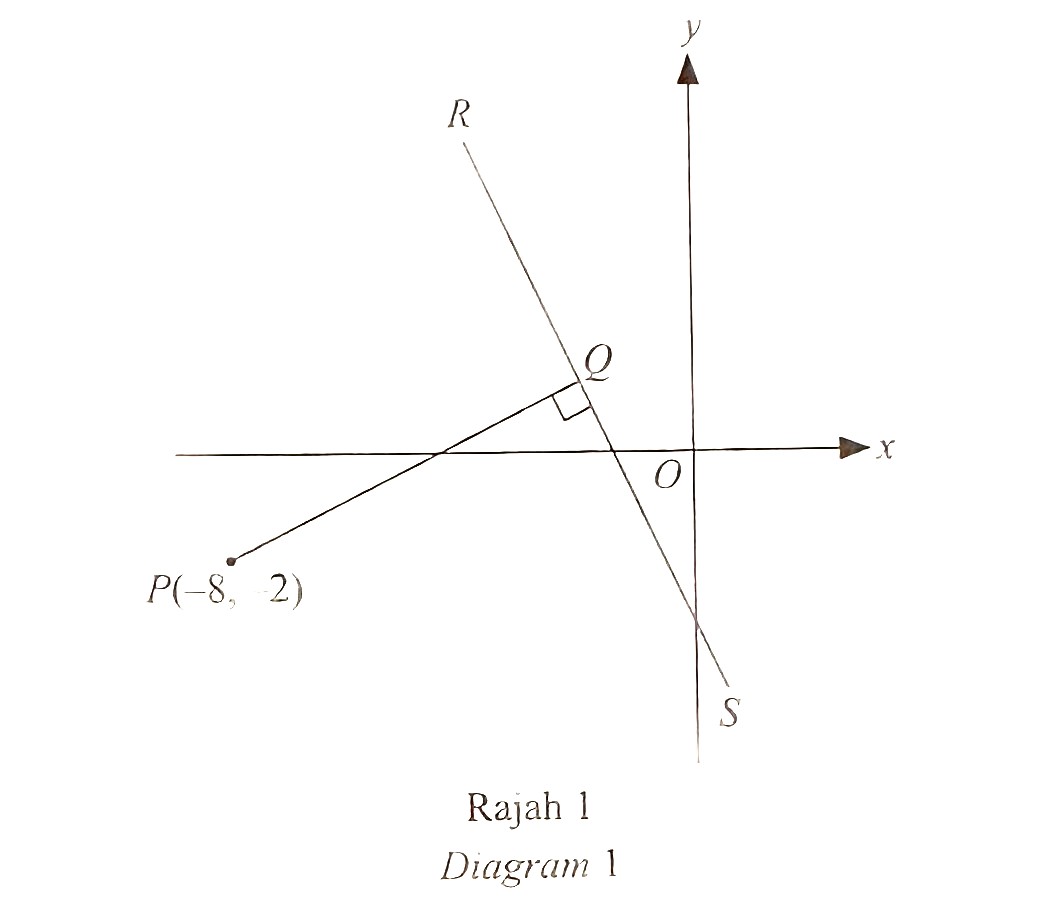 (a) Find
(i) the equation of the straight line PQ,
(ii) the coordinates of Q.
[5 marks]
(b) The straight line PQ is extended to point T, such that PQ : QT = 3 : 2.
Find the coordinates of T.
[2 marks]
Answer:
(a)(i) $$ \begin{aligned} &\begin{aligned} -2 m & =-1 \\ m & =\frac{1}{2} \end{aligned}\\ &\begin{aligned} y-(-2) & =\frac{1}{2}(x+8) \\ y & =\frac{1}{2} x+2 \end{aligned} \end{aligned} $$
(a)(ii) $$ \begin{aligned} &\begin{aligned} \frac{1}{2} x+2 & =-2 x-3 \\ \frac{5}{2} x & =-5 \\ x & =-2 \end{aligned}\\ &\begin{aligned} y & =-2(-2)-3 \\ & =1 \end{aligned}\\ &\therefore Q(-2,1) \end{aligned} $$
(b) $$ (-2,1)=\left[\frac{2(-8)+3(x)}{2+3}, \frac{2(-2)+3(y)}{2+3}\right] $$
$$ \begin{aligned} &\begin{aligned} \frac{-16+3 x}{5} & =-2 \\ x & =2 \end{aligned}\\ &\begin{aligned} \frac{-4+3 y}{5} & =1 \\ y & =3 \end{aligned}\\ &\therefore T(2,3) \end{aligned} $$
Solution by scale drawing is not accepted.
Diagram 1 shows two straight lines. The equation of the straight line RS is y + 2x + 3 = 0.
(a) Find(i) the equation of the straight line PQ,
(ii) the coordinates of Q.
[5 marks]
(b) The straight line PQ is extended to point T, such that PQ : QT = 3 : 2.
Find the coordinates of T.
[2 marks]
Answer:
(a)(i) $$ \begin{aligned} &\begin{aligned} -2 m & =-1 \\ m & =\frac{1}{2} \end{aligned}\\ &\begin{aligned} y-(-2) & =\frac{1}{2}(x+8) \\ y & =\frac{1}{2} x+2 \end{aligned} \end{aligned} $$
(a)(ii) $$ \begin{aligned} &\begin{aligned} \frac{1}{2} x+2 & =-2 x-3 \\ \frac{5}{2} x & =-5 \\ x & =-2 \end{aligned}\\ &\begin{aligned} y & =-2(-2)-3 \\ & =1 \end{aligned}\\ &\therefore Q(-2,1) \end{aligned} $$
(b) $$ (-2,1)=\left[\frac{2(-8)+3(x)}{2+3}, \frac{2(-2)+3(y)}{2+3}\right] $$
$$ \begin{aligned} &\begin{aligned} \frac{-16+3 x}{5} & =-2 \\ x & =2 \end{aligned}\\ &\begin{aligned} \frac{-4+3 y}{5} & =1 \\ y & =3 \end{aligned}\\ &\therefore T(2,3) \end{aligned} $$
Question 3:
A quadratic function is given by f(x) = 2x2 – 5x + p, such that p is a constant.
(a) The roots of the quadratic equation when f(x) = 0 are α and β.
Form a quadratic equation which has roots 2α – 1 and 2β – 1 in terms of p. [3 marks]
(b) Given that the straight line y = x + 1 touches the curve y = f(x), find the value of p. [3 marks]
Answer:
(a) $$ \begin{aligned} & \frac{5}{2}=\alpha+\beta \\ & \frac{p}{2}=\alpha \beta \end{aligned} $$
$$ \begin{aligned} 2 \alpha-1+2 \beta-1 & =2(\alpha+\beta)-2 \\ & =2\left(\frac{5}{2}\right)-2 \\ & =3 \end{aligned} $$
$$ \begin{aligned} (2 \alpha-1)(2 \beta-1) & =4 \alpha \beta-2(\alpha+\beta)+1 \\ & =4\left(\frac{p}{2}\right)-2\left(\frac{5}{2}\right)+1 \\ & =2 p-4 \end{aligned} $$
$$ \begin{aligned} x^2-(3) x+(2 p-4) & =0 \\ x^2-3 x+2 p-4 & =0 \end{aligned} $$
(b) $$ \begin{aligned} &\begin{aligned} 2 x^2-5 x+p & =x+1 \\ 2 x^2-6 x+p-1 & =0 \end{aligned}\\ &\begin{aligned} (-6)^2-4(2)(p-1) & =0 \\ 36-8 p+8 & =0 \\ p & =\frac{44}{8} \\ p & =\frac{11}{2} \end{aligned} \end{aligned} $$
Question 4:
In a geometric progression, the sum of first four terms is 16 times the sum of the next four terms.
(a) Show that the common ratio, r, of the progression is ½. [3 marks]
(b) It is given that the different between the 4th term and the 8th term of the progression is 120.
Find
(i) the first term of the progression,
(ii) the sum to infinity of the progression.
[4 marks]
Answer:
(a) $$ S_4=16\left(S_8-S_4\right) $$
$$ \begin{aligned} \frac{a\left(r^4-1\right)}{r-1} & =16\left[\frac{a\left(r^8-1\right)}{r-1}-\frac{a\left(r^4-1\right)}{r-1}\right] \\ {\left[\frac{a\left(r^4-1\right)}{r-1}\right] \times \frac{(r-1)}{a} } & =16\left[\frac{a\left(r^8-1\right)}{r-1}-\frac{a\left(r^4-1\right)}{r-1}\right] \times \frac{(r-1)}{a} \\ r^4-1 & =16 r^8-16 r^4 \\ r^4-1 & =16 r^8-16 r^4 \\ 16 r^8-17 r^4+1 & =0 \end{aligned} $$
$$ \begin{aligned} &\text { Let } x=r^4 \text {, }\\ &\begin{aligned} & 16 x^2-17 x+1=0 \\ & (x-1)(16 x-1)=0 \\ & x=r^4=1 \\ & \quad r= \pm 1 \text { (Impossible) } \end{aligned} \end{aligned} $$
$$ \begin{aligned} x=r^4 & =\frac{1}{16} \\ r & = \pm \frac{1}{2}(\text { Ignore negative }) \\ r & =\frac{1}{2} \end{aligned} $$
(b)(i) $$ \begin{aligned} T_8-T_4 & =120 \\ a r^7-a r^3 & =120 \\ a\left(\frac{1}{2}\right)^7-a\left(\frac{1}{2}\right)^3 & =120 \\ \frac{-15}{128} a & =120 \\ a & =\frac{120}{-\frac{15}{128}} \\ a & =-1024 \end{aligned} $$
(b)(ii) $$ \begin{aligned} S_{\infty} & =\frac{-1024}{1-\left(\frac{1}{2}\right)} \\ & =-2048 \end{aligned} $$