
Question 3:
Diagram 3 shows the relation of three sets.
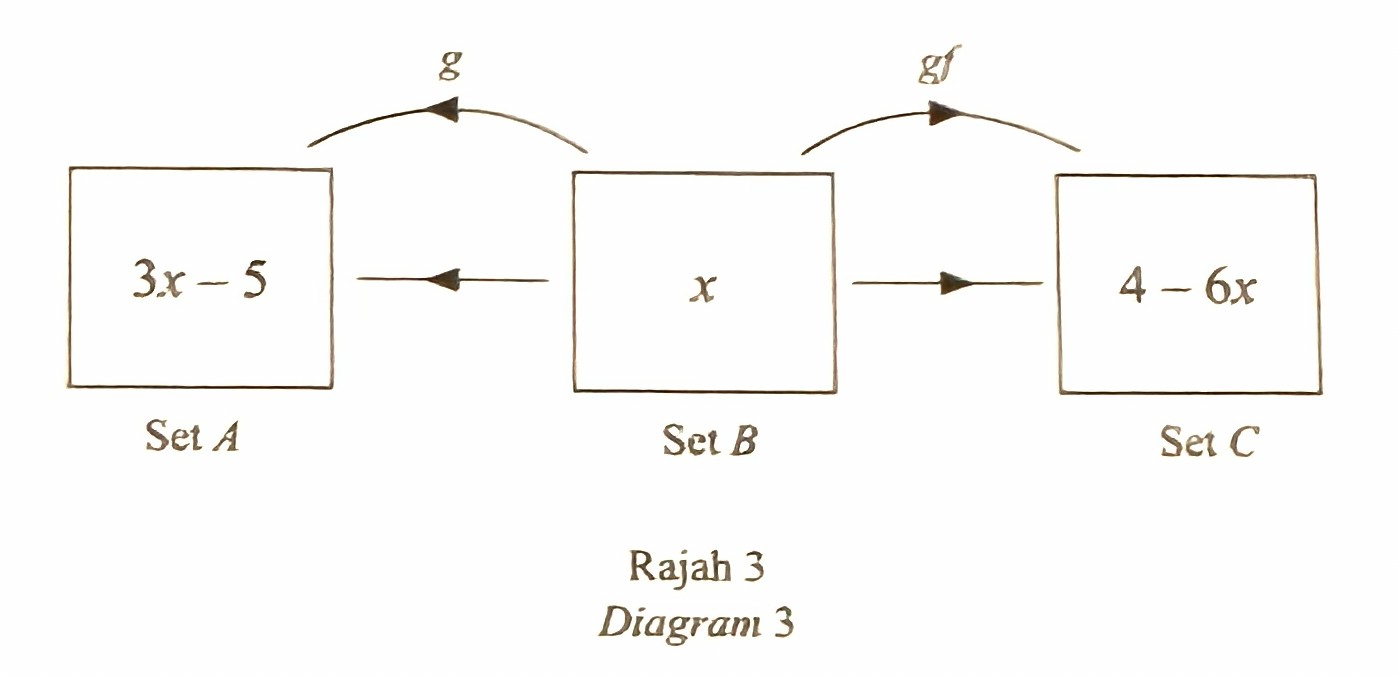 (a) Determine gf(2). [1 mark]
(b) Without finding g-1(x), determine f(x). [2 marks]
(c) From answer in (b),
(i) find f-1(x),
(ii) hence, determine the value of x if f-1g(x) = 4gf(2). [3 marks]
Answer:
(a) $$ \begin{aligned} g f(x) & =4-6 x \\ g f(2) & =4-6(2) \\ g f(2) & =-8 \end{aligned} $$
(b) $$ \begin{aligned} g f(x) & =4-6 x \\ g[f(x)] & =4-6 x \\ 3 f(x)-5 & =4-6 x \\ 3 f(x) & =9-6 x \\ f(x) & =3-2 x \end{aligned} $$
(c)(i) $$ \begin{aligned} &\text { Let } 3-2 x=y\\ &\begin{aligned} x & =\frac{3-y}{2} \\ f^{-1}(y) & =\frac{3-y}{2} \end{aligned}\\ &\therefore f^{-1}(x)=\frac{3-x}{2} \end{aligned} $$
(c)(ii) $$ \begin{aligned} f^{-1} g(x) & =4 g f(2) \\ f^{-1}(3 x-5) & =4(-8) \\ \frac{3-(3 x-5)}{2} & =-32 \\ \frac{3-3 x+5}{3} & =-64 \\ -3 x & =-72 \\ x & =24 \end{aligned} $$
Diagram 3 shows the relation of three sets.
(a) Determine gf(2). [1 mark](b) Without finding g-1(x), determine f(x). [2 marks]
(c) From answer in (b),
(i) find f-1(x),
(ii) hence, determine the value of x if f-1g(x) = 4gf(2). [3 marks]
Answer:
(a) $$ \begin{aligned} g f(x) & =4-6 x \\ g f(2) & =4-6(2) \\ g f(2) & =-8 \end{aligned} $$
(b) $$ \begin{aligned} g f(x) & =4-6 x \\ g[f(x)] & =4-6 x \\ 3 f(x)-5 & =4-6 x \\ 3 f(x) & =9-6 x \\ f(x) & =3-2 x \end{aligned} $$
(c)(i) $$ \begin{aligned} &\text { Let } 3-2 x=y\\ &\begin{aligned} x & =\frac{3-y}{2} \\ f^{-1}(y) & =\frac{3-y}{2} \end{aligned}\\ &\therefore f^{-1}(x)=\frac{3-x}{2} \end{aligned} $$
(c)(ii) $$ \begin{aligned} f^{-1} g(x) & =4 g f(2) \\ f^{-1}(3 x-5) & =4(-8) \\ \frac{3-(3 x-5)}{2} & =-32 \\ \frac{3-3 x+5}{3} & =-64 \\ -3 x & =-72 \\ x & =24 \end{aligned} $$
Question 4:
Listing out all terms of the sequence is not accepted for this question.
Diagram 4 shows part of a pattern that is made from an infinite number of semicircles on a straight line whose diameters form a geometric progression.
 As more semicircles are added to the pattern, the total length of the diameters approaches 38 cm . The common ratio of the geometric progression of the diameter of the semicircle is 4/5.
(a) Find
(i) the diameter, in cm, of the first semicircle,
(ii) the arc length, in cm , of the 8th semicircle in terms of π.
[4 marks]
(b) Given that the sum of the area of the first n blue semicircles is less than 12π cm2, find the value of n. [4 marks]
Answer:
(a)(i) $$ \begin{aligned} G P: r & =\frac{4}{5}=0.8, S_{\infty}=38 \mathrm{~cm} \\ S_{\infty} & =38 \mathrm{~cm} \\ \frac{a}{1-0.8} & =38 \\ \frac{a}{0.2} & =38 \\ a & =7.6 \mathrm{~cm} \end{aligned} $$
Diameter of the first semicircle = 7.6 cm
(a)(ii) $$ \begin{aligned} \text { Diameter of the 8th semicircle } , T_8 & =(7.6)(0.8)^7 \mathrm{~cm} \\ \ =1.5938 \mathrm{~cm} \end{aligned} $$
$$ \begin{aligned} & \text { Radius of the 8th semicircle } =1.5938 \div 2 \mathrm{~cm} \\ &=0.7969 \mathrm{~cm} \end{aligned} $$
$$ \begin{aligned} \text { Arc length } & =\frac{1}{2}(2 \pi r) \\ & =\pi(0.7969 \mathrm{~cm}) \\ & =0.7969 \pi \mathrm{~cm} \end{aligned} $$
(b) Blue semicircles: 1st, 3rd, 5th, …
$$ \begin{aligned} \text { New geometric progression: } r & =\left(\frac{4}{5}\right)^2 \\ =\frac{16}{25} \\ & =0.64 \end{aligned} $$
$$ \begin{aligned} \text { Radius of the first semicircle } & =7.6 \mathrm{~cm} \div 2 \\ =3.8 \mathrm{~cm} \end{aligned} $$
$$ \begin{aligned} \text { Area of the first semicircle } & =\frac{1}{2}(\pi)(3.8)^2 \\ =7.22 \pi \mathrm{~cm}^2 \end{aligned} $$
$$ \begin{aligned} S_n & <12 \pi \\ \frac{7.22 \pi\left[1-(0.64)^n\right]}{1-0.64} & <12 \pi \\ 1-(0.64)^n & <\frac{12 \pi(0.36)}{7.22 \pi} \\ 1-(0.64)^n & <0.5983 \\ 1-0.5983 & <(0.64)^n \\ 0.4017 & <(0.64)^n \end{aligned} $$
log10(0.4017) < nlog10(0.64)
-0.3961 < n(-0.1938)
$$ \frac{-0.3961}{-0.1938}>n $$
n < 2.0439
∴ n = 2
Listing out all terms of the sequence is not accepted for this question.
Diagram 4 shows part of a pattern that is made from an infinite number of semicircles on a straight line whose diameters form a geometric progression.
As more semicircles are added to the pattern, the total length of the diameters approaches 38 cm . The common ratio of the geometric progression of the diameter of the semicircle is 4/5.(a) Find
(i) the diameter, in cm, of the first semicircle,
(ii) the arc length, in cm , of the 8th semicircle in terms of π.
[4 marks]
(b) Given that the sum of the area of the first n blue semicircles is less than 12π cm2, find the value of n. [4 marks]
Answer:
(a)(i) $$ \begin{aligned} G P: r & =\frac{4}{5}=0.8, S_{\infty}=38 \mathrm{~cm} \\ S_{\infty} & =38 \mathrm{~cm} \\ \frac{a}{1-0.8} & =38 \\ \frac{a}{0.2} & =38 \\ a & =7.6 \mathrm{~cm} \end{aligned} $$
Diameter of the first semicircle = 7.6 cm
(a)(ii) $$ \begin{aligned} \text { Diameter of the 8th semicircle } , T_8 & =(7.6)(0.8)^7 \mathrm{~cm} \\ \ =1.5938 \mathrm{~cm} \end{aligned} $$
$$ \begin{aligned} & \text { Radius of the 8th semicircle } =1.5938 \div 2 \mathrm{~cm} \\ &=0.7969 \mathrm{~cm} \end{aligned} $$
$$ \begin{aligned} \text { Arc length } & =\frac{1}{2}(2 \pi r) \\ & =\pi(0.7969 \mathrm{~cm}) \\ & =0.7969 \pi \mathrm{~cm} \end{aligned} $$
(b) Blue semicircles: 1st, 3rd, 5th, …
$$ \begin{aligned} \text { New geometric progression: } r & =\left(\frac{4}{5}\right)^2 \\ =\frac{16}{25} \\ & =0.64 \end{aligned} $$
$$ \begin{aligned} \text { Radius of the first semicircle } & =7.6 \mathrm{~cm} \div 2 \\ =3.8 \mathrm{~cm} \end{aligned} $$
$$ \begin{aligned} \text { Area of the first semicircle } & =\frac{1}{2}(\pi)(3.8)^2 \\ =7.22 \pi \mathrm{~cm}^2 \end{aligned} $$
$$ \begin{aligned} S_n & <12 \pi \\ \frac{7.22 \pi\left[1-(0.64)^n\right]}{1-0.64} & <12 \pi \\ 1-(0.64)^n & <\frac{12 \pi(0.36)}{7.22 \pi} \\ 1-(0.64)^n & <0.5983 \\ 1-0.5983 & <(0.64)^n \\ 0.4017 & <(0.64)^n \end{aligned} $$
log10(0.4017) < nlog10(0.64)
-0.3961 < n(-0.1938)
$$ \frac{-0.3961}{-0.1938}>n $$
n < 2.0439
∴ n = 2