
Question 1:
The graph of quadratic function f(x) = x2 – 2x + 6 – m intersects the x-axis at points A and B, such that m is a constant.
(a) Find the range of values of m. [2 marks]
(b)(i) If m = 6, find the range of values of x for f(x) > 8 by using the number line method.
(ii) It is given that A(h, 0) and B(k, 0), such that h and k are constants.
If f(x) = 0, find a quadratic equation in terms of m which has roots h + k + 1 and hk – 1.
[5 marks]
Answer:
(a) f(x) intersects at two points = two different roots
$$ \begin{aligned} b^2-4 a c & >0 \\ (-2)^2-4(1)(6-m) & >0 \\ 4-24+4 m & >0 \\ -20+4 m & >0 \\ 4 m & >20 \\ m & >\frac{20}{4} \\ m & >5 \end{aligned} $$
(b)(i) $$ \begin{aligned} m=6 \rightarrow f(x) & =x^2-2 x+6-6 \\ & =x^2-2 x \end{aligned} $$
$$ \begin{aligned} f(x) & >8 \\ x^2-2 x & >8 \\ x^2-2 x-8 & >0 \\ (x-4)(x+2) & >0 \end{aligned} $$
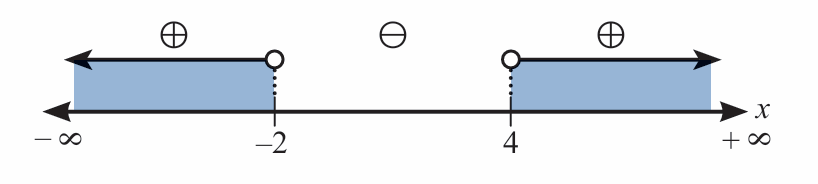 $$
\therefore x<-2 \text { or } x>4
$$
$$
\therefore x<-2 \text { or } x>4
$$
(b)(ii)
$$ \begin{aligned} &\begin{aligned} f(x) & =0 \\ x^2-2 x+6-m & =0 \end{aligned}\\ &\text { Roots: } h, k \end{aligned} $$
$$ \begin{aligned} &\text { SOR: }\\ &\begin{aligned} & h+k=-\left(-\frac{2}{1}\right) \\ & h+k=2 \end{aligned}\\ &\begin{aligned} \mathrm{POR} : h \times k & =\left(\frac{6-m}{1}\right) \\ h k & =6-m \end{aligned} \end{aligned} $$
$$ \text { New roots: } h+k+1, h k-1 $$
$$ \begin{aligned} &\text { New SOR: }\\ &\begin{aligned} (h+k+1)+(h k-1) & =h+k+1+h k-1 \\ & =h+k+h k \\ & =2+(6-m) \\ & =8-m \end{aligned} \end{aligned} $$
$$ \begin{aligned} &\text { New POR: }\\ &\begin{aligned} (h+k+1)(h k-1) & =(2+1)(6-m-1) \\ & =3(5-m) \\ & =15-3 m \end{aligned} \end{aligned} $$
$$ \begin{aligned} &\text { New equation: }\\ &\begin{array}{r} x^2-(8-m) x+(15-3 m)=0 \\ x^2-(8-m) x+15-3 m=0 \end{array} \end{aligned} $$
The graph of quadratic function f(x) = x2 – 2x + 6 – m intersects the x-axis at points A and B, such that m is a constant.
(a) Find the range of values of m. [2 marks]
(b)(i) If m = 6, find the range of values of x for f(x) > 8 by using the number line method.
(ii) It is given that A(h, 0) and B(k, 0), such that h and k are constants.
If f(x) = 0, find a quadratic equation in terms of m which has roots h + k + 1 and hk – 1.
[5 marks]
Answer:
(a) f(x) intersects at two points = two different roots
$$ \begin{aligned} b^2-4 a c & >0 \\ (-2)^2-4(1)(6-m) & >0 \\ 4-24+4 m & >0 \\ -20+4 m & >0 \\ 4 m & >20 \\ m & >\frac{20}{4} \\ m & >5 \end{aligned} $$
(b)(i) $$ \begin{aligned} m=6 \rightarrow f(x) & =x^2-2 x+6-6 \\ & =x^2-2 x \end{aligned} $$
$$ \begin{aligned} f(x) & >8 \\ x^2-2 x & >8 \\ x^2-2 x-8 & >0 \\ (x-4)(x+2) & >0 \end{aligned} $$
$$
\therefore x<-2 \text { or } x>4
$$(b)(ii)
$$ \begin{aligned} &\begin{aligned} f(x) & =0 \\ x^2-2 x+6-m & =0 \end{aligned}\\ &\text { Roots: } h, k \end{aligned} $$
$$ \begin{aligned} &\text { SOR: }\\ &\begin{aligned} & h+k=-\left(-\frac{2}{1}\right) \\ & h+k=2 \end{aligned}\\ &\begin{aligned} \mathrm{POR} : h \times k & =\left(\frac{6-m}{1}\right) \\ h k & =6-m \end{aligned} \end{aligned} $$
$$ \text { New roots: } h+k+1, h k-1 $$
$$ \begin{aligned} &\text { New SOR: }\\ &\begin{aligned} (h+k+1)+(h k-1) & =h+k+1+h k-1 \\ & =h+k+h k \\ & =2+(6-m) \\ & =8-m \end{aligned} \end{aligned} $$
$$ \begin{aligned} &\text { New POR: }\\ &\begin{aligned} (h+k+1)(h k-1) & =(2+1)(6-m-1) \\ & =3(5-m) \\ & =15-3 m \end{aligned} \end{aligned} $$
$$ \begin{aligned} &\text { New equation: }\\ &\begin{array}{r} x^2-(8-m) x+(15-3 m)=0 \\ x^2-(8-m) x+15-3 m=0 \end{array} \end{aligned} $$
Question 2:
(a) It is given that tan θ = p, such that p is a constant and 0o ≤ θ ≤ 90o.
Find cos 2θ in terms of p. [3 marks]
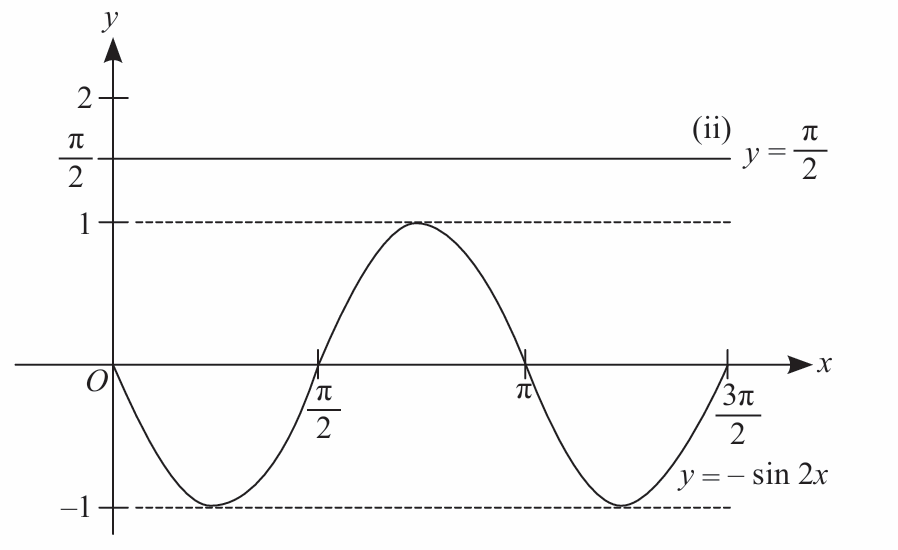
(b)(i) $$ \text { Sketch the graph of } y=-\sin 2 x \text { for } 0 \leqslant x \leqslant \frac{3 \pi}{2} \text {. } $$
(ii) Hence, using the same axes, sketch a suitable straight line to find the number of solutions for the equation
$$ \begin{aligned} &-\frac{\pi}{4}=\sin x \cos x \text { for } 0 \leqslant x \leqslant \frac{3 \pi}{2} \text {. }\\ &\text { State the number of solutions. } \end{aligned} $$
[5 marks]
Answer:
(a)
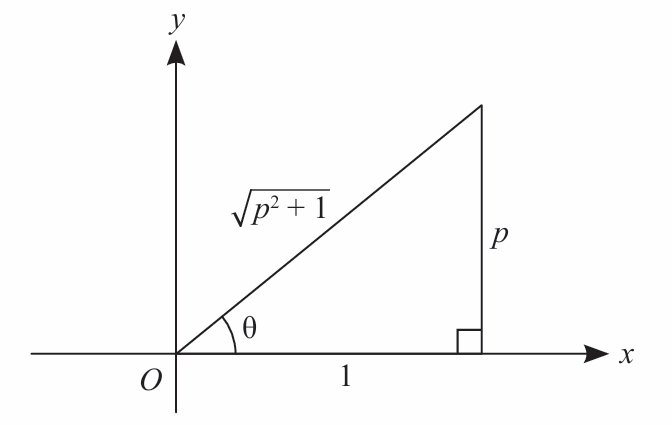
$$ \begin{aligned} & \cos 2 \theta= \cos ^2 \theta-\sin ^2 \theta \\ & \cos 2 \theta=\left(\frac{1}{\sqrt{p^2+1}}\right)^2-\left(\frac{p}{\sqrt{p^2+1}}\right)^2 \\ & \cos 2 \theta=\frac{1}{p^2+1}-\frac{p^2}{p^2+1} \\ & \ \cos 2 \theta=\frac{1-p^2}{p^2+1} \end{aligned} $$
(b)(i)
(b)(ii)
$$ \begin{aligned} &\begin{aligned} y & =-\sin 2 x \\ y & =-2 \sin x \cos x \\ -\frac{y}{2} & =\sin x \cos x \end{aligned}\\ &\begin{aligned} \sin x \cos x & =-\frac{\pi}{4} \\ -\frac{y}{2} & =-\frac{\pi}{4} \\ \frac{y}{2} & =\frac{\pi}{4} \\ y & =\frac{\pi}{2} \end{aligned} \end{aligned} $$
$$ \text { Number of solutions }=0 $$
(a) It is given that tan θ = p, such that p is a constant and 0o ≤ θ ≤ 90o.
Find cos 2θ in terms of p. [3 marks]
(b)(i) $$ \text { Sketch the graph of } y=-\sin 2 x \text { for } 0 \leqslant x \leqslant \frac{3 \pi}{2} \text {. } $$
(ii) Hence, using the same axes, sketch a suitable straight line to find the number of solutions for the equation
$$ \begin{aligned} &-\frac{\pi}{4}=\sin x \cos x \text { for } 0 \leqslant x \leqslant \frac{3 \pi}{2} \text {. }\\ &\text { State the number of solutions. } \end{aligned} $$
[5 marks]
Answer:
(a)
$$ \begin{aligned} & \cos 2 \theta= \cos ^2 \theta-\sin ^2 \theta \\ & \cos 2 \theta=\left(\frac{1}{\sqrt{p^2+1}}\right)^2-\left(\frac{p}{\sqrt{p^2+1}}\right)^2 \\ & \cos 2 \theta=\frac{1}{p^2+1}-\frac{p^2}{p^2+1} \\ & \ \cos 2 \theta=\frac{1-p^2}{p^2+1} \end{aligned} $$
(b)(i)
(b)(ii)
$$ \begin{aligned} &\begin{aligned} y & =-\sin 2 x \\ y & =-2 \sin x \cos x \\ -\frac{y}{2} & =\sin x \cos x \end{aligned}\\ &\begin{aligned} \sin x \cos x & =-\frac{\pi}{4} \\ -\frac{y}{2} & =-\frac{\pi}{4} \\ \frac{y}{2} & =\frac{\pi}{4} \\ y & =\frac{\pi}{2} \end{aligned} \end{aligned} $$
$$ \text { Number of solutions }=0 $$