
Question 7:
(a) State the complementary angle, in radian, of α in terms of π and α. [1 mark]
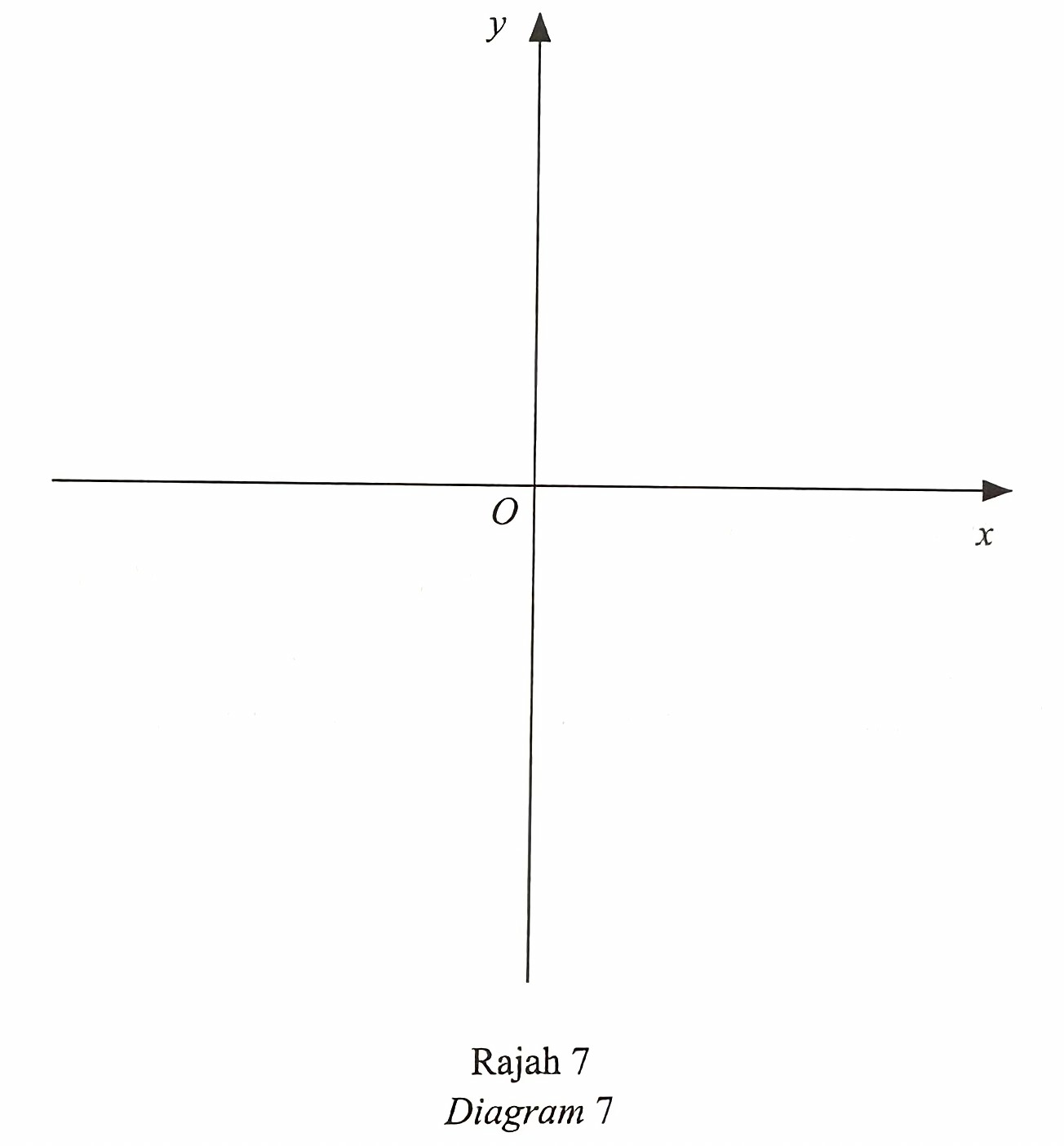
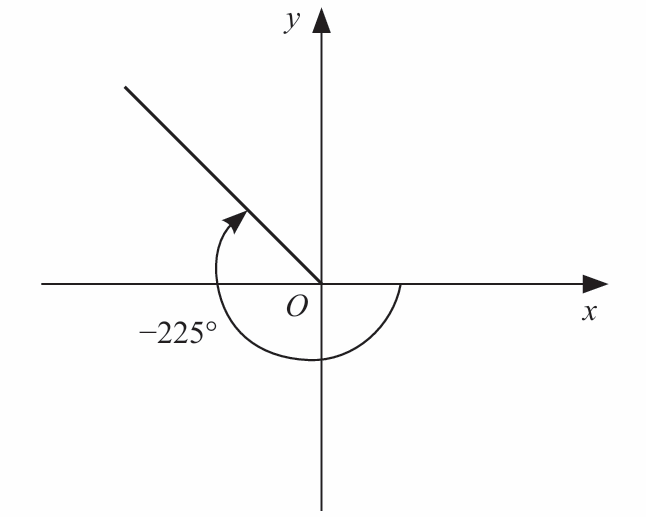
(b) On Diagram 7, sketch a line to represent -225°. [1 mark]
Answer:
(a) $$ \begin{aligned} &\text { Complementary angle }\\ &=\frac{\pi}{2}-\alpha \end{aligned} $$
(b)
(a) State the complementary angle, in radian, of α in terms of π and α. [1 mark]
(b) On Diagram 7, sketch a line to represent -225°. [1 mark]
Answer:
(a) $$ \begin{aligned} &\text { Complementary angle }\\ &=\frac{\pi}{2}-\alpha \end{aligned} $$
(b)
Question 8:
(a) $$ \text { It is given that } f(x)=\frac{3}{(1-2 x)^8} \text { and } f^{\prime}(x)=\frac{a}{(1-2 x)^b} \text {, such that } a \text { and } b \text { are constants. } $$
$$ \text { Find the value of } a \text { and of } b \text {. } $$
[2 marks]
(b) The area of a sector of a circle is given by y = x2 – 4x + 10p, such that x is a radius and p is a constant. Using differentiation, find the minimum area, in cm2, of the sector in terms of p. [3 marks]
(c) A cone has a volume of 16πcm3 with height of 3 cm.
If the height of the cone is fixed, using differentiation, find the small change in the volume, in cm3, of the cone when its radius increases by 0.5%.
[5 marks]
(d) $$ \text { It is given that } \int_0^p f(x) \mathrm{d} x=3 \text { and } \int_0^p g(x) \mathrm{d} x=6 \text {. } $$
$$ \text { If } \int_0^p[h f(x)+k g(x)] \mathrm{d} x-\int_p^0 g(x) \mathrm{d} x=12 \text { such that } h \text { and } k \text { are constants, express } h \text { in terms of } k \text {. } $$
[3 marks]
(e) $$ \text { Given that } \mathrm{d} x\left[\frac{4}{3} h(x)\right]=\frac{x+1}{3 x-4} \text {, find } \int\left(\frac{2 x^2-2}{3 x^2-7 x+4}\right) \mathrm{d} x \text {, in terms of } h(x) \text {. } $$
[3 marks]
Answer:
(a) $$ \begin{aligned} f(x) & =3(1-2 x)^{-8} \\ f^{\prime}(x) & =(3)(-8)(1-2 x)^{-9}(0-2) \\ f^{\prime}(x) & =48(1-2 x)^{-9} \\ f^{\prime}(x) & =\frac{48}{(1-2 x)^9} \equiv \frac{a}{(1-2 x)^b} \\ \therefore a & =48 \\ b & =9 \end{aligned} $$
(b) $$ \begin{aligned} &\begin{aligned} y & =x^2-4 x+10 p \\ \frac{\mathrm{~d} y}{\mathrm{~d} x} & =2 x-4 \end{aligned}\\ &\text { At minimum, }\\ &\begin{aligned} \frac{\mathrm{d} y}{\mathrm{~d} x} & =0 \\ 2 x-4 & =0 \\ x & =2 \end{aligned} \end{aligned} $$
$$ \begin{aligned} &\text { When } x=2 \text {, }\\ &\begin{aligned} & y=(2)^2-4(2)+10 p \\ & y=4-8+10 p \\ & y=10 p-4 \end{aligned} \end{aligned} $$
(c) $$ \begin{aligned} V_{\text {cone }} & =\frac{1}{3} \pi r^2 h \\ \frac{1}{3} \pi r^2 h & =16 \pi \\ \frac{1}{3} \pi r^2(3) & =16 \pi \\ \pi r^2 & =16 \pi \\ r^2 & =16 \\ r & =\sqrt{16} \\ r & =4 \mathrm{~cm} \\ r_{\text {new }} & =4 \mathrm{~cm}+(4 \times 0.5 \%) \mathrm{cm} \\ & =4 \mathrm{~cm}+0.02 \mathrm{~cm} \\ & =4.02 \mathrm{~cm} \end{aligned} $$
$$ \begin{aligned} & V_{\text {cone }}=\frac{1}{3} \pi r^2 h \\ & \quad \frac{\mathrm{~d} V}{\mathrm{~d} r}=\frac{2}{3} \pi r h \\ & \frac{\delta V}{\delta r} \approx \frac{\mathrm{~d} V}{\mathrm{~d} r} \\ & \delta V=\frac{\mathrm{d} V}{\mathrm{~d} r} \times \delta r \\ & \delta V=\left(\frac{2}{3} \pi r h\right)(4.02-4) \\ & \delta V=\frac{2}{3} \pi(4)(3)(0.02) \\ & \delta V=0.16 \pi \mathrm{~cm}^3 \end{aligned} $$
(d) $$ \begin{aligned} \int_0^p[h f(x)+k g(x)] \mathrm{d} x-\int_p^0 g(x) \mathrm{d} x & =12 \\ h \int_0^p f(x) \mathrm{d} x+k \int_0^p g(x) \mathrm{d} x-\int_p^0 g(x) \mathrm{d} x & =12 \\ h(3)+k(6)-(-6) & =12 \\ 3 h & =12-6-6 k \\ 3 h & =6-6 k \\ h & =\frac{6}{3}-\frac{6 k}{3} \\ h & =2-2 k \end{aligned} $$
(e) $$ \begin{aligned} \int \frac{2 x^2-2}{3 x^2-7 x+4} \mathrm{~d} x & =\int \frac{2\left(x^2-1\right)}{(3 x-4)(x-1)} \mathrm{d} x \\ & =\int \frac{2(x-1)(x+1)}{(3 x-4)(x-1)} \mathrm{d} x \\ & =\int \frac{2(x+1)}{(3 x-4)} \mathrm{d} x \\ & =2 \int \frac{x+1}{3 x-4} \mathrm{~d} x \\ & =2\left[\frac{4}{3} h(x)\right]+c \\ & =\frac{8}{3} h(x)+c \end{aligned} $$
(a) $$ \text { It is given that } f(x)=\frac{3}{(1-2 x)^8} \text { and } f^{\prime}(x)=\frac{a}{(1-2 x)^b} \text {, such that } a \text { and } b \text { are constants. } $$
$$ \text { Find the value of } a \text { and of } b \text {. } $$
[2 marks]
(b) The area of a sector of a circle is given by y = x2 – 4x + 10p, such that x is a radius and p is a constant. Using differentiation, find the minimum area, in cm2, of the sector in terms of p. [3 marks]
(c) A cone has a volume of 16πcm3 with height of 3 cm.
If the height of the cone is fixed, using differentiation, find the small change in the volume, in cm3, of the cone when its radius increases by 0.5%.
[5 marks]
(d) $$ \text { It is given that } \int_0^p f(x) \mathrm{d} x=3 \text { and } \int_0^p g(x) \mathrm{d} x=6 \text {. } $$
$$ \text { If } \int_0^p[h f(x)+k g(x)] \mathrm{d} x-\int_p^0 g(x) \mathrm{d} x=12 \text { such that } h \text { and } k \text { are constants, express } h \text { in terms of } k \text {. } $$
[3 marks]
(e) $$ \text { Given that } \mathrm{d} x\left[\frac{4}{3} h(x)\right]=\frac{x+1}{3 x-4} \text {, find } \int\left(\frac{2 x^2-2}{3 x^2-7 x+4}\right) \mathrm{d} x \text {, in terms of } h(x) \text {. } $$
[3 marks]
Answer:
(a) $$ \begin{aligned} f(x) & =3(1-2 x)^{-8} \\ f^{\prime}(x) & =(3)(-8)(1-2 x)^{-9}(0-2) \\ f^{\prime}(x) & =48(1-2 x)^{-9} \\ f^{\prime}(x) & =\frac{48}{(1-2 x)^9} \equiv \frac{a}{(1-2 x)^b} \\ \therefore a & =48 \\ b & =9 \end{aligned} $$
(b) $$ \begin{aligned} &\begin{aligned} y & =x^2-4 x+10 p \\ \frac{\mathrm{~d} y}{\mathrm{~d} x} & =2 x-4 \end{aligned}\\ &\text { At minimum, }\\ &\begin{aligned} \frac{\mathrm{d} y}{\mathrm{~d} x} & =0 \\ 2 x-4 & =0 \\ x & =2 \end{aligned} \end{aligned} $$
$$ \begin{aligned} &\text { When } x=2 \text {, }\\ &\begin{aligned} & y=(2)^2-4(2)+10 p \\ & y=4-8+10 p \\ & y=10 p-4 \end{aligned} \end{aligned} $$
(c) $$ \begin{aligned} V_{\text {cone }} & =\frac{1}{3} \pi r^2 h \\ \frac{1}{3} \pi r^2 h & =16 \pi \\ \frac{1}{3} \pi r^2(3) & =16 \pi \\ \pi r^2 & =16 \pi \\ r^2 & =16 \\ r & =\sqrt{16} \\ r & =4 \mathrm{~cm} \\ r_{\text {new }} & =4 \mathrm{~cm}+(4 \times 0.5 \%) \mathrm{cm} \\ & =4 \mathrm{~cm}+0.02 \mathrm{~cm} \\ & =4.02 \mathrm{~cm} \end{aligned} $$
$$ \begin{aligned} & V_{\text {cone }}=\frac{1}{3} \pi r^2 h \\ & \quad \frac{\mathrm{~d} V}{\mathrm{~d} r}=\frac{2}{3} \pi r h \\ & \frac{\delta V}{\delta r} \approx \frac{\mathrm{~d} V}{\mathrm{~d} r} \\ & \delta V=\frac{\mathrm{d} V}{\mathrm{~d} r} \times \delta r \\ & \delta V=\left(\frac{2}{3} \pi r h\right)(4.02-4) \\ & \delta V=\frac{2}{3} \pi(4)(3)(0.02) \\ & \delta V=0.16 \pi \mathrm{~cm}^3 \end{aligned} $$
(d) $$ \begin{aligned} \int_0^p[h f(x)+k g(x)] \mathrm{d} x-\int_p^0 g(x) \mathrm{d} x & =12 \\ h \int_0^p f(x) \mathrm{d} x+k \int_0^p g(x) \mathrm{d} x-\int_p^0 g(x) \mathrm{d} x & =12 \\ h(3)+k(6)-(-6) & =12 \\ 3 h & =12-6-6 k \\ 3 h & =6-6 k \\ h & =\frac{6}{3}-\frac{6 k}{3} \\ h & =2-2 k \end{aligned} $$
(e) $$ \begin{aligned} \int \frac{2 x^2-2}{3 x^2-7 x+4} \mathrm{~d} x & =\int \frac{2\left(x^2-1\right)}{(3 x-4)(x-1)} \mathrm{d} x \\ & =\int \frac{2(x-1)(x+1)}{(3 x-4)(x-1)} \mathrm{d} x \\ & =\int \frac{2(x+1)}{(3 x-4)} \mathrm{d} x \\ & =2 \int \frac{x+1}{3 x-4} \mathrm{~d} x \\ & =2\left[\frac{4}{3} h(x)\right]+c \\ & =\frac{8}{3} h(x)+c \end{aligned} $$
Question 9:
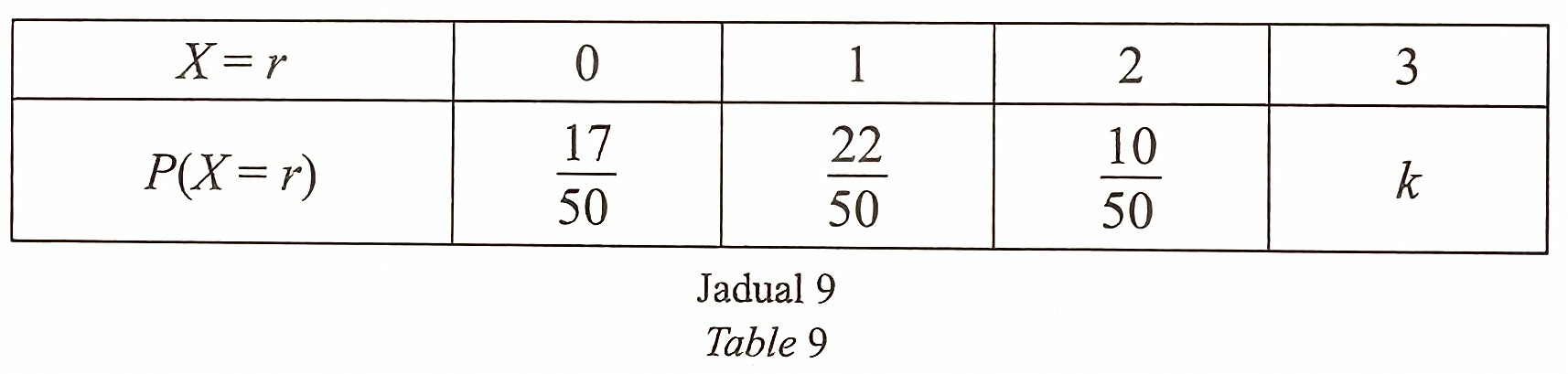
In an audition for a reality TV show, each contestant is evaluated based on three types of talents which are singing, dancing and acting. Table 9 shows a probability distribution for discrete random variable of X, such that X represents the number of talents that the contestants passed in the audition from the previous season.
(a)(i) Determine the value of k. [1 mark]
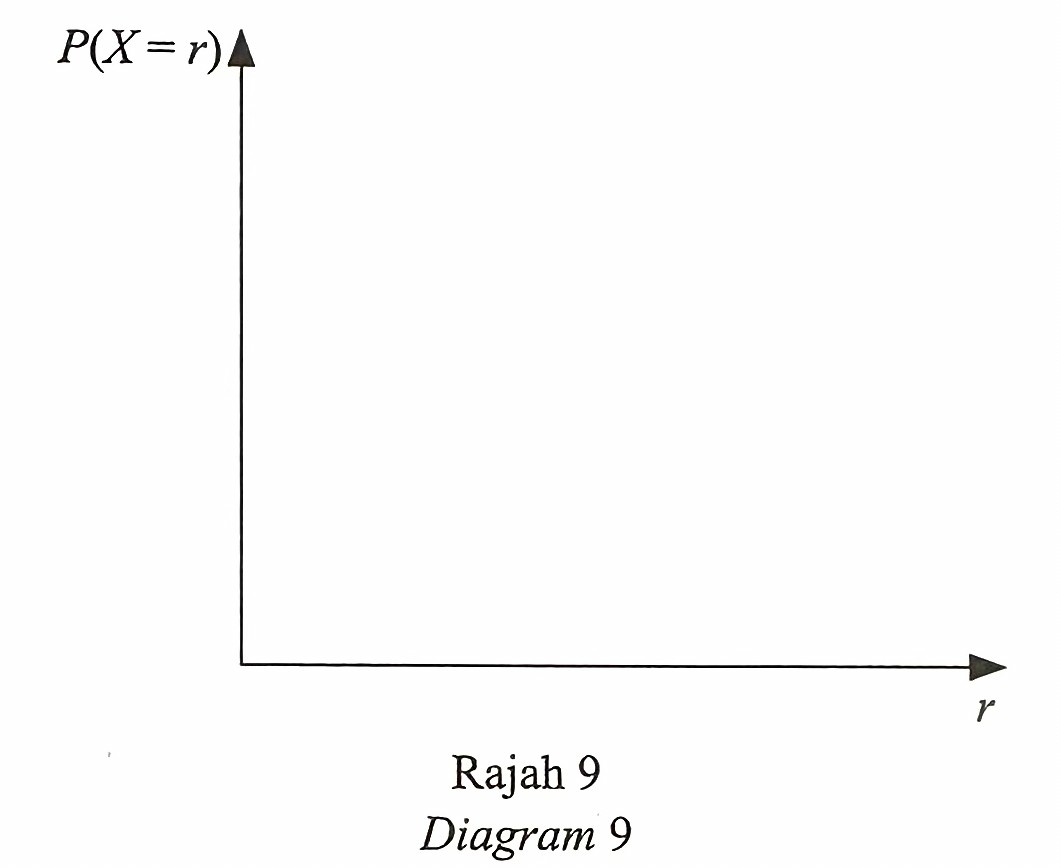
(ii) Hence, sketch and label the distribution graph on Diagram 9. [2 marks]
(b) The contestants who pass with at least two types of talents will qualify to the next stage.
Using the answer in (a)(i), estimate the number of contestants who will qualify if the total number of contestants in this season is 1850 .
[2 marks]
Answer:
(a)(i) $$ \begin{aligned} \frac{17}{50}+\frac{22}{50}+\frac{10}{50}+k & =1 \\ \frac{49}{50}+k & =1 \\ k & =1-\frac{49}{50} \\ k & =\frac{1}{50} \end{aligned} $$
(a)(ii)
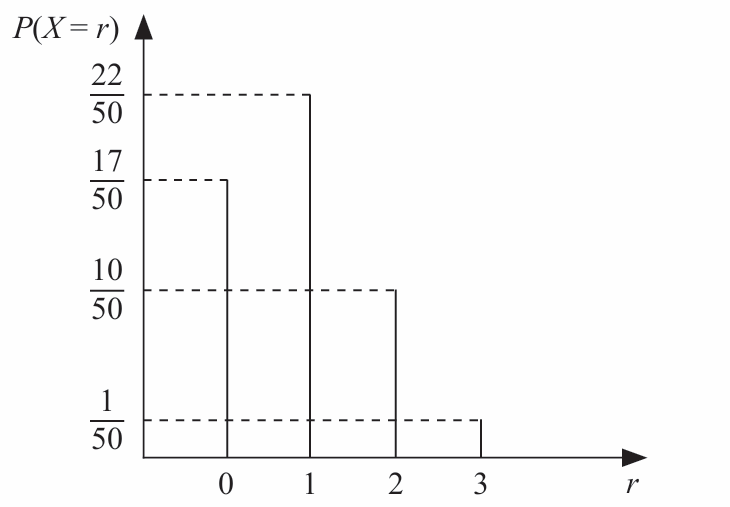
(b) $$ \begin{aligned} & P(X \geqslant 2)=P(X=2)+P(X=3) \\ & P(X \geqslant 2)=\frac{10}{50}+\frac{1}{50} \\ & P(X \geqslant 2)=\frac{11}{50} \\ & E(X)=\frac{11}{50} \times 1850 \\ & E(X)=407 \end{aligned} $$ 407 contestants will qualify.
In an audition for a reality TV show, each contestant is evaluated based on three types of talents which are singing, dancing and acting. Table 9 shows a probability distribution for discrete random variable of X, such that X represents the number of talents that the contestants passed in the audition from the previous season.
(a)(i) Determine the value of k. [1 mark]
(ii) Hence, sketch and label the distribution graph on Diagram 9. [2 marks]
(b) The contestants who pass with at least two types of talents will qualify to the next stage.
Using the answer in (a)(i), estimate the number of contestants who will qualify if the total number of contestants in this season is 1850 .
[2 marks]
Answer:
(a)(i) $$ \begin{aligned} \frac{17}{50}+\frac{22}{50}+\frac{10}{50}+k & =1 \\ \frac{49}{50}+k & =1 \\ k & =1-\frac{49}{50} \\ k & =\frac{1}{50} \end{aligned} $$
(a)(ii)
(b) $$ \begin{aligned} & P(X \geqslant 2)=P(X=2)+P(X=3) \\ & P(X \geqslant 2)=\frac{10}{50}+\frac{1}{50} \\ & P(X \geqslant 2)=\frac{11}{50} \\ & E(X)=\frac{11}{50} \times 1850 \\ & E(X)=407 \end{aligned} $$ 407 contestants will qualify.