Question 4:
(a) Diagram 4 shows two parallelograms with height of p cm.
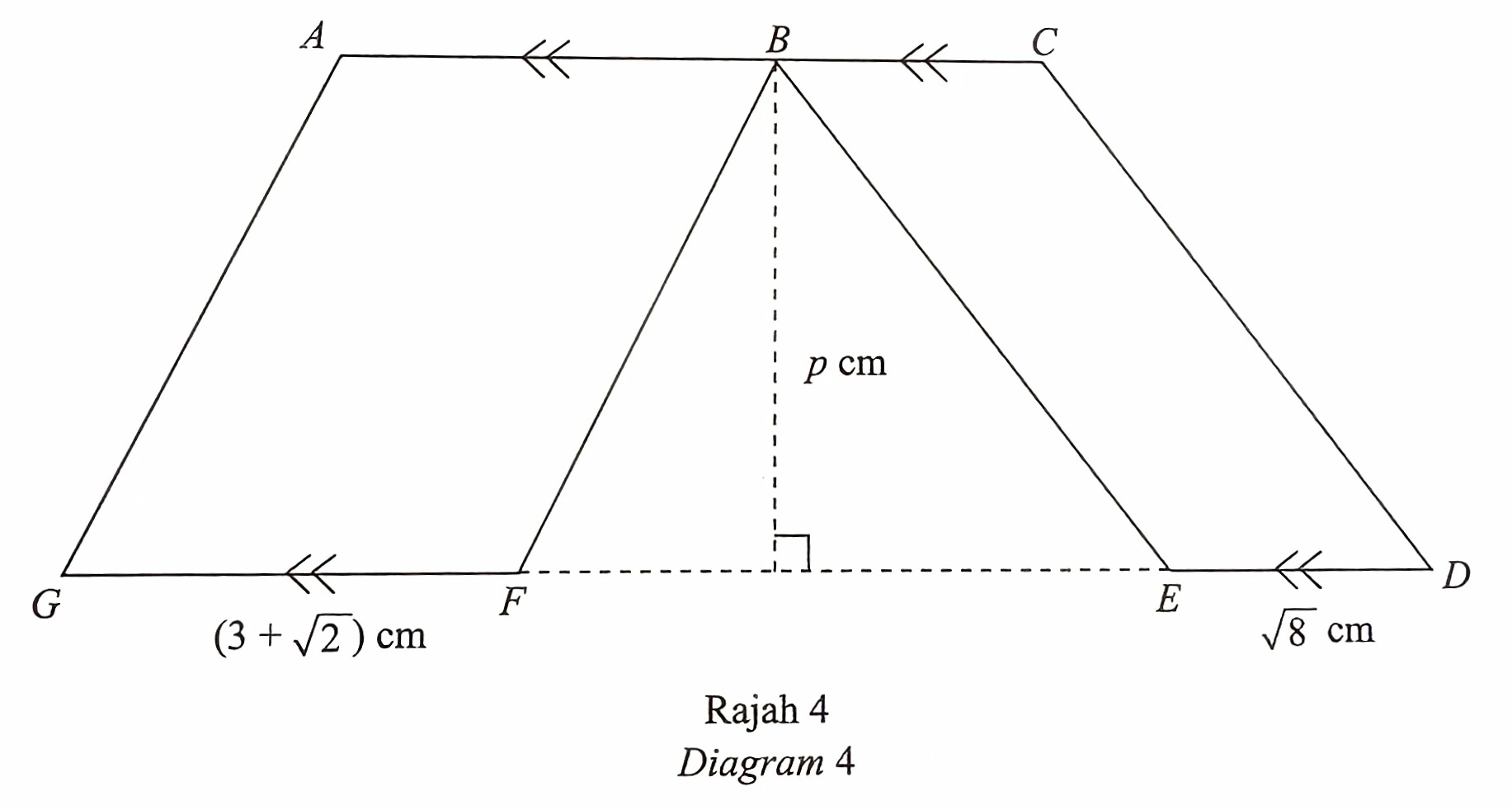 $$
\text { It is given that } G F=(3+\sqrt{2}) \mathrm{cm}, E D=\sqrt{8} \mathrm{~cm} \text { and the total area of the parallelograms is }(9 r+3 r \sqrt{2}) \mathrm{cm}^2 \text {. }
$$
$$
\text { It is given that } G F=(3+\sqrt{2}) \mathrm{cm}, E D=\sqrt{8} \mathrm{~cm} \text { and the total area of the parallelograms is }(9 r+3 r \sqrt{2}) \mathrm{cm}^2 \text {. }
$$
$$ \text { Express } p \text { in the form } a+b \sqrt{2} \text { in terms of } r \text {, such that } a \text { and } b \text { are constants. } $$
[4 marks]
(b) $$ \text { Given that } \log _p 3-\log _p x=\frac{1}{3} \log _p(2-y) \text {, express } x \text { in terms of } y \text {. } $$
[4 marks]
(c) $$ \text { Given that } \frac{\left(x^m\right)^n}{(x+y)^m}-\frac{x^{m n+1}}{(x+y)^{m+1}}=y^2\left(x^m\right)^n+y x^{m n+1} \text {, find the value of } m \text {. } $$
[4 marks]
Answer:
(a) $$ \begin{aligned} \text { ABFG }+ \text { BCDE } & =9 r+3 r \sqrt{2} \\ (3+\sqrt{2})(p)+(\sqrt{8})(p) & =9 r+3 r \sqrt{2} \\ p(3+\sqrt{2}+\sqrt{8}) & =9 r+3 r \sqrt{2} \\ p[3+\sqrt{2}+(\sqrt{4})(\sqrt{2}] & =9 r+3 r \sqrt{2} \\ p(3+\sqrt{2}+2 \sqrt{2}) & =9 r+3 r \sqrt{2} \\ p(3+3 \sqrt{2}) & =9 r+3 r \sqrt{2} \\ p & =\frac{9 r+3 r \sqrt{2}}{3+3 \sqrt{2}} \\ p & =\frac{3(3 r+r \sqrt{2})}{3(1+\sqrt{2})} \\ p & =\frac{3 r+r \sqrt{2}}{1+\sqrt{2}} \times \frac{1-\sqrt{2}}{1-\sqrt{2}} \\ p & =\frac{3 r-3 r \sqrt{2}+r \sqrt{2}-2 r}{1-2} \\ p & =\frac{r-2 r \sqrt{2}}{-1} \\ p & =-r+2 r \sqrt{2} \text { or } 2 r \sqrt{2}-r \end{aligned} $$
(b) $$ \begin{aligned} \log _p 3-\log _p x & =\frac{1}{3} \log _p(2-y) \\ \log _p\left(\frac{3}{x}\right) & =\log _p(2-y)^{\frac{1}{3}} \\ \frac{3}{x} & =(2-y)^{\frac{1}{3}} \\ \frac{x}{3} & =\frac{1}{(2-y)^{\frac{1}{3}}} \\ x & =\frac{3}{(2-y)^{\frac{1}{3}}} \end{aligned} $$
(c) $$ \begin{aligned} \frac{\left(x^m\right)^n}{(x+y)^m}-\frac{x^{m n+1}}{(x+y)^{m+1}} & =y^2\left(x^m\right)^n+y x^{m n+1} \\ \frac{\left(x^{m n}\right) \times(x+y)}{(x+y)^m \times(x+y)}-\frac{x^{m n+1}}{(x+y)^{m+1}} & =y^2\left(x^m\right)^n+y x^{m n+1} \\ \frac{\left(x^{m n}\right)(x)+\left(x^{m n}\right)(y)}{(x+y)^{m+1}}-\frac{x^{m n+1}}{(x+y)^{m+1}} & =y^2\left(x^{m n}\right)+y\left(x^{m n}\right)(x) \\ \frac{x^{m n+1}+y x^{m n}-x^{m n+1}}{(x+y)^{m+1}} & =y x^{m n}(y+x) \\ \frac{y x^{m n}}{(x+y)^{m+1}} & =\frac{y x^{m n}(y+x)}{1} \\ \frac{y x^{m n}}{y x^{m n}} & =\frac{(x+y) \times(x+y)^{m+1}}{1} \\ 1 & =(x+y)^{m+2} \\ (x+y)^0 & =(x+y)^{m+2} \\ 0 & =m+2 \\ m & =-2 \end{aligned} $$
(a) Diagram 4 shows two parallelograms with height of p cm.
$$
\text { It is given that } G F=(3+\sqrt{2}) \mathrm{cm}, E D=\sqrt{8} \mathrm{~cm} \text { and the total area of the parallelograms is }(9 r+3 r \sqrt{2}) \mathrm{cm}^2 \text {. }
$$$$ \text { Express } p \text { in the form } a+b \sqrt{2} \text { in terms of } r \text {, such that } a \text { and } b \text { are constants. } $$
[4 marks]
(b) $$ \text { Given that } \log _p 3-\log _p x=\frac{1}{3} \log _p(2-y) \text {, express } x \text { in terms of } y \text {. } $$
[4 marks]
(c) $$ \text { Given that } \frac{\left(x^m\right)^n}{(x+y)^m}-\frac{x^{m n+1}}{(x+y)^{m+1}}=y^2\left(x^m\right)^n+y x^{m n+1} \text {, find the value of } m \text {. } $$
[4 marks]
Answer:
(a) $$ \begin{aligned} \text { ABFG }+ \text { BCDE } & =9 r+3 r \sqrt{2} \\ (3+\sqrt{2})(p)+(\sqrt{8})(p) & =9 r+3 r \sqrt{2} \\ p(3+\sqrt{2}+\sqrt{8}) & =9 r+3 r \sqrt{2} \\ p[3+\sqrt{2}+(\sqrt{4})(\sqrt{2}] & =9 r+3 r \sqrt{2} \\ p(3+\sqrt{2}+2 \sqrt{2}) & =9 r+3 r \sqrt{2} \\ p(3+3 \sqrt{2}) & =9 r+3 r \sqrt{2} \\ p & =\frac{9 r+3 r \sqrt{2}}{3+3 \sqrt{2}} \\ p & =\frac{3(3 r+r \sqrt{2})}{3(1+\sqrt{2})} \\ p & =\frac{3 r+r \sqrt{2}}{1+\sqrt{2}} \times \frac{1-\sqrt{2}}{1-\sqrt{2}} \\ p & =\frac{3 r-3 r \sqrt{2}+r \sqrt{2}-2 r}{1-2} \\ p & =\frac{r-2 r \sqrt{2}}{-1} \\ p & =-r+2 r \sqrt{2} \text { or } 2 r \sqrt{2}-r \end{aligned} $$
(b) $$ \begin{aligned} \log _p 3-\log _p x & =\frac{1}{3} \log _p(2-y) \\ \log _p\left(\frac{3}{x}\right) & =\log _p(2-y)^{\frac{1}{3}} \\ \frac{3}{x} & =(2-y)^{\frac{1}{3}} \\ \frac{x}{3} & =\frac{1}{(2-y)^{\frac{1}{3}}} \\ x & =\frac{3}{(2-y)^{\frac{1}{3}}} \end{aligned} $$
(c) $$ \begin{aligned} \frac{\left(x^m\right)^n}{(x+y)^m}-\frac{x^{m n+1}}{(x+y)^{m+1}} & =y^2\left(x^m\right)^n+y x^{m n+1} \\ \frac{\left(x^{m n}\right) \times(x+y)}{(x+y)^m \times(x+y)}-\frac{x^{m n+1}}{(x+y)^{m+1}} & =y^2\left(x^m\right)^n+y x^{m n+1} \\ \frac{\left(x^{m n}\right)(x)+\left(x^{m n}\right)(y)}{(x+y)^{m+1}}-\frac{x^{m n+1}}{(x+y)^{m+1}} & =y^2\left(x^{m n}\right)+y\left(x^{m n}\right)(x) \\ \frac{x^{m n+1}+y x^{m n}-x^{m n+1}}{(x+y)^{m+1}} & =y x^{m n}(y+x) \\ \frac{y x^{m n}}{(x+y)^{m+1}} & =\frac{y x^{m n}(y+x)}{1} \\ \frac{y x^{m n}}{y x^{m n}} & =\frac{(x+y) \times(x+y)^{m+1}}{1} \\ 1 & =(x+y)^{m+2} \\ (x+y)^0 & =(x+y)^{m+2} \\ 0 & =m+2 \\ m & =-2 \end{aligned} $$
Question 5:
The quadratic function f is defined by f(x) = k(x – p)2 + q, such that k, p and q are constants.
(a) If k = 2, state the equation of the axis of symmetry of the graph f(x). [1 mark]
(b) If k is increased from 2 to 3 , how would the position of the minimum point of the graph change? [1 mark]
Answer:
(a) $$ \begin{aligned} &\begin{aligned} & f(x)=k(x-p)^2+q \\ & f(x)=2(x-p)^2+q \end{aligned}\\ &\text { Axis of symmetry: }\\ &\begin{aligned} x-p & =0 \\ x & =p \end{aligned} \end{aligned} $$
(b) The position of minimum point will not change.
The quadratic function f is defined by f(x) = k(x – p)2 + q, such that k, p and q are constants.
(a) If k = 2, state the equation of the axis of symmetry of the graph f(x). [1 mark]
(b) If k is increased from 2 to 3 , how would the position of the minimum point of the graph change? [1 mark]
Answer:
(a) $$ \begin{aligned} &\begin{aligned} & f(x)=k(x-p)^2+q \\ & f(x)=2(x-p)^2+q \end{aligned}\\ &\text { Axis of symmetry: }\\ &\begin{aligned} x-p & =0 \\ x & =p \end{aligned} \end{aligned} $$
(b) The position of minimum point will not change.
Question 6:
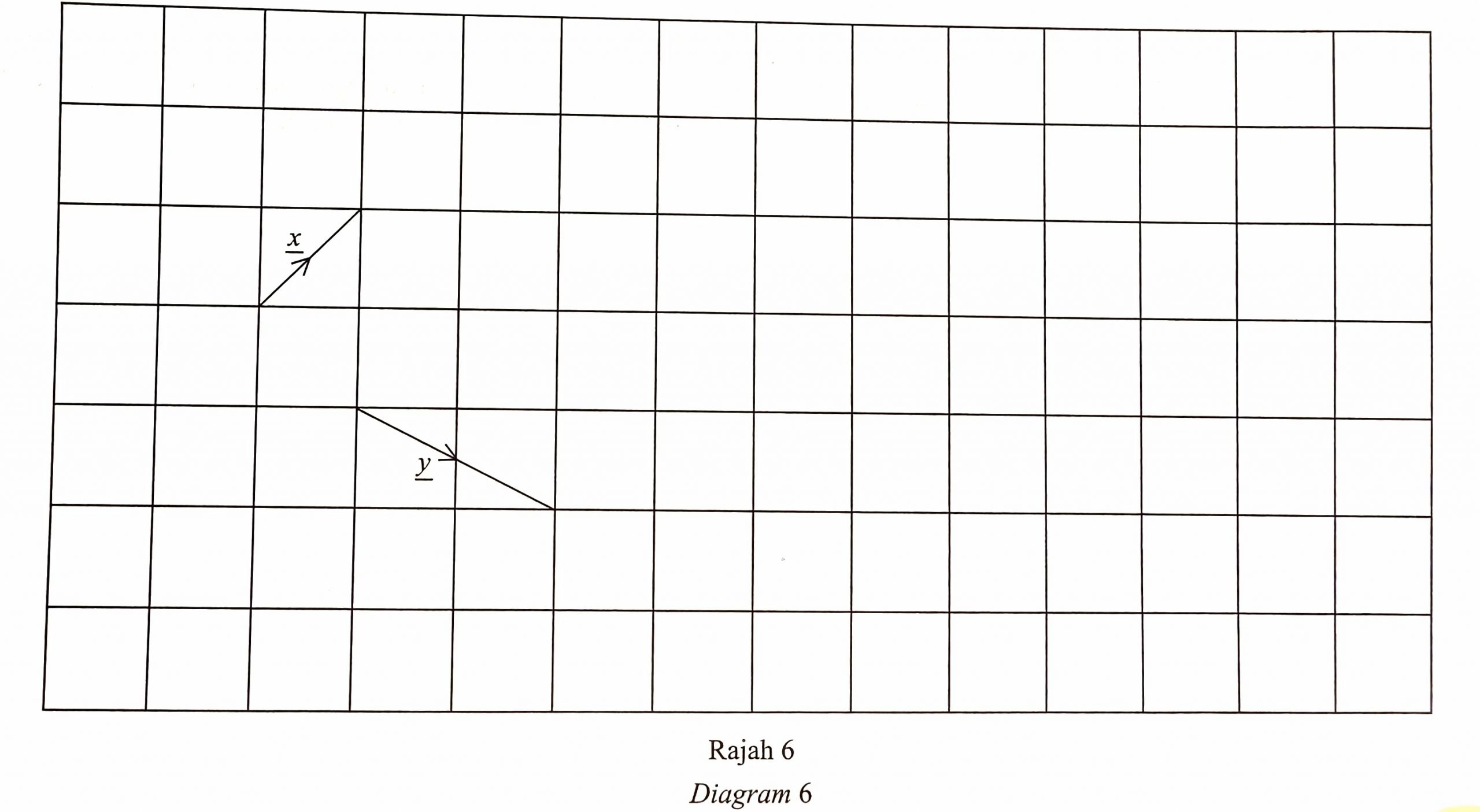
Diagram 6 shows x and y drawn on a square grid with sides of 1 unit.
 (a) $$
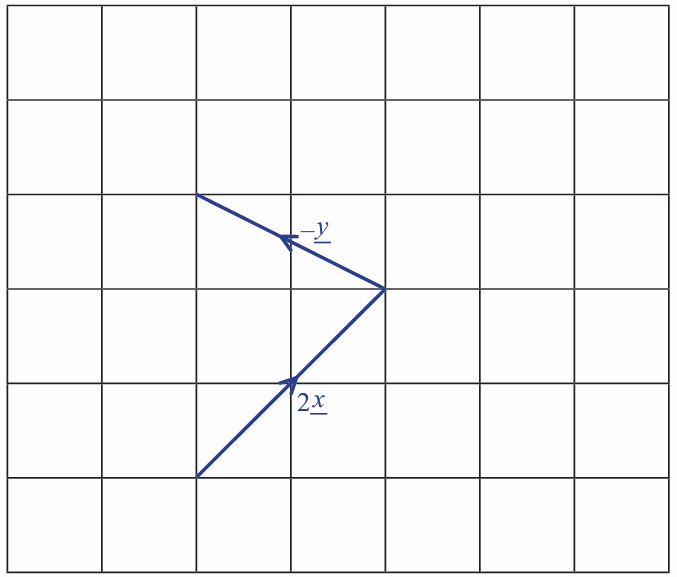
\text { On diagram 6, draw and label } 2 \underline{x}-\underline{y} \text {. }
$$
(a) $$
\text { On diagram 6, draw and label } 2 \underline{x}-\underline{y} \text {. }
$$
[2 marks]
(b) $$ \text { Hence, state }|2 \underline{x}-\underline{y}| \text {. } $$
[1 mark]
Answer:
(a)
(b)
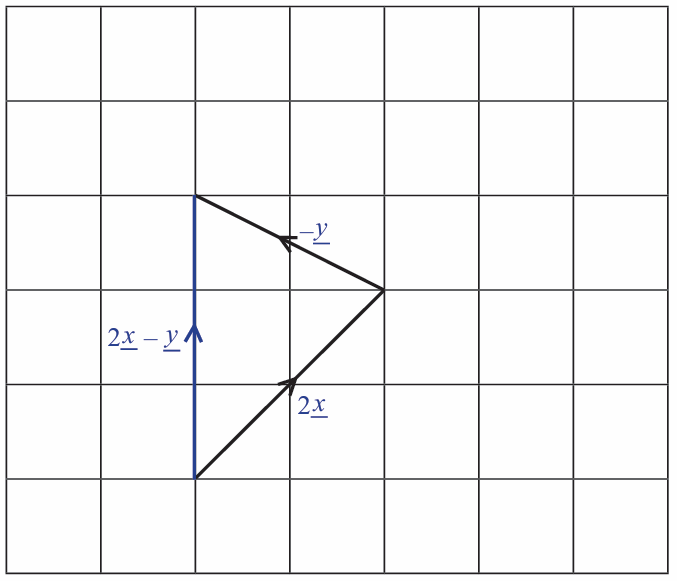
$$ \begin{aligned} |2 \underline{x}-\underline{y}| & =\sqrt{x^2+y^2} \\ & =\sqrt{0^2+3^2} \\ & =3 \end{aligned} $$
Diagram 6 shows x and y drawn on a square grid with sides of 1 unit.
(a) $$
\text { On diagram 6, draw and label } 2 \underline{x}-\underline{y} \text {. }
$$[2 marks]
(b) $$ \text { Hence, state }|2 \underline{x}-\underline{y}| \text {. } $$
[1 mark]
Answer:
(a)
(b)
$$ \begin{aligned} |2 \underline{x}-\underline{y}| & =\sqrt{x^2+y^2} \\ & =\sqrt{0^2+3^2} \\ & =3 \end{aligned} $$