Question 7:
(a) It is given that the first three terms of a sequence are 4, 8, 16.
(i) State the type of sequence. Give a reason for your answer.
(ii) Hence, find the n term of the sequence.
[3 marks]
(b) In an arithmetic progression, the 2nd term is 5p – 10 and the 10th term is 7 times the first term, a.
Express a in terms of p.
[3 marks]
(c) A polygon with n sides is drawn such that the sizes of its interior angles form an arithmetic progression. It is given that the size of the largest interior angle is 5 times the size of the smallest interior angle, a.
Express a in terms of n.
[2 marks]
Answer:
(a)(i)
$$ \begin{aligned} & 4,8,16 \\ & r_1=\frac{8}{4}=2 \\ & r_2=\frac{16}{8}=2 \end{aligned} $$
$$ \text { Geometric progression because } r_1=r_2=2 $$
(a)(ii)
$$ \begin{aligned} T_n & =a r^n-1 \\ & =(4)(2)^{n-1} \\ & =\left(2^2\right)(2)^{n-1} \\ & =2^{n-1+2} \\ & =2^{n+1} \end{aligned} $$
(b)
$$ \begin{aligned} A P: T_n=a+ & (n-1) d \\ T_2 & =5 p-10 \\ a+(2-1) d & =5 p-10 \\ a+d & =5 p-10 \\ d & =5 p-10-a \ldots (1) \end{aligned} $$
$$ \begin{aligned} T_{10} & =7 a \\ a+(10-1) d & =7 a \\ a+9 d & =7 a \\ a+9(5 p-10-a) & =7 a \\ a+45 p-90-9 a) & =7 a \\ a-9 a-7 a & =90-45 p \\ -15 a & =90-45 p \\ a & =\frac{90-45 p}{-15} \\ a & =-6+3 p \end{aligned} $$
(c)
$$ T_1=a, T_n=5 a $$
$$ \begin{aligned} \text { Total interior angle } & =(n-2) \times 180^{\circ} \\ S_n & =(n-2) \times 180^{\circ} \\ \frac{n}{2}(a+l) & =(n-2) \times 180^{\circ} \\ \frac{n}{2}(a+5 a) & =(n-2) \times 180^{\circ} \\ \frac{n}{2}(6 a) & =(n-2) \times 180^{\circ} \\ 3 a n & =(n-2) \times 180^{\circ} \\ a & =\frac{(n-2) \times 180^{\circ}}{3 n} \\ a & =\frac{(n-2) \times 60^{\circ}}{n} \end{aligned} $$
(a) It is given that the first three terms of a sequence are 4, 8, 16.
(i) State the type of sequence. Give a reason for your answer.
(ii) Hence, find the n term of the sequence.
[3 marks]
(b) In an arithmetic progression, the 2nd term is 5p – 10 and the 10th term is 7 times the first term, a.
Express a in terms of p.
[3 marks]
(c) A polygon with n sides is drawn such that the sizes of its interior angles form an arithmetic progression. It is given that the size of the largest interior angle is 5 times the size of the smallest interior angle, a.
Express a in terms of n.
[2 marks]
Answer:
(a)(i)
$$ \begin{aligned} & 4,8,16 \\ & r_1=\frac{8}{4}=2 \\ & r_2=\frac{16}{8}=2 \end{aligned} $$
$$ \text { Geometric progression because } r_1=r_2=2 $$
(a)(ii)
$$ \begin{aligned} T_n & =a r^n-1 \\ & =(4)(2)^{n-1} \\ & =\left(2^2\right)(2)^{n-1} \\ & =2^{n-1+2} \\ & =2^{n+1} \end{aligned} $$
(b)
$$ \begin{aligned} A P: T_n=a+ & (n-1) d \\ T_2 & =5 p-10 \\ a+(2-1) d & =5 p-10 \\ a+d & =5 p-10 \\ d & =5 p-10-a \ldots (1) \end{aligned} $$
$$ \begin{aligned} T_{10} & =7 a \\ a+(10-1) d & =7 a \\ a+9 d & =7 a \\ a+9(5 p-10-a) & =7 a \\ a+45 p-90-9 a) & =7 a \\ a-9 a-7 a & =90-45 p \\ -15 a & =90-45 p \\ a & =\frac{90-45 p}{-15} \\ a & =-6+3 p \end{aligned} $$
(c)
$$ T_1=a, T_n=5 a $$
$$ \begin{aligned} \text { Total interior angle } & =(n-2) \times 180^{\circ} \\ S_n & =(n-2) \times 180^{\circ} \\ \frac{n}{2}(a+l) & =(n-2) \times 180^{\circ} \\ \frac{n}{2}(a+5 a) & =(n-2) \times 180^{\circ} \\ \frac{n}{2}(6 a) & =(n-2) \times 180^{\circ} \\ 3 a n & =(n-2) \times 180^{\circ} \\ a & =\frac{(n-2) \times 180^{\circ}}{3 n} \\ a & =\frac{(n-2) \times 60^{\circ}}{n} \end{aligned} $$
Question 8:
$$ \text { It is given that } \sin A=\frac{p}{2} \text { and } \sin (A+B)-\sin (A-B)=2 p \text {, such that } A \text { and } B \text { are acute angles. } $$
Express in terms of p of
(a) cos A, [2 marks]
(b) sin B [3 marks]
Answer:
(a)
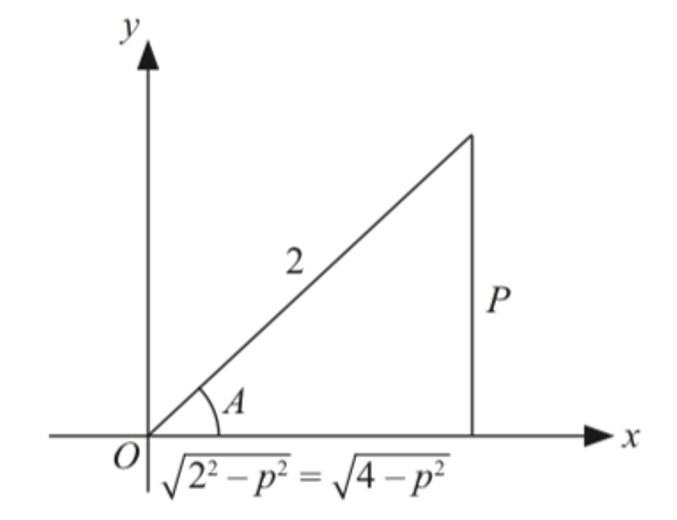
$$ \operatorname{cos} A=\frac{\sqrt{4-p^2}}{2} $$
(b)
$$ \begin{aligned} \sin (A+B)-\sin (A-B) & =2 p \\ (\sin A \cos B+\cos A \sin B)-(\sin A \cos B-\cos A \sin B) & =2 p \\ \sin A \cos B+\cos A \sin B-\sin A \cos B+\cos A \sin B & =2 p \\ 2 \cos A \sin B & =2 p \\ 2\left(\frac{\sqrt{4-p^2}}{2}\right) \sin B & =2 p \\ \sqrt{4-p^2} \sin B & =2 p \\ \sin B & =\frac{2 p}{\sqrt{4-p^2}} \end{aligned} $$
$$ \text { It is given that } \sin A=\frac{p}{2} \text { and } \sin (A+B)-\sin (A-B)=2 p \text {, such that } A \text { and } B \text { are acute angles. } $$
Express in terms of p of
(a) cos A, [2 marks]
(b) sin B [3 marks]
Answer:
(a)
$$ \operatorname{cos} A=\frac{\sqrt{4-p^2}}{2} $$
(b)
$$ \begin{aligned} \sin (A+B)-\sin (A-B) & =2 p \\ (\sin A \cos B+\cos A \sin B)-(\sin A \cos B-\cos A \sin B) & =2 p \\ \sin A \cos B+\cos A \sin B-\sin A \cos B+\cos A \sin B & =2 p \\ 2 \cos A \sin B & =2 p \\ 2\left(\frac{\sqrt{4-p^2}}{2}\right) \sin B & =2 p \\ \sqrt{4-p^2} \sin B & =2 p \\ \sin B & =\frac{2 p}{\sqrt{4-p^2}} \end{aligned} $$