Question 5:
Diagram 2 shows the plan of a rectangular garden ABCD.
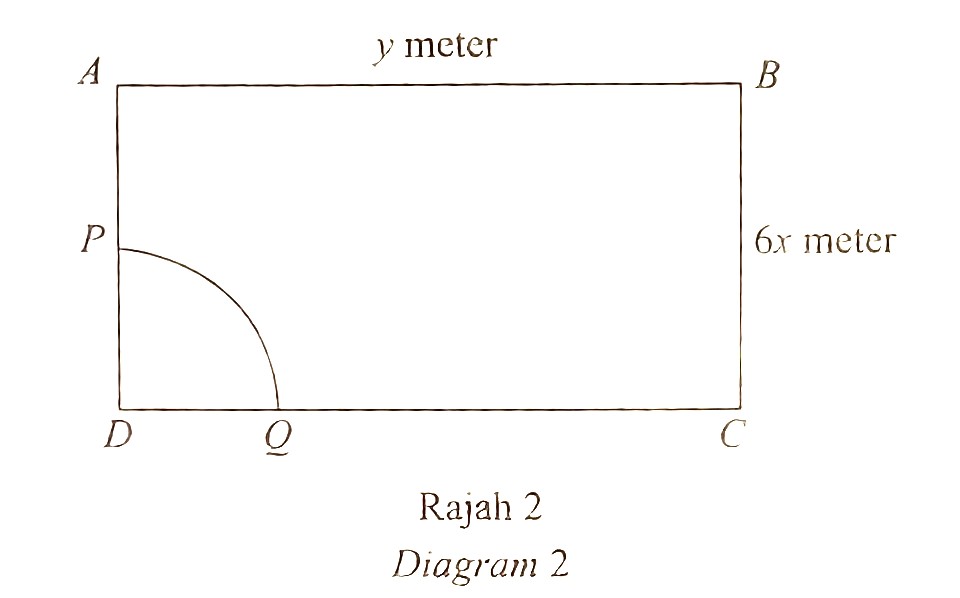
A pond in a shape of a quadrant of a circle with centre D will be built in the garden. The remaining area, (90x + 27)π metre2, will be planted with grass. It is given that P is the midpoint of AD and length of AB is twice the length of the arc PQ.
Find the value of x and of y.
[7 marks]
Answer:
$$ \begin{aligned} &A B=2 \times \text { Length of the arc } P Q \text { : }\\ &\begin{aligned} & y=2\left(\frac{3}{2} \pi x\right) \\ & y=3 \pi x \ldots .(1) \end{aligned} \end{aligned} $$
$$ \begin{aligned} &\text { Area of the non-grass region: }\\ &6 x y-\frac{1}{4}(3 x)^2(\pi)=(90 x+27) \pi \ldots . .(2) \end{aligned} $$
$$ \begin{aligned} &\text { Substitute (1) into ②: }\\ &6 x(3 \pi x)-\frac{1}{4}(3 x)^2(\pi)=(90 x+27) \pi \ldots . .(3) \end{aligned} $$
$$ \begin{aligned} &\begin{aligned} & \text { (3) } \times \frac{1}{\pi}: \\ & \begin{aligned} 18 x^2-\frac{9 x^2}{4} & =90 x+27 \\ 21 x^2-120 x-36 & =0 \\ 7 x^2-40 x-12 & =0 \\ (x-6)(7 x+2) & =0 \end{aligned} \end{aligned}\\ &x=6, x=-\frac{2}{7}( \text { Ignore }) \end{aligned} $$
$$ \begin{aligned} & \text { Substitute } x=6 \text { into } \text { (1) } \text { : }\\ &\begin{aligned} y & =3 \pi(6) \\ & =18 \pi \text { or } 56.56 \end{aligned} \end{aligned} $$
Diagram 2 shows the plan of a rectangular garden ABCD.
A pond in a shape of a quadrant of a circle with centre D will be built in the garden. The remaining area, (90x + 27)π metre2, will be planted with grass. It is given that P is the midpoint of AD and length of AB is twice the length of the arc PQ.
Find the value of x and of y.
[7 marks]
Answer:
$$ \begin{aligned} &A B=2 \times \text { Length of the arc } P Q \text { : }\\ &\begin{aligned} & y=2\left(\frac{3}{2} \pi x\right) \\ & y=3 \pi x \ldots .(1) \end{aligned} \end{aligned} $$
$$ \begin{aligned} &\text { Area of the non-grass region: }\\ &6 x y-\frac{1}{4}(3 x)^2(\pi)=(90 x+27) \pi \ldots . .(2) \end{aligned} $$
$$ \begin{aligned} &\text { Substitute (1) into ②: }\\ &6 x(3 \pi x)-\frac{1}{4}(3 x)^2(\pi)=(90 x+27) \pi \ldots . .(3) \end{aligned} $$
$$ \begin{aligned} &\begin{aligned} & \text { (3) } \times \frac{1}{\pi}: \\ & \begin{aligned} 18 x^2-\frac{9 x^2}{4} & =90 x+27 \\ 21 x^2-120 x-36 & =0 \\ 7 x^2-40 x-12 & =0 \\ (x-6)(7 x+2) & =0 \end{aligned} \end{aligned}\\ &x=6, x=-\frac{2}{7}( \text { Ignore }) \end{aligned} $$
$$ \begin{aligned} & \text { Substitute } x=6 \text { into } \text { (1) } \text { : }\\ &\begin{aligned} y & =3 \pi(6) \\ & =18 \pi \text { or } 56.56 \end{aligned} \end{aligned} $$
Question 6:
(a) $$ \text { Prove that cot } \frac{x}{2}-\tan \frac{x}{2}=2 \text { cot } x \text {. } $$
[2 marks]
(b)(i) $$ \text { Hence, sketch the graph of } y=\left\lvert\, \operatorname{kot} \frac{x}{2}-2\right. \text { cot } x \mid-1 \text { for } 0^{\circ} \leqslant x \leqslant 360^{\circ} \text {. } $$
(ii) There is no solution obtained if y = m is sketched at the same axes in 6(b)(i), such that m is a constant.
State the range of values of m.
[4 marks]
Answer:
(a) $$ \begin{aligned} & \operatorname{cot} \frac{x}{2}-\tan \frac{x}{2} \\ & =\frac{1}{\tan \frac{x}{2}}-\tan \frac{x}{2} \\ & =\frac{1-\tan ^2 \frac{x}{2}}{\tan \frac{x}{2}} \\ & =\frac{1}{\left(\frac{\tan \frac{x}{2}}{1-\tan ^2 \frac{x}{2}}\right)} \\ & =\frac{1}{\frac{1}{2} \tan x} \\ & =2 \mathrm{cot} x \end{aligned} $$
(b)(i)
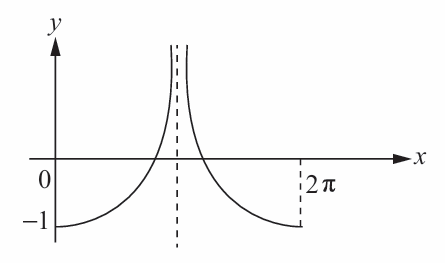
(b)(ii) m < -1
(a) $$ \text { Prove that cot } \frac{x}{2}-\tan \frac{x}{2}=2 \text { cot } x \text {. } $$
[2 marks]
(b)(i) $$ \text { Hence, sketch the graph of } y=\left\lvert\, \operatorname{kot} \frac{x}{2}-2\right. \text { cot } x \mid-1 \text { for } 0^{\circ} \leqslant x \leqslant 360^{\circ} \text {. } $$
(ii) There is no solution obtained if y = m is sketched at the same axes in 6(b)(i), such that m is a constant.
State the range of values of m.
[4 marks]
Answer:
(a) $$ \begin{aligned} & \operatorname{cot} \frac{x}{2}-\tan \frac{x}{2} \\ & =\frac{1}{\tan \frac{x}{2}}-\tan \frac{x}{2} \\ & =\frac{1-\tan ^2 \frac{x}{2}}{\tan \frac{x}{2}} \\ & =\frac{1}{\left(\frac{\tan \frac{x}{2}}{1-\tan ^2 \frac{x}{2}}\right)} \\ & =\frac{1}{\frac{1}{2} \tan x} \\ & =2 \mathrm{cot} x \end{aligned} $$
(b)(i)
(b)(ii) m < -1
Question 7:
A district council constructs a parabolic steel frame to hang a banner. Diagram 3 shows the front view of the steel frame.
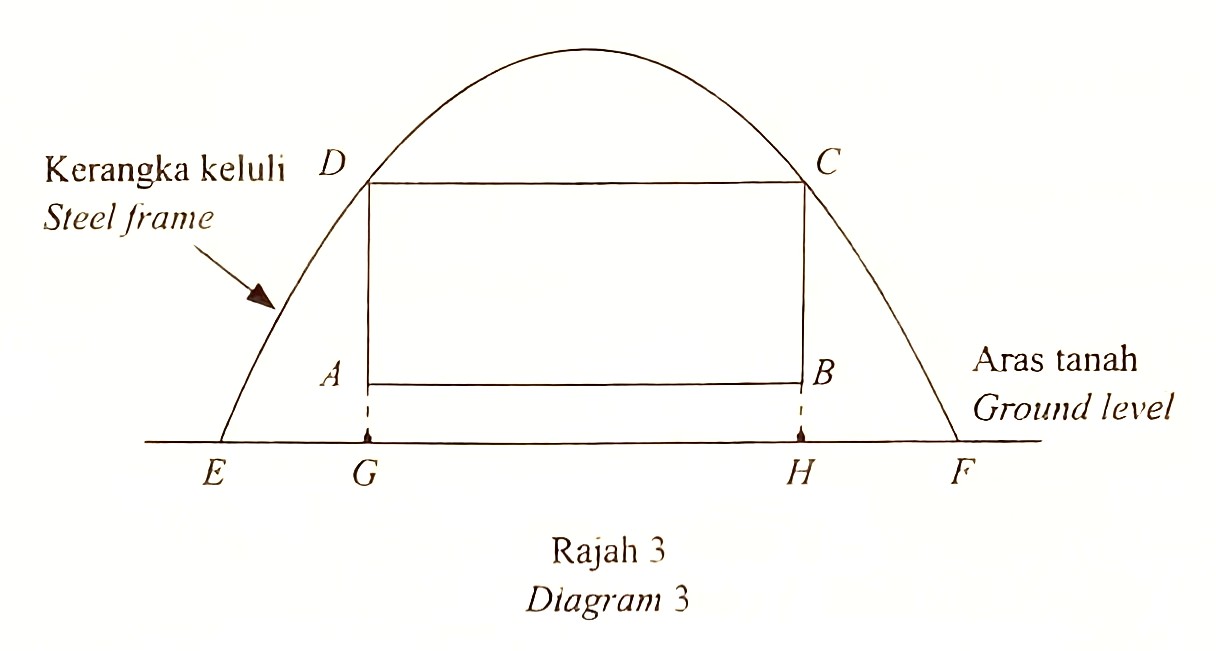 A rectangular banner ABCD will be hung at points C and D such that CD is horizontal. The height of AB from the ground level is 1 metre. The edges A and B are tied vertically to the points G and H respectively. It is given that the gradient function of the curve is 6 – 2x and the distance of GH is 2p metre.
(a)(i) Show that the distance of EH is (3 + p) metre.
Hence, express the area, L, of the banner in terms of p.
[6 marks]
(b) If the cost to make the banner is RM40 metre2, calculate the total cost to the nearest RM, to make the banner such that its area is maximum. [4 marks]
Answer:
(a)(i) $$ \begin{aligned} \frac{\mathrm{d} y}{\mathrm{~d} x}: 6-2 x & =0 \\ x & =3 \end{aligned} $$
$$ \begin{aligned} E H & =3-p+2 p \\ & =3+p \end{aligned} $$
(a)(ii) $$ \begin{aligned} \int \frac{\mathrm{d} y}{\mathrm{~d} x} & =\int 6-2 x \\ y & =6 x-x^2+c \ldots . . (1) \end{aligned} $$
$$ \begin{aligned} &\text { Substitute }(0,0) \text { into (1) }\\ &\begin{aligned} & 0=6(0)-0^2+c \\ & c=0 \end{aligned}\\ &y=6 x-x^2 \ldots . . \text { (2) } \end{aligned} $$
$$ \begin{aligned} &\text { Substitute } x=3+p \text { into (2) }\\ &\begin{aligned} y & =6(3+p)-(3+p)^2 \\ & =9-p^2 \end{aligned} \end{aligned} $$
$$ \begin{aligned} Area, L & =\left(9-p^2-1\right)(2 p) \\ & =16 p-2 p^3 \end{aligned} $$
(b) $$ \begin{aligned} &\text { Maximum area: }\\ &\begin{aligned} \frac{\mathrm{d} L}{\mathrm{~d} p} & =0 \\ 16-6 p^2 & =0 \\ p^2 & = \pm \sqrt{\frac{8}{3}} \\ p & =1.633 \end{aligned} \end{aligned} $$
$$ \begin{aligned} \text { Total cost } & =40 \times\left[16(1.633)-2(1.633)^3\right] \\ & =\mathrm{RM} 697 \end{aligned} $$
A district council constructs a parabolic steel frame to hang a banner. Diagram 3 shows the front view of the steel frame.
A rectangular banner ABCD will be hung at points C and D such that CD is horizontal. The height of AB from the ground level is 1 metre. The edges A and B are tied vertically to the points G and H respectively. It is given that the gradient function of the curve is 6 – 2x and the distance of GH is 2p metre.(a)(i) Show that the distance of EH is (3 + p) metre.
Hence, express the area, L, of the banner in terms of p.
[6 marks]
(b) If the cost to make the banner is RM40 metre2, calculate the total cost to the nearest RM, to make the banner such that its area is maximum. [4 marks]
Answer:
(a)(i) $$ \begin{aligned} \frac{\mathrm{d} y}{\mathrm{~d} x}: 6-2 x & =0 \\ x & =3 \end{aligned} $$
$$ \begin{aligned} E H & =3-p+2 p \\ & =3+p \end{aligned} $$
(a)(ii) $$ \begin{aligned} \int \frac{\mathrm{d} y}{\mathrm{~d} x} & =\int 6-2 x \\ y & =6 x-x^2+c \ldots . . (1) \end{aligned} $$
$$ \begin{aligned} &\text { Substitute }(0,0) \text { into (1) }\\ &\begin{aligned} & 0=6(0)-0^2+c \\ & c=0 \end{aligned}\\ &y=6 x-x^2 \ldots . . \text { (2) } \end{aligned} $$
$$ \begin{aligned} &\text { Substitute } x=3+p \text { into (2) }\\ &\begin{aligned} y & =6(3+p)-(3+p)^2 \\ & =9-p^2 \end{aligned} \end{aligned} $$
$$ \begin{aligned} Area, L & =\left(9-p^2-1\right)(2 p) \\ & =16 p-2 p^3 \end{aligned} $$
(b) $$ \begin{aligned} &\text { Maximum area: }\\ &\begin{aligned} \frac{\mathrm{d} L}{\mathrm{~d} p} & =0 \\ 16-6 p^2 & =0 \\ p^2 & = \pm \sqrt{\frac{8}{3}} \\ p & =1.633 \end{aligned} \end{aligned} $$
$$ \begin{aligned} \text { Total cost } & =40 \times\left[16(1.633)-2(1.633)^3\right] \\ & =\mathrm{RM} 697 \end{aligned} $$